
The Witcher 2: Assassins of Kings Guide Basics
How to Equip a Witcher: Items, Alchemy, and Crafting
Items

Items in The Witcher 2 work pretty much the way you’d expect. You can pick up items you find lying around as loot, purchase items from merchants, or create your own items through alchemy or crafting. Note that merchant lists are semi-randomized, so sometimes an item you can usually buy from a particular merchant won’t be in stock. Each item has certain basic characteristics, like a value in orens, a weight, and a description that suits whatever the item happen to be. For a useful piece of equipment like a sword or armor, the description might list its effects or resistances. Defensive equipment items alter Geralt’s basic statistics when equipped, while swords alter his statistics when unsheathed.
Certain items are quest items, which cannot be removed from your inventory. Most quest items have 0 weight, so you aren’t penalized for having to carry them around. Otherwise, each item (except books and certain herbs) has a weight that builds up as you carry more and more of them in your inventory. If you carry more weight than Geralt’s current maximum load, Geralt becomes encumbered. Geralt’s default maximum load is 250. This stat can be increased by equipping items that boost maximum load or obtaining the Strong Back character attribute.
While encumbered, Geralt cannot run or dodge-roll. He can swing his swords in combat but is limited to slow, awkward strokes. He won’t be able to make the acrobatic leaps that let him home in on a foe’s location. In short, being encumbered is bad and a sign that you’re carrying too many items. At this point, you should sell some items to merchants or put them into storage at the local inn. There is no real advantage to carrying around any item that can’t be used freely in alchemy or combat.
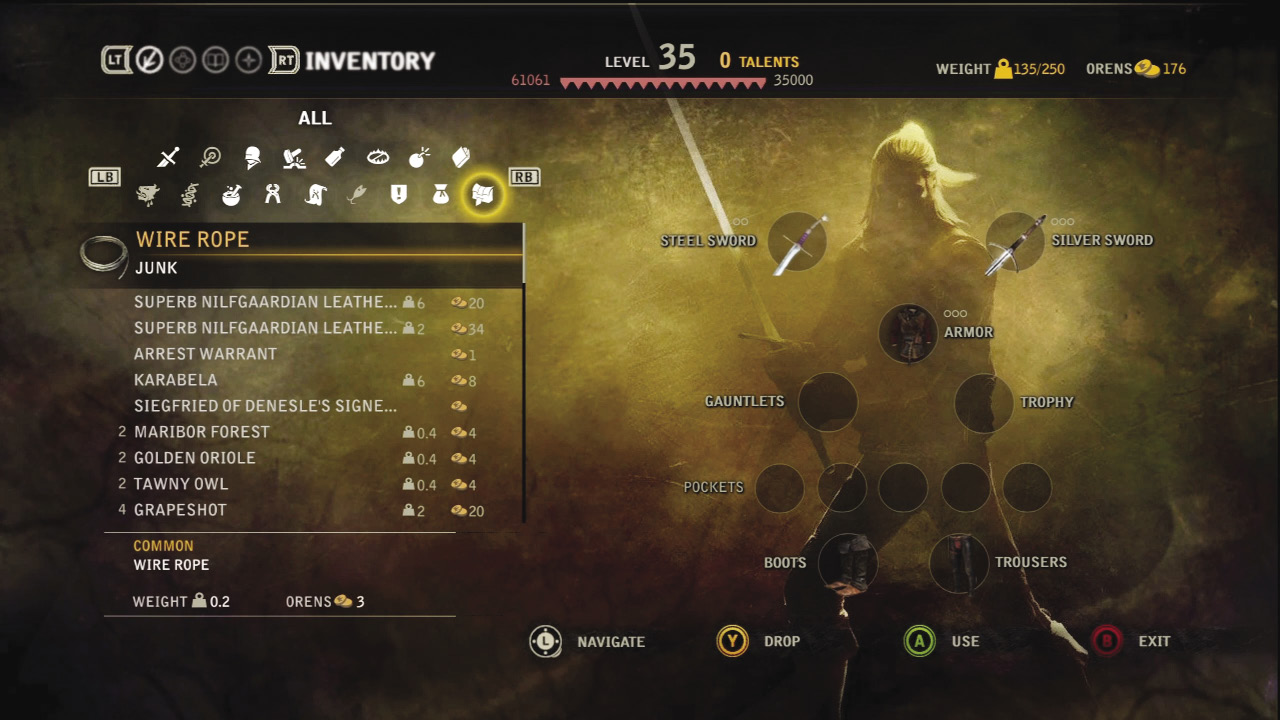
The items you carry in your inventory (as well as the items in storage or in shops) are split up by category: swords, ranged weapons, armor, enhancements, potions, traps, bombs, books, trophies, mutagens, alchemy materials, crafting materials, diagrams and formulas, lures, quest items, and junk. You can tab between the categories if you only want to look at items of a specific type when buying and selling items, or when simply managing your own items. There is also an All tab that lets you look at a list of all items available in your inventory, your storage, or a merchant’s inventory. This tab tends to sort items from oldest to newest, so you can glance at the All tab to see what new items you might have just picked up from a big bundle.
Swords and Armor
By far the most important items Geralt carries with him are the swords and armor he uses in combat. To be used actively in combat, an item must be equipped to one of Geralt’s equipment slots. Geralt has an equipment slot for each of the following: steel sword, silver sword, armor, gauntlets, trousers, boots, trophy. Five pocket slots can be used for disposable items like traps, bombs, and ranged weapons.
You begin the game with default equipment and can acquire more by crafting it, purchasing it, or finding it as loot. As you quickly discover when you begin exploring your first town area, purchasing effective equipment of any sort is incredibly expensive. Merchants sell items at default prices that are often 10 or 20 times greater than the item’s resale value.
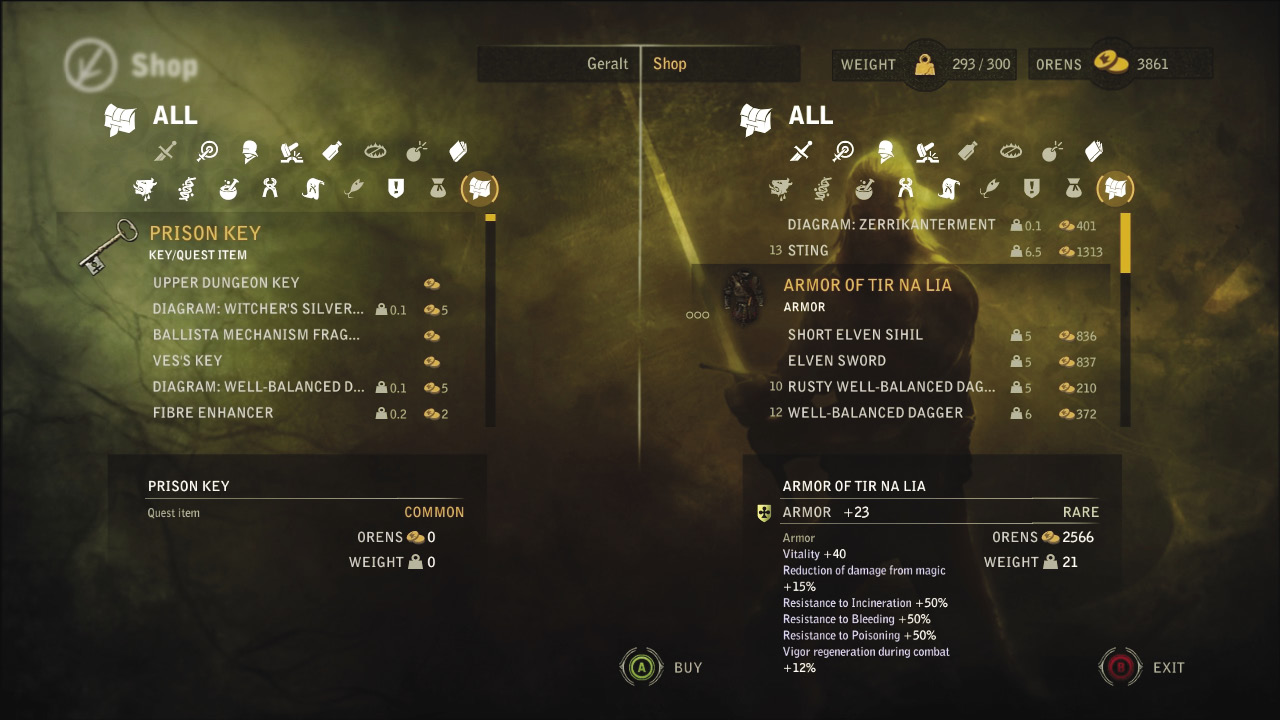
In some games, the wisest approach to upgrading equipment is incremental. You start with something bad, buy something a little bit better, then slowly use your improved gear to earn more money, which you invest in better gear. You cannot do this in The Witcher 2, due to the prohibitively high costs of purchasing equipment. It is instead wiser to learn how to get by using only looted gear, while investing your orens in only the best gear you can obtain in a given area.
Ideally, you upgrade each major piece of Geralt’s gear roughly once per chapter, maybe two or three times if you loot equipment that can tide you over to obtaining the best items available in a given chapter. Otherwise, focus on moving from one strong set of equipment to another. Constant minor equipment upgrades only serve to drain your resources.
Enhancements
Potions and oils temporarily boost Geralt’s abilities, but it is also possible to grant him permanent boosts to his abilities by enhancing his equipment. You enhance armor by filling empty slots with armor enhancements, and you enhance swords by filling empty slots with runes. There are only five types of runes but around two dozen types of armor enhancements.
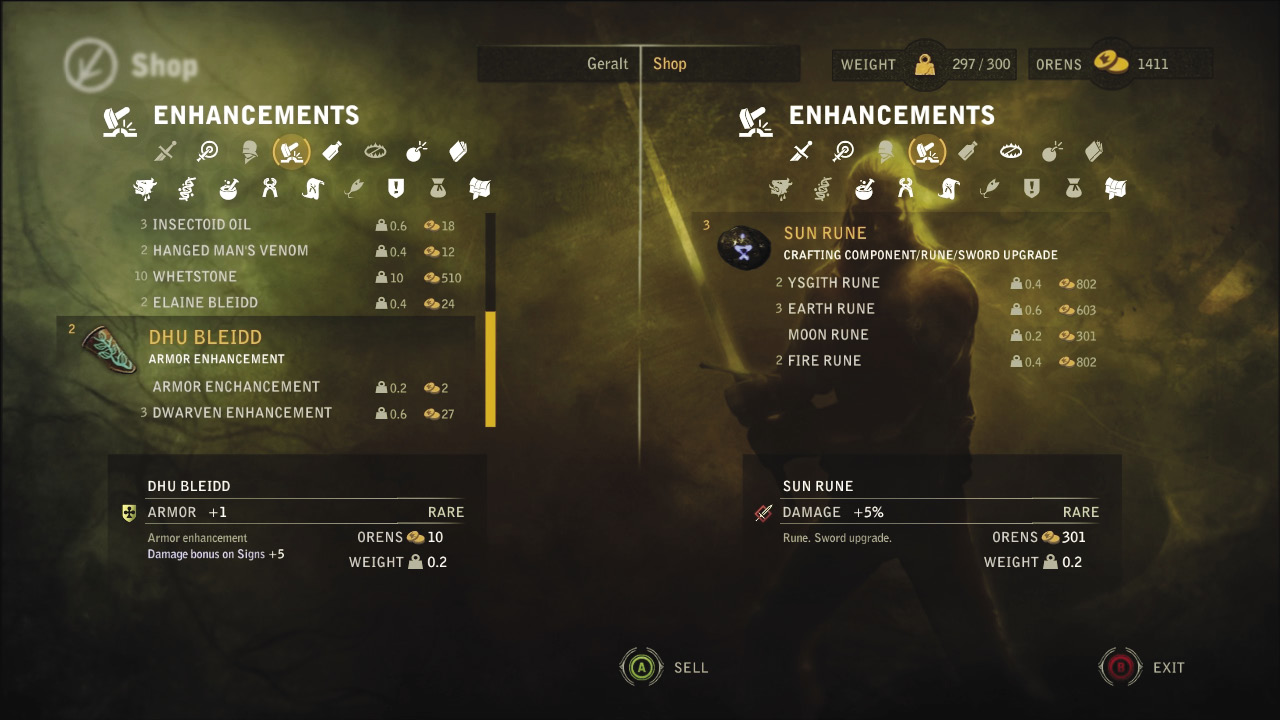
Runes can add passive effects, boost damage, or add additional critical effects to a sword. Passive effects, like the boost to sign intensity granted by a moon rune or the extra vitality granted by the earth rune, only become active when the sword is unsheathed. Damage boosts are a flat percentile boost of the basic damage range of the sword. Sun runes add a +10 percent chance of incineration to a sword while Ysgith runes add a +8 percent chance of bleeding.
While there is a greater variety of armor enhancements, their effects are more limited. All armor enhancements grant either +1 or +2 to the base armor value of a suit of armor when slotted. More powerful armor enhancements also add passive effects to Geralt’s armor, which are always in effect. These can include boosts in resistances, boosts to sign damage, and vitality boosts.
Not all swords or armor can be enhanced. As a basic characteristic, each individual piece of equipment possesses a number of enhancement slots. A piece of equipment with no enhancement slots cannot be enhanced, while a piece of equipment with one slot can be enhanced once. The maximum number of slots for any piece of equipment is three.
You can slot equipment with multiples of the same type of enhancement (say, two fire runes or two steel plate enhancements). There are relatively few armor enhancements so good that you’d want to slot multiple versions of them, rather than just plopping in whatever has a +2 armor bonus. When it comes to runes, though, it is generally most efficient to slot swords with multiple copies of whatever rune suits your build best. That is, a mage build would get the most benefit from slotting a sword with three moon runes, while a swordsman or alchemist would be better served by three fire runes.
Alchemy
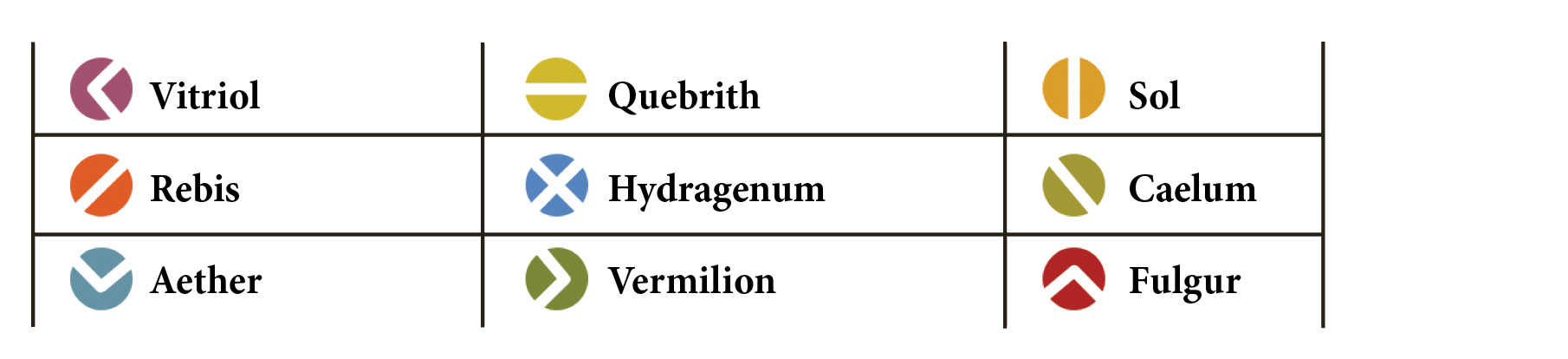
Geralt’s modest skills as an alchemist allow him to manufacture certain items by himself, provided he has the right materials and a formula for the desired item on hand. An alchemy material contains one of the nine basic alchemical substances. Each formula combines a number of alchemical substances in a certain proportion. You can use any material that contains a substance to fulfill a formula—what really matters is achieving the correct mixture of substances.
The nine alchemical substances are:
There are two major sources of alchemy materials: herbs and monsters. Herbs that contain alchemical substances glitter faintly with magic as you pass them by. If you approach one of these herbs, you can opt to pick it by tapping the interaction button. If you scan an area, any pickable herbs in the area glow a bright orange. This can be useful for picking herbs out of dense forests or patches of weeds. Herbs respawn eventually after you gather them, usually after about a day’s worth of time passes in-game.
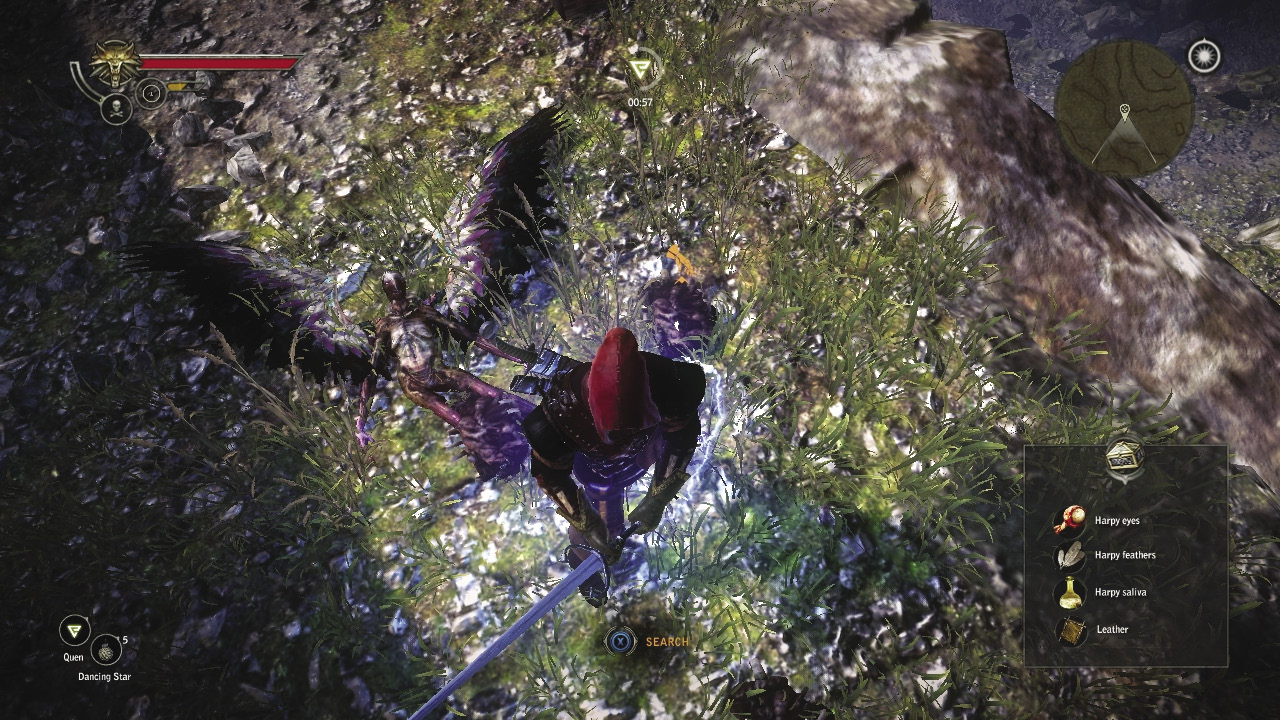
You can harvest alchemical materials from most monsters upon their defeat. After you defeat a monster look around for a “corpse” that looks a bit like a smoking, meaty rib cage. Usually these bundles of items are easy to find, but sometimes you may need to scan with your medallion. Monster drops glow bright orange after a scan, which can help you pick them out of thick grasses. While monster drops are usually heavier than herbs, they sometimes include materials containing rarer substances like aether and fulgur.
It is also possible to craft certain alchemy items by taking ingredients to a craftsman and paying a fee. The details of this procedure are discussed in the “Crafting” section. In general, though, you shouldn’t need to do this for purposes of basic alchemy. Some alchemy materials also double as crafting materials, so you tend to end up manufacturing them only for crafting purposes.
Geralt can synthesize alchemy items in any area where he can meditate, so basically in any quiet spot free of monsters, provided he has the formula on hand. Formulas can synthesize any of the bombs, oils, or potions available in the game. Some formulas can be looted, but most need to be purchased from vendors. So while being good at alchemy requires a big investment in orens to get the right formulas, it pays off later in the game by letting you synthesize certain items whenever you need them.
Crafting
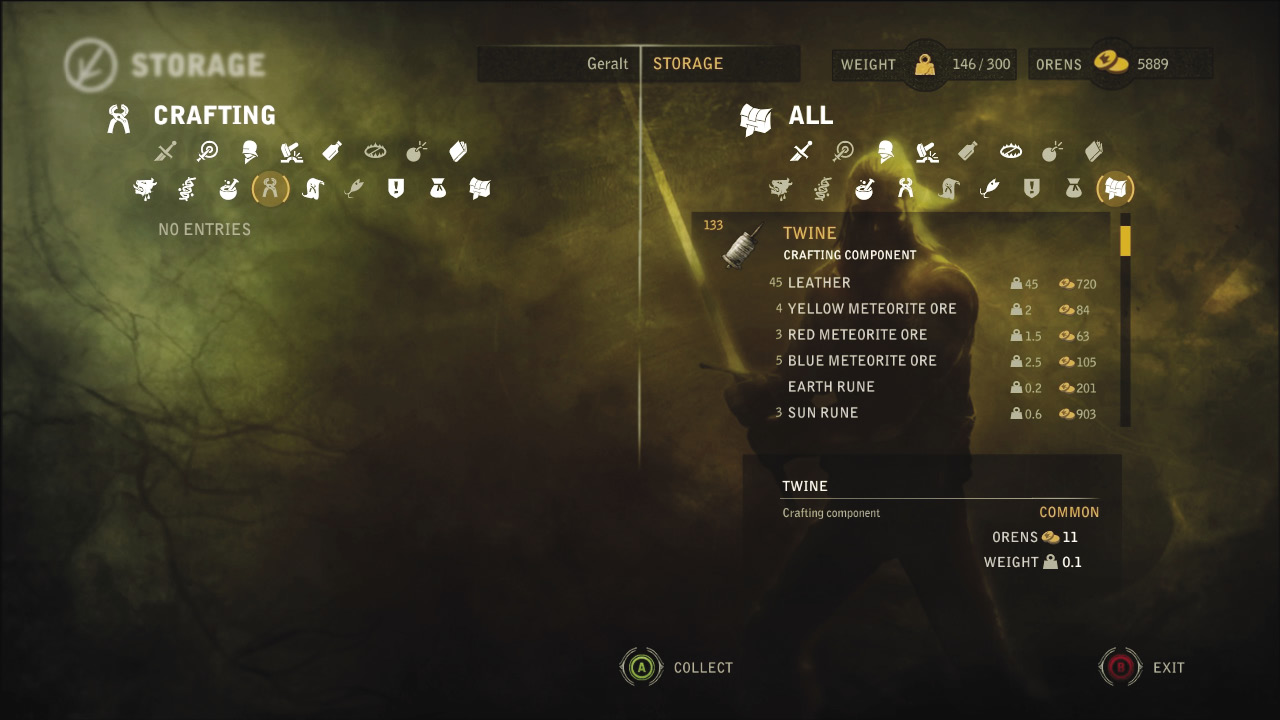
Simply buying items from merchants can be prohibitively expensive. It can be much cheaper to create items by purchasing diagrams that show how they’re constructed, gathering up the materials, and then paying a craftsman to make the item for you. Of course, not every item has a diagram, and some diagrams are difficult to obtain. On the other hand, almost all of the best equipment in the game can only be manufactured from a diagram with the right materials.
Most diagrams can either be found as loot or purchased from a merchant. You can obtain diagrams for basically any sort of item that isn’t made primarily through alchemy. This includes equipment, consumables like traps, enhancements, and (recursively) certain common crafting materials like oil. Once you have a diagram you want to manufacture, make sure you have the materials required to craft it.
While there are certain items in the game like oil and leather that are used only in crafting, basically anything in the game can end up being required to craft a diagram. This includes many monster drops, certain runes, and in rare cases, even full pieces of equipment. Most item diagrams call for a blend of common and rarer items.
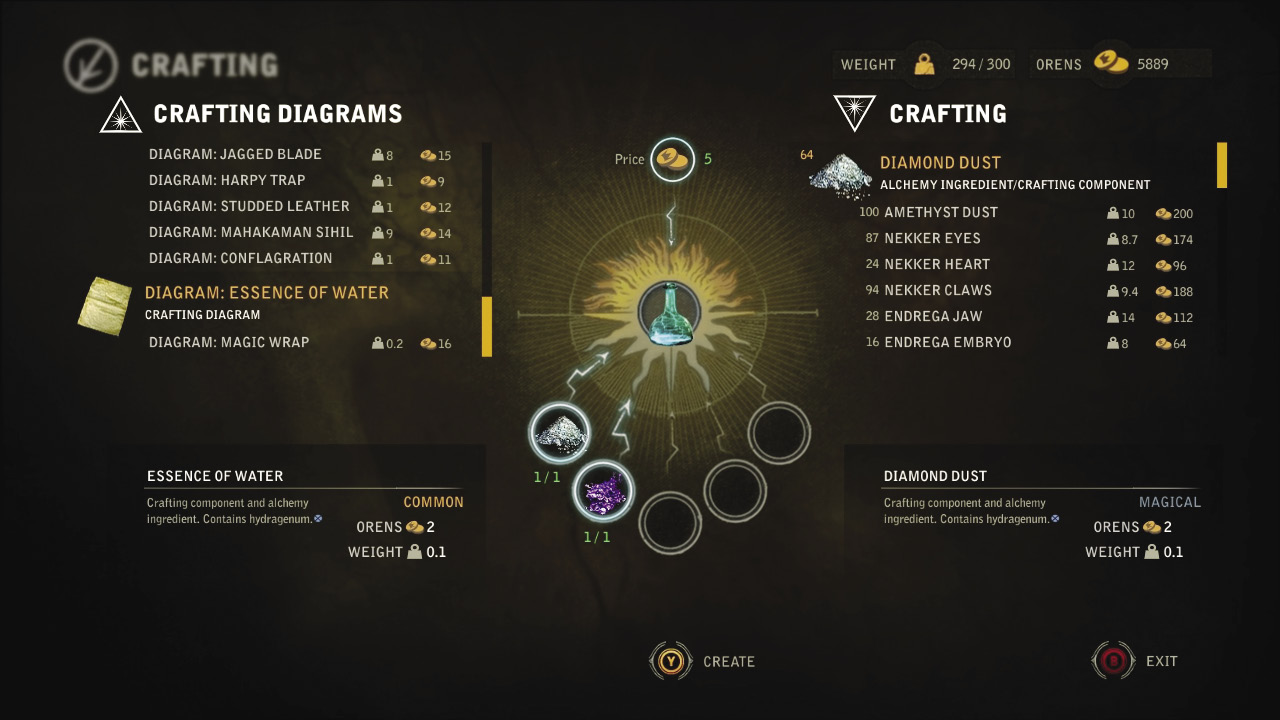
Once you have a diagram and the crafting materials it requires, find a craftsman. Craftsmen do business in settled areas and are usually marked on your in-game mini-map. Generally, while playing in the main game, you have access to one major town or city in each chapter, where a few craftsmen ply their trade. All craftsmen are also merchants, often selling a wide selection of diagrams and crafting materials. You can consult the walkthrough for specific locations and shop lists for the craftsmen available in each chapter.
Once you have a diagram, materials, and a craftsman, you can make an item. First, speak with the craftsman and ask him to create an item for you. This takes you into the game’s crafting interface. Simply select the diagram you wish to craft with your confirmation button. If you have the materials required to make it in your inventory, then you can pay a fee to craft the item. Your crafting materials are consumed, but in exchange you get a new item.
It can be tremendously useful to acquire diagrams and stockpile materials necessary for crafting items you use frequently, like runes or certain armor enhancements. You also want to obtain diagrams for rarer materials required in crafting, like robust cloth, essence of water, and studded leather. Otherwise, it’s best to keep an eye out for diagrams that let you make unique equipment that cannot otherwise be purchased. The items that result from these diagrams are often unusually powerful, though not necessarily better than certain rare items you find only as loot.