
The Witcher 2: Assassins of Kings Guide Basics
How to Build a Witcher: Skills and Attributes
Geralt does not quite begin the game as a blank slate, but he does begin in an undeveloped state. He has access to all of the most basic abilities a witcher can have, but none are refined. In The Witcher 2, you can begin with this “blank slate” Geralt and specialize his abilities in many ways.
This chapter presents a lot of advice and a variety of sample builds for Geralt, but this isn’t a game where the process of leveling up and buying skills is very complicated. When playing on a standard difficulty level, you can easily make a very strong Geralt build by just figuring out what you like to do in fights and investing in skills that let you do that better.
Gaining Experience
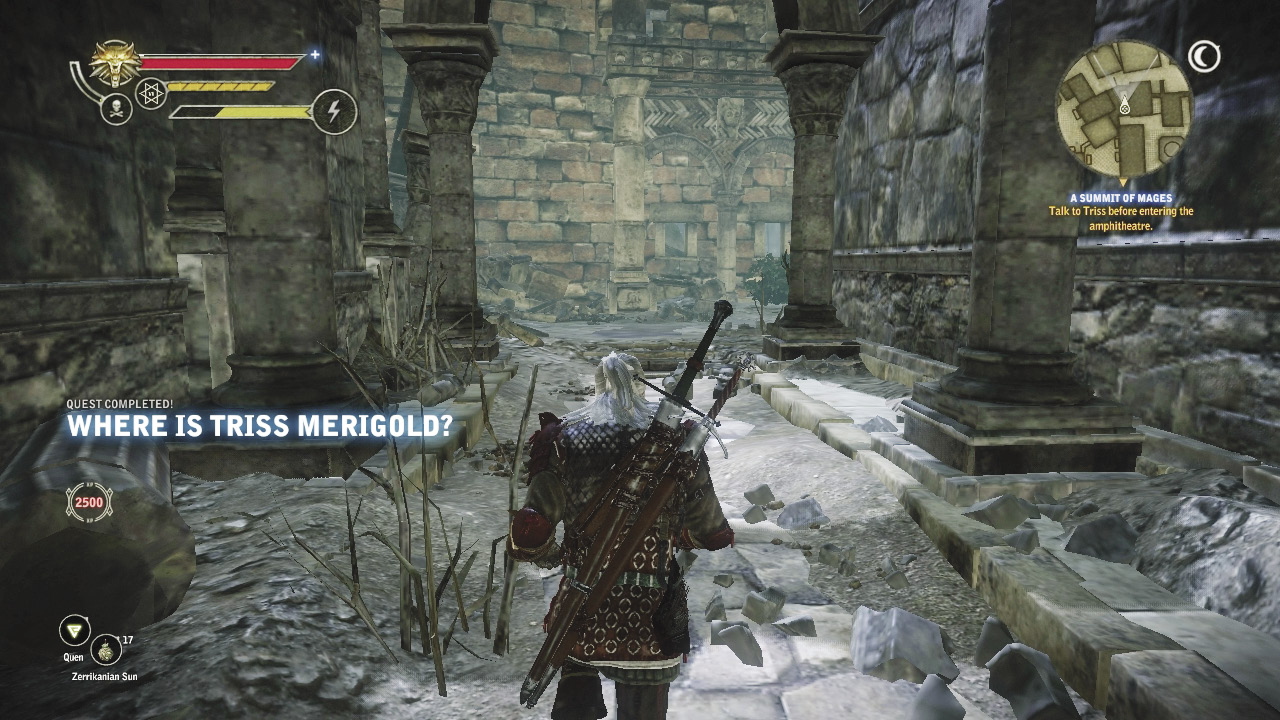
Geralt begins the game at level 1, with 0 experience. While you can gain experience from simply defeating enemies, the experience gains you earn this way are relatively small. This is not a game where you should go out and shank some monsters when you want to make your main character stronger. Instead, you gain most of your experience (or XP) by completing quests.
Generally, completing main story quests yields the most XP. A quest may award a large amount of XP when it is resolved or stagger its XP rewards throughout the quest. In addition to main story quests, you can take on side quests. These are completely optional, skippable quests that you can try to complete while you’re in a given area. Completing main story quests can make certain side quests inaccessible or cause you to fail them if you haven’t completed them already.
As a further complication, getting XP isn’t simply a question of blitzing through as many quests as you can between plot points. How you complete a given quest can radically change the amount of XP and other rewards it gives you. Many of the game’s quests can be completed in two or three different ways, and usually one particular way ends up being worth the most XP. This isn’t necessarily going to be the most challenging approach to finishing the quest. Often, what the game chooses to reward is lateral thinking and sticking to your principles once you’ve made a decision.
Consult the “Walkthrough” chapter for complete coverage of all quests, including the various ways of completing them and breakdowns of how to get the most XP from the decisions you can make. If you want to play the game blind and only look up information on completing specific quests, use the index to see which specific page of the walkthrough covers a particular quest.
Leveling Up
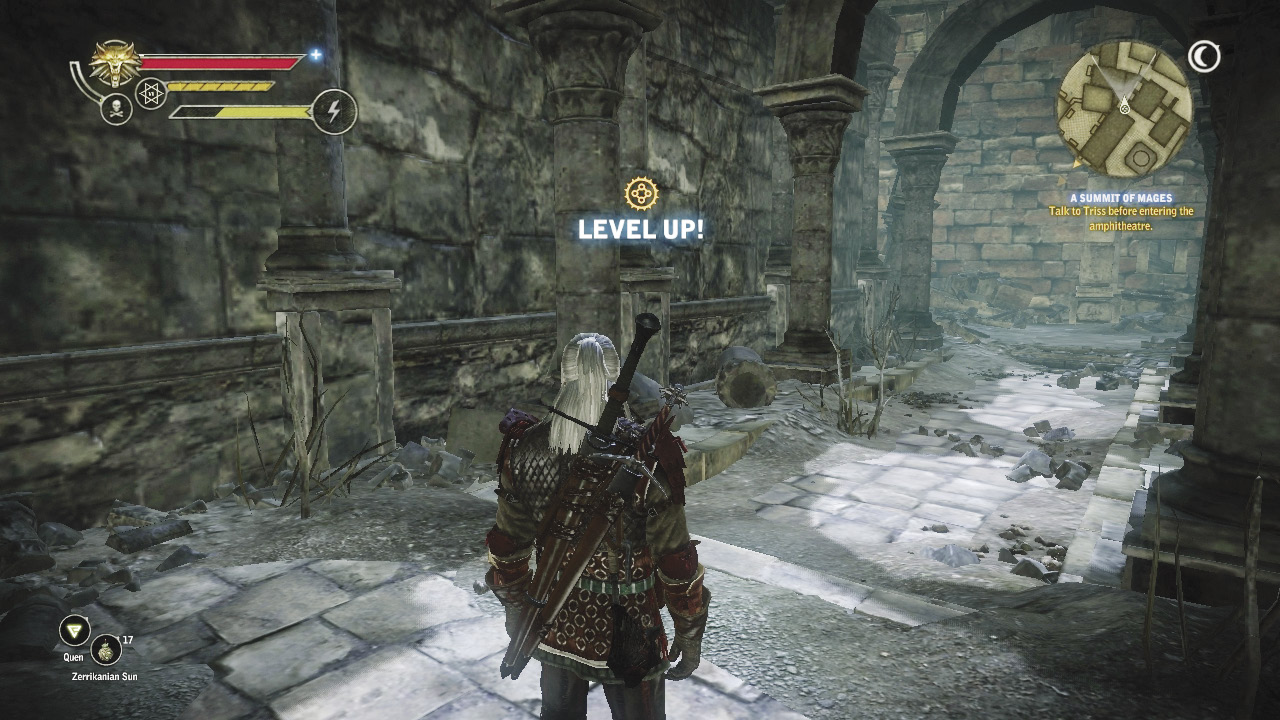
The Witcher 2 uses a simple, elegant leveling system. Every time Geralt gains 1,000 XP, he levels up. He begins at level 1 and can attain a maximum level of 35. His basic statistics grow somewhat as he levels up, but the most important thing that happens when Geralt levels up is that he gets a talent to spend. You can spend a talent to unlock a new skill or to purchase a second level of a skill that’s already unlocked. Since Geralt begins at level 1 with 0 talents, he can gain a maximum of 34 talents throughout the course of the game.
Before you can begin training Geralt in one of the game’s three main skill trees, you must first buy skills from the training tree. You must spend six talents in the training tree before you can spend talents on skills from any other tree. The training tree offers basic utility skills that serve as a foundation to build from. If you already have a long-term goal in mind for your Geralt build, take training tree skills that reinforce your specialization plans. If you aren’t quite sure what you’ll be doing yet, just put points into whatever looks interesting.
Since you must always spend six talents in the training tree, you can’t specialize Geralt at all until he reaches level 8. This typically happens somewhere in the middle of Chapter 1. Before you’ve gotten too far into Chapter 2, you need to have at least settled on a specialization or general plan for how you’re spending Geralt’s talents. While it’s pretty hard to create a Geralt so weak he can’t finish the game, spending talents in a scattershot way can result in a Geralt who begins limping through fights toward the end of Chapter 3.
Skills
This section covers all the skills available to each skill tree and how they work at both levels of investment. Some skills are perfectly useful with only one talent invested in them, while others don’t really come into their own until you’ve spent two talents on them. If it’s not entirely clear to you how a build’s skills are supposed to work, just read the “Build Notes” that go along with the discussion of each skill’s tree. You can also check the “Cross-Class Skills” sections to see which skills from other trees might be good complements to a given type of build.
While you can spend all 28 of your discretionary talents on one tree, it is not necessary. A truly strong Geralt build that specializes in one particular tree may have its effectiveness dramatically enhanced by spending a small number of talents on skills from another tree. A swordsman could invest a couple of points in Quen from the magic tree to help with defense, for instance, or a couple of points in Alchemist from the alchemy tree to make better use of bombs and traps.
Mutagen Slots
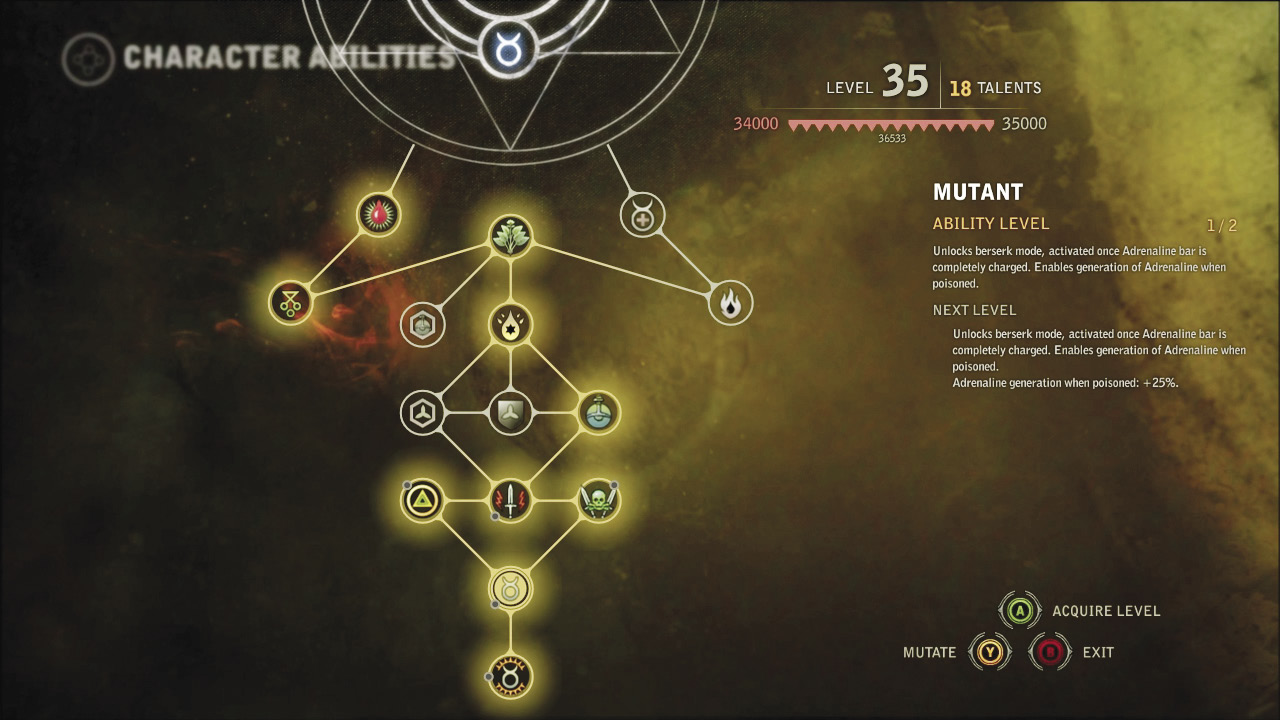
Certain skills have attached mutagen slots. Once you’ve spent a talent in gaining these skills, you can then slot mutagens that enhance Geralt’s intrinsic stats. You can identify them visually in the game’s character tab by looking for an empty circle near the edge of a skill bubble after purchasing a new skill. After you slot a mutagen, the bubble turns green. Which mutagen you slot won’t affect how the skill works. If you respec Geralt’s skills by visiting the Operator, note that any mutagens you’ve slotted remain even if you choose not to buy the attached skill during your respec. You can exploit this intentionally to help boost Geralt’s endgame stats if you like, although it’s so late in the game before you can visit the Operator that you don’t get much payoff for it.
How useful or important mutagens are to your Geralt build varies wildly according to which skill tree you are investing in. The alchemy tree offers the most mutagen slots overall and is somewhat dependent on mutagens to help boost Geralt’s stats. A mage build is not particularly reliant on mutagens and offers only a handful of mutagen slots. The swordsman build can get a strong shot in the arm from wise mutagen investment but can also get by without slotting any mutagens at all.
Using Mutagens
Let’s go into more detail about how mutagens work so you can make good use them as a part of your build. Most Geralt builds can loot mutagens as drops from monster corpses. Most monsters drop random basic mutagens, though more powerful enemies are more likely to drop powerful mutagens. Only one enemy in the game, the queen endrega, reliably drops a certain type of mutagen (the greater vitality mutagen).
Players who purchase the Side Effect skill from the alchemy tree can also create mutagens as a side effect of crafting bombs, oils, and potions from formulas. You have a 2 percent chance of creating a mutagen through Side Effect at first level and a 10 percent chance at second level. The chance is calculated once each time you craft, regardless of how much of an item you craft. That is, your chances of generating a mutagen are no better when crafting 30 samum bombs than they are when crafting one.
There are eight types of mutagen. Most mutagens can occur in a variety of forms, indicating different strengths of the same basic mutagen. The most common arrangement is a mutagen occurring in lesser, standard,and greater forms. When slotting mutagens, wait until you’ve obtained the strongest possible version of it. You cannot remove or overwrite mutagens once you’ve slotted them. With so few slots available, it just doesn’t make sense to waste your mutagen slots on inferior specimens. Consult the “Best Mutagens” table to see what is the strongest variant of each of the eight types of mutagen.
| Mutagen | Effect | Best for… |
|---|---|---|
| Greater Enhancement Mutagen | Adrenaline generation on hitting foe +5% | Mages, swordsmen |
| Greater Critical Effects Mutagen | +3% to knockdown, stun, freeze, incineration, poison, bleeding | All builds |
| Madness Mutagen | Armor +2, vitality +5, damage bonus on signs +1 | Mages, alchemists |
| Greater Power Mutagen | Damage +1–3 | All builds |
| Greater Strength Mutagen | Armor +2, vitality regeneration +1 | All builds |
| Greater Vitality Mutagen | Vitality +10 | All builds |
| Concentration Mutagen | Damage bonus on signs +1 | Builds that use signs regularly |
| Range Mutagen | Sign range Aard and Igni +5% | Builds with enhanced Aard sign |
The table identifies builds that can take particular advantage of a given type of mutagen’s stat boosts. Speaking broadly, though, most mutagens can be used effectively by any type of build. Stat boosts like more vitality, armor bonuses, critical effect increases, and extra damage are going to help regardless of how you buy skills. Often, your mutagen choices reflect what you happen to obtain in your game just as much as what’s actually optimal for your build.
For alchemists, the ability to get both Side Effect and the Impregnation skill, which boosts mutagen effects, radically changes the way you approach mutagens. An alchemist Geralt ends up with big piles of strong mutagens at his disposal and can afford to be especially picky about using them. Alchemists should hoard the madness mutagen, which grants simultaneous boosts to armor, vitality, and sign damage. This effectively combines the effects of the power, strength, and concentration mutagens, making it an extremely efficient way to boost Geralt’s stats.
Using Potions
As you begin building up your own version of Geralt, give some thought to what types of potions would work best to buff your strengths. You want to obtain the right potion formulas for supporting your build as early in the game as you can, but formulas are expensive. You don’t want to waste orens on formulas for potions you never use or spend a lot of time drinking potions that don’t give you the buffs you need. Note that some potions have drawbacks that are best balanced by drinking a complementary potion.
| Potion Effect | Corresponding Potions | Best for... |
|---|---|---|
| Boosts incineration, poison, and bleeding | Brock, Wolf | All |
| Vitality regeneration | Gadwall, Swallow | Swordsmen, alchemists |
| Resistance to poison, incineration, and bleeding | Golden Oriole | Mages |
| Vigor regeneration | Lapwing, Tawny Owl | Mages |
| Maximum vigor | Maribor Forest | Mages |
| Immunity to Poison | Mongoose | All |
| Damage bonus on signs | Petri’s Philtre, Stammelford’s Philtre | Mages |
| Damage bonus | Rook, Thunderbolt | Swordsmen, alchemists |
| Armor bonus | Tiara, Virga | Mages, alchemists |
| Maximum vitality | White Raffard’s Decoction | Swordsmen, alchemists |
Note that how you use potions is completely different when playing as an alchemist than it is when using other builds. If you’ve taken the Catalysis skill, then all potions have greater advantages and fewer drawbacks. The only potions really worth skipping as an alchemist are potions that primarily serve to increase vigor regeneration, as a typical alchemist build doesn’t burn through vigor the way a mage or a defensive swordsman can. As an alchemist, focus on drinking the potions that give the biggest overall stat boosts. You can basically ignore drawbacks, which will be reduced to the point of being negligible once you have Catalysis.
Training Tree
| Skill | Mutagen Slot? | Level 1 | Level 2 | Unlocks |
|---|---|---|---|---|
| Vigor Regeneration | No | Vigor regeneration while out of combat +25% | Vigor regeneration while in combat +25% | Parrying |
| Hardiness | No | Vitality +10 | Vitality +50 | Parrying |
| Dagger Throwing | No | Unlocks the ability to throw daggers | Damage dealt by daggers +20 | Parrying |
| Parrying | No | Unlocks the ability to parry blows from all directions | Damage reduction while parrying 50% | Arrow RedirectionFortitude |
| Arrow Redirection | Yes | Unlocks the ability to redirect arrows | Unlocks the ability to redirect arrows toward the shooter | — |
| Fortitude | Yes | Vigor regeneration during combat +10% | Vigor +1 | — |
Build Notes
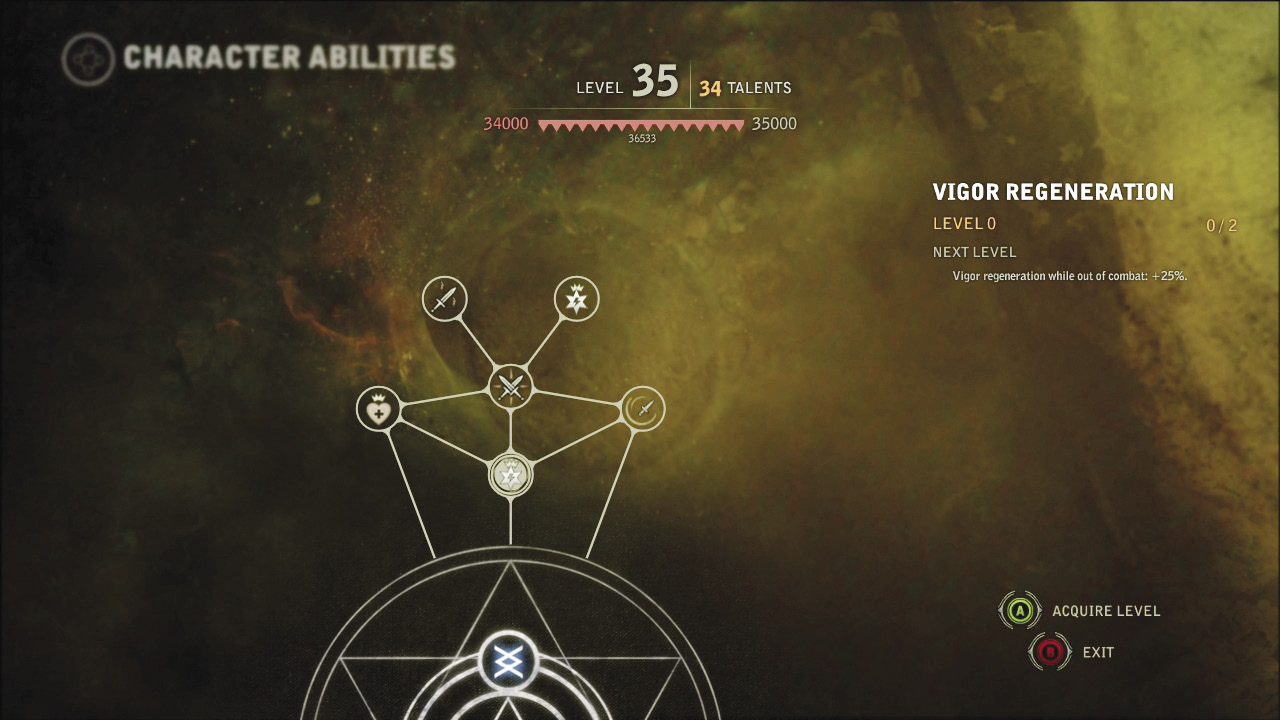
Avoid spending a talent on Vigor Regeneration unless you intend to invest a second talent in it. A +25 percent bonus to vigor regeneration in combat is great for mages and swordsmen, while +25 percent vigor regeneration out of combat isn’t really useful at all.
Hardiness is recommended for alchemists but isn’t a great way for other builds to spend talents.
Two points in Dagger Throwing is one of the best talent investments you can make in the training tree. The ability to throw daggers is useful to most builds. High-end daggers do a base 50–70 points of damage, and the flat +20 damage bonus means a high-end thrown dagger does at least 70 points of damage before armor resistance kicks in. For comparison, the forgotten vran sword, one of the best steel swords in the game, does base damage of 50–55 points.
Two points in Parrying is a great skill buy for aspiring swordsmen builds. Any build can make use of one point, though.
Arrow Redirection is a quirky skill that can be very useful in the hands of swordsmen, provided you take two levels of it. With two levels of Arrow Redirection, you can easily cause an archer or arbalist to kill himself with his own ammunition just by blocking.
Two points in Fortitude is a great buy for aspiring mages, who need all the vigor they can get to remain effective. One point in Fortitude can be helpful to all builds.
Swordsmanship Tree
| Skill | Mutagen Slot? | Level 1 | Level 2 | Unlocks |
|---|---|---|---|---|
| Position | No | Damage taken by backstab reduced to 150% | Damage taken by backstab reduced to 100% | Violence |
| Riposte | No | Tap the light attack button while blocking if you see the riposte prompt to counterattack for heavy damage | Chance of instant kill +10% when countering with Riposte | Guard |
| Feet Work | No | Dodge distance +100% | Dodge distance +200% | Schemer |
| Violence | No | Sword damage +5% | Sword damage +15% | Whirl |
| Whirl | No | Sword attacks deal 50% damage to secondary targets within range | Sword attacks deal 100% damage to secondary targets within range | ViolenceHardy |
| Guard | No | Vigor required to block -25% | Vigor required to block -50% | Tough Guy |
| Tough Guy | No | Damage reduction +5% | Damage reduction +15% | GuardSchemerHardy |
| Schemer | No | Vigor regeneration in combat +10% | Vigor regeneration in combat +40% | Tough Guy |
| Hardy | No | Vitality +25 | Vitality +100 | WhirlTough GuyPrecisionSudden DeathFinesse |
| Precision | No | Bleeding +10% | Bleeding +20%Sword damage +5% | Invincible |
| Sudden Death | No | Chance of instant kill +2% | Chance of instant kill +5% | Invincible |
| Finesse | No | All critical effects chance +5% | All critical effects chance +15% | Invincible |
| Invincible | Yes | Vitality +50Damage reduction +5% | Vitality +150Damage reduction +15% | Combat Acumen |
| Combat Acumen | Yes | Adrenaline ability: group finisherSword blows generate adrenaline | Damage +10%Damage taken -10% | Whirlwind |
| Whirlwind | Yes | Adrenaline generation +10%All resistances +10%All critical effects chance +10% | Adrenaline generation +30%All resistances +20%All critical effects chance +20% | — |
Build Notes
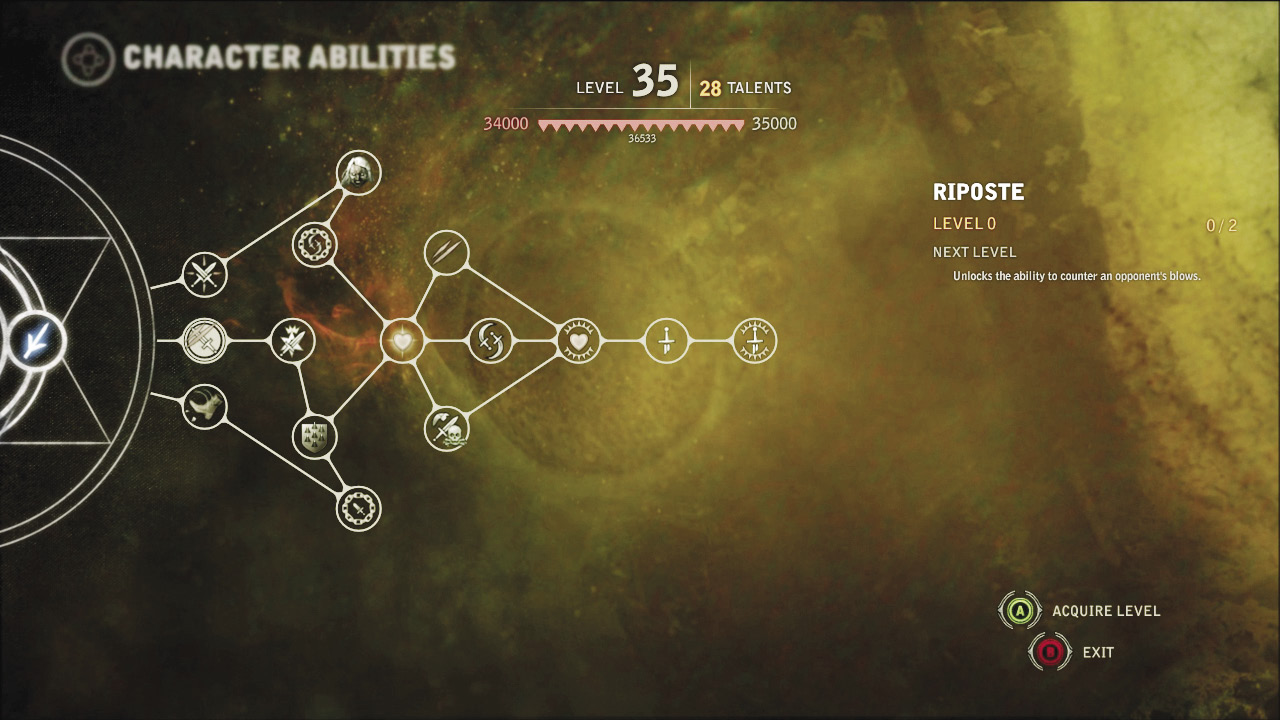
The swordsmanship tree is probably the game’s most robust overall skill tree. There are no bad ways to spend your talents, and few skills are even appreciably weaker than the others. You almost can’t go wrong by spending on swordsmanship skills. Players making their first trip through the game are encouraged to invest in this tree heavily, since swordsmanship builds are easy to use well. That said, the closest thing to a truly bad decision you can make when buying swordsmanship skills is picking up only one point of Precision. Bleeding just isn’t very useful as a critical effect. Even Precision is worthwhile at its second level, though, since it grants another flat bonus to sword damage.
Several swordsmanship tree skills completely alter the way Geralt handles in the game. The most obvious of these is Feet Work, which makes your dodge roll faster and extends its reach. The other major skill of this type is Riposte, which gives Geralt an automatic counterattacking ability that can completely change your approach to fighting human foes. Investing in a second level of Riposte and other skills that increase the chance of instant kill can turn Geralt into a nigh-invincible turtle that has a good chance of one-shotting any human opponent who tries to take a swing at him, provided his vigor holds out. You can reinforce this fighting style by investing in Guard and Schemer.
The adrenaline skill the swordsmanship tree grants is Combat Acumen, which lets you spend a full adrenaline bar to use a group finisher on any nearby humans or to execute an immediate instant kill on the nearest monster. Combat Acumen does not work against unique enemies, but does work against rare foes like elemental golems and gargoyles. If you want to use Combat Acumen to eliminate humans, try to make sure you’re in the middle of a large group of enemies first. Combat Acumen gives a swordsmanship build an incredible ability to control crowds of human enemies, especially when you combine it with other skills like Whirl and Whirlwind.
Cross-Class Skills
- Enhanced Aard Sign: Lets a swordsman quickly stun and knock down troublesome enemies like combat mages, making it possible to defeat them with a single blow. Can stun certain unique enemies and create openings for dealing damage.
- Enhanced Quen Sign: Swordsmen tend to wade into the thick of a group of enemies and can really benefit from the extra defense Quen provides. Amping up Quen with a couple of points in the Venting skill means that enemies just damage themselves whenever they try to attack you, too.
- Alchemist: On top of giving swordsmen another crowd-control option, the skills that enhance chances of critical effects synergize nicely with the effects of bombs like the Zerrikanian sun and traps like the Talgar winter.
- Synthesis: High vitality turns a swordsman into an unstoppable juggernaut. If you’ve taken all the swordsmanship abilities that boost vitality and still need more, two points invested in Synthesis can offer a swordsman a hefty additional bonus.
Sample Build: Swordsman
| Level | Skill | Level | Skill |
|---|---|---|---|
| 1 | — | 19 | Finesse |
| 2 | Vigor Regeneration | 20 | Invincible |
| 3 | Parry | 21 | Combat Acumen |
| 4 | Fortitude | 22 | Whirlwind |
| 5 | Fortitude | 23 | Whirlwind |
| 6 | Parry | 24 | Combat Acumen |
| 7 | Vigor Regeneration | 25 | Invincible |
| 8 | Feet Work | 26 | Finesse |
| 9 | Feet Work | 27 | Hardy |
| 10 | Position | 28 | Whirl |
| 11 | Position | 29 | Violence |
| 12 | Riposte | 30 | Tough Guy |
| 13 | Riposte | 31 | Tough Guy |
| 14 | Guard | 32 | Sudden Death |
| 15 | Guard | 33 | Sudden Death |
| 16 | Violence | 34 | Precision |
| 17 | Whirl | 35 | Precision |
| 18 | Hardy | ||
This sample build is an extremely straightforward one that doesn’t splash in any cross-class abilities. It is designed for players new to the game, who tend to favor a defensive style. This build invests talent heavily in the swordsmanship build’s many defensive abilities at low levels and emphasizes defensive abilities in the training tree as well. At low levels, this build can be boosted by use of the basic Quen sign, dancing star bombs, and basic potions to help Geralt survive grueling early-game battles. Abilities that speed up vigor regeneration make relying on Riposte in battles with human opponents a more viable option.
At level 16, which is usually early in Chapter 2, this build pivots from a defensive emphasis to a growing emphasis on offense abilities. At this point in the game, a new player should be growing bolder and feeling more confident. Going as directly as possible from Violence to Combat Acumen helps give the player access to group finishers right at the point in the game where they become hugely useful. From there, the build further invests in abilities that enhance its offensive capabilities. At level 35, this build is so difficult to damage that it can ignore Quen on lower difficulties. It defeats most enemies with only a few blows and inflicts critical effects and instant kills very frequently.
Making this build work well even at early levels doesn’t demand a lot of situational knowledge about the game’s major battles or constant reliance on use of potions, signs, and witcher’s tricks. This can make it ideal for a new player who finds all of the game’s options a bit overwhelming. This build allows a player to focus on more familiar elements of gameplay like dodging, blocking, and dealing damage through pure, overwhelming sword blows. Veteran players more comfortable with advanced strategy can probably find all sorts of ways to strengthen the build’s effectiveness, through use of unusual bombs like stenchbulb, high-end potion combinations, and more aggressive investment in cross-class skills.
Magic Tree
| Skill | Mutagen Slot? | Level 1 | Level 2 | Unlocks |
|---|---|---|---|---|
| Enhanced Aard Sign | No | Unlocks Aard sign level IISign range +2m | Unlocks Aard sign level IIIAard sign affects entire areasSign range +6m | Enhanced Quen Sign |
| Destructive Magic | No | Sign damage +5 | Sign damage +10Vigor +1 | Enhanced Quen Sign |
| Enhanced Axii Sign | No | Unlocks Axii sign level IIBewitched opponent gets:+20% vitality+20% damage | Unlocks Axii sign level IIIBewitched opponent gets: +50% vitality+50% damage | Enhanced Quen Sign |
| Enhanced Quen Sign | No | Unlocks Quen sign level IIQuen now deflects 20% damageSign duration +20 seconds | Unlocks Quen sign level IIIQuen now deflects 50% damageSign duration +60 seconds | Magic IntensificationVentingMagical Vigor |
| Magic Intensification | No | Sign intensity +1 | Sign intensity +2Damage reduction +5% | Enhanced Quen SignFatal Attraction |
| Venting | No | Quen transfers deflected damage to up to two opponents | Quen transfers deflected damage to up to three opponents | Enhanced Quen SignEnhanced Igni Sign |
| Fatal Attraction | No | Axii sign can now bewitch two opponents at once | Axii sign can now bewitch three opponents at once | Magic IntensificationMagical VigorEnhanced Yrden Sign |
| Magical Vigor | No | Vigor +1 | Vigor +2 | Fatal AttractionEnhanced Igni SignEnhanced Yrden Sign |
| Enhanced Igni Sign | No | Unlocks Igni sign level IIIgni can inflict incinerationSign range +3m | Unlocks Igni sign level IIIIgni now has area effectSign range +6m | VentingMagical VigorEnhanced Yrden Sign |
| Enhanced Yrden Sign | Yes | Unlocks Yrden sign level IICan lay down two Yrden sigils | Unlocks Yrden sign level IIICan lay down three Yrden sigils | Fatal AttractionEnhanced Igni SignGlyph EnhancementEnergy FlowMagical Life Force |
| Glyph Enhancement | No | Impassable links form between Yrden sigils | Links between Yrden sigils deal 5 damage per second | Sense of Magic |
| Energy Flow | No | Critical effects chance from signs +5% | Critical effects chance from signs +25% | Sense of Magic |
| Magical Life Force | No | Vitality +50 | All resistances +5% | Sense of Magic |
| Sense of Magic | Yes | Adrenaline ability: HeliotropeUsing signs generates adrenaline | All resistances +5%Signs generate +50% adrenaline | Control Over the Power |
| Control Over the Power | Yes | All resistances +20%Sign damage +3Signs generate +10% adrenaline | All resistances +50%Sign damage +10Signs generate +75% adrenaline | — |
Build Notes
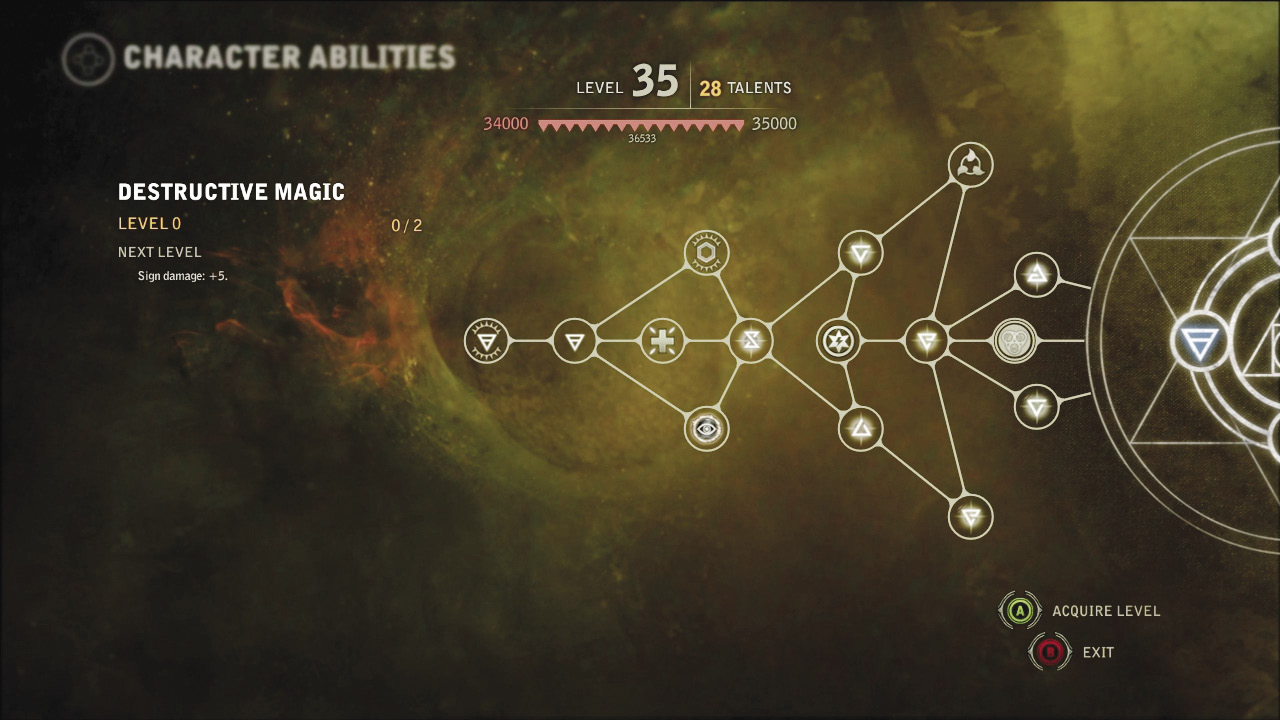
The magic tree is for gamers who typically prefer spell-slinging to sword-swinging, though it’s worth noting that spells in The Witcher 2 are poor sources of direct damage. You can’t go through the game simply throwing fireballs at everything—you will absolutely have to use your swords to damage enemies. What mages specialize in is stunning and weakening foes, so Geralt can get one-shot kills or other sorts of easy victories over his opponents.
Mage builds tend to be fragile early in the game if they don’t invest in Quen, but they blossom in the mid-to-late game as they acquire more high-level spells and stat bonuses. The magic tree has difficulty with crowd control, even with full investments in Axii or Yrden, and a mage build needs to acquire Sense of Magic as soon as possible to provide a fallback in brutal fights against lots of opponents. Mage builds often excel in fights against lone enemies, where they can use signs to exploit weaknesses, bolster defense, and lock down attacks.
The difficulty of building a strong mage is in making sure Geralt has enough vigor that he can cast spells regularly. While the magic tree includes abilities that increase Geralt’s maximum amount of vigor, it does not grant any abilities that speed up vigor regeneration. A mage build benefits greatly from the training tree’s vigor-related abilities and from regular use of potions that speed up vigor regeneration. Potions and oils that increase damage are also useful to mages, since most of the best magic tree spells focus not on damaging enemies directly, but instead on disabling them somehow. Even a Geralt build with a heavy investment in Axii eventually needs to be able to defeat some opponents by himself.
The adrenaline skill the magic tree grants is Sense of Magic, which allows Geralt to spend a full adrenaline bar to cast the sixth sign, Heliotrope. This spell creates a wide, dome-shaped area of effect in which time slows around Geralt. This gives Geralt a tremendous edge in handling large groups of foes, since he still moves at his normal speed. When Heliotrope is in effect, it becomes profoundly easy to dodge-roll around opponents and annihilate them with combos from the back. Your enemies won’t be able to move fast enough to defend themselves against you or regularly land attacks. In fact, an attacking foe becomes a sitting duck, trapped in a long and drawn-out animation.
Cross-Class Skills
- Feet Work: Mobility is invaluable to mage builds, who are too fragile to handle being trapped in a corner or in the thick of an enemy group. A couple of points in Feet Work gives Geralt a huge advantage when it comes to getting into an ideal position for spellcasting.
- Position: Mage builds often rely on Quen for defense, leaving them extremely vulnerable to damage once their vigor runs out. A point or two invested in Position makes these moments less deadly by reducing the damage bonuses granted to enemies who attack you from behind.
- Alchemist: Most mage builds don’t have effective means of crowd control available until around the halfway point of the game. Even then, running out of vigor shuts most of these options down. Dropping a point or two into Alchemist lets the mage fall back on bombs and traps for crowd control.
- Synthesis: The mage tree offers very few vitality bonuses, which can create a dangerous situation when a mage runs out of vigor. Investing a couple of points in Synthesis helps make a mage build a bit more survivable.
Sample Build: Mage
| Level | Skill | Level | Skill |
|---|---|---|---|
| 1 | — | 19 | Control Over the Power |
| 2 | Vigor Regeneration | 20 | Sense of Magic |
| 3 | Vigor Regeneration | 21 | Magical Vigor |
| 4 | Dagger Throwing | 22 | Magical Vigor |
| 5 | Parrying | 23 | Magical Life Force |
| 6 | Fortitude | 24 | Energy Flow |
| 7 | Fortitude | 25 | Energy Flow |
| 8 | Enhanced Aard Sign | 26 | Enhanced Yrden Sign |
| 9 | Enhanced Aard Sign | 27 | Glyph Enhancement |
| 10 | Enhanced Quen Sign | 28 | Glyph Enhancement |
| 11 | Enhanced Quen Sign | 29 | Enhanced Axii Sign |
| 12 | Venting | 30 | Enhanced Axii Sign |
| 13 | Venting | 31 | Fatal Attraction |
| 14 | Enhanced Igni Sign | 32 | Fatal Attraction |
| 15 | Enhanced Yrden Sign | 33 | Enhanced Igni Sign |
| 16 | Magical Life Force | 34 | Enhanced Igni Sign |
| 17 | Sense of Magic | 35 | Magic Intensification |
| 18 | Control Over the Power | ||
This build is designed to give players amped-up versions of all of the major signs to play with, while making the mage more survivable by unlocking and enhancing Sense of Magic and Control Over the Power as soon as possible. While this build tops out at five bars of vigor, it regenerates spent vigor relatively quickly and should let most players cast as much magic as they like without running out too quickly. Stat-wise, this build is fragile and very reliant on Quen for defense and Enhanced Aard Sign for getting quick kills. Energy Flow further amps up Enhanced Aard Sign, letting it stun entire groups of enemies at once and set them up for one-shot kills.
Its main crowd control option aside from Heliotrope (which it can cast frequently) is going to be Enhanced Yrden Sign with Glyph Enhancement. Geralt can use this ability to construct impassable barriers in choke points, then stand behind them and throw daggers, bombs, or even other spells (such as Enhanced Axii Sign) at enemies. This aspect of the build takes time to blossom fully. Throughout the game, using full arrays of potions to enhance Geralt’s vitality regeneration, resistances, and vigor regeneration is a must when preparing for long battles that can’t be settled by a single shot of Heliotrope.
This build can be used on a first pass through the game by a player who is talented at figuring out which spell best suits a situation, or who simply enjoys experimenting with spells enough that he or she doesn’t mind dying a few times while figuring out the best approach to a fight. Otherwise, it is best suited to a player who is going through the game a second time and has a rough idea of how enemies behave and where a map’s good choke points are. Obtaining strong equipment is essential with this build, as it gets no abilities that boost sword damage and very few abilities that boost Geralt’s defensive stats. This is balanced out by the many ways it can totally neutralize its enemies.
Alchemy Tree
| Skill | Mutagen Slot? | Level 1 | Level 2 | Unlocks |
|---|---|---|---|---|
| Alchemist | No | Bomb damage +30%Trap damage +50% | Bomb damage +70%Trap damage +70% | Side Effect |
| Synthesis | No | Vitality +20 | Vitality +80 | Specialization: Potions |
| Side Effect | No | +2% chance to create mutagens as a byproduct during alchemy | +10% chance to create mutagens as a byproduct during alchemy | Harvester |
| Specialization: Potions | No | Potion duration +10% | Potion duration +40% | Harvester |
| Harvester | No | Alchemical ingredients harvested +50% | Alchemical ingredients harvested +100% | Side EffectSpecialization: PotionsCatalysisSpecialization: Oils |
| Catalysis | No | Positive effects of potions +15%Negative effects of potions -30% | Positive effects of potions +35%Negative effects of potion -80% | — |
| Specialization: Oils | No | Oil duration +10% | Oil duration +40% | ImpregnationTransmutationTaster |
| Impregnation | No | Mutagen effects +15% | Mutagen effects +80% to +35% | TransmutationTaster |
| Transmutation | No | +15% to oil effects | +35% to oil effects | ImpregnationMetathesis |
| Taster | No | Can consume four potions at once | Damage reduction while poisoned -10% | ImpregnationMetathesis |
| Condensation | Yes | Vigor regeneration while poisoned +15% | Vigor regeneration while poisoned +40% | Mutant |
| Metathesis | Yes | Damage dealt when poisoned +5% | Damage dealt when poisoned +25% | CondensationBerserker |
| Berserker | Yes | Chance of instant kill while poisoned +1% | Chance of instant kill while poisoned +3% | Mutant |
| Mutant | Yes | Adrenaline ability: berserk modeGenerate adrenaline while poisoned | Adrenaline generated while poisoned +25% | Amplification |
| Amplification | Yes | Adrenaline generated while poisoned +15%Damage done while poisoned +5%Damage taken while poisoned -5% | Adrenaline generated while poisoned +50%Damage done while poisoned +15%Damage taken while poisoned -15% | — |
Build Notes
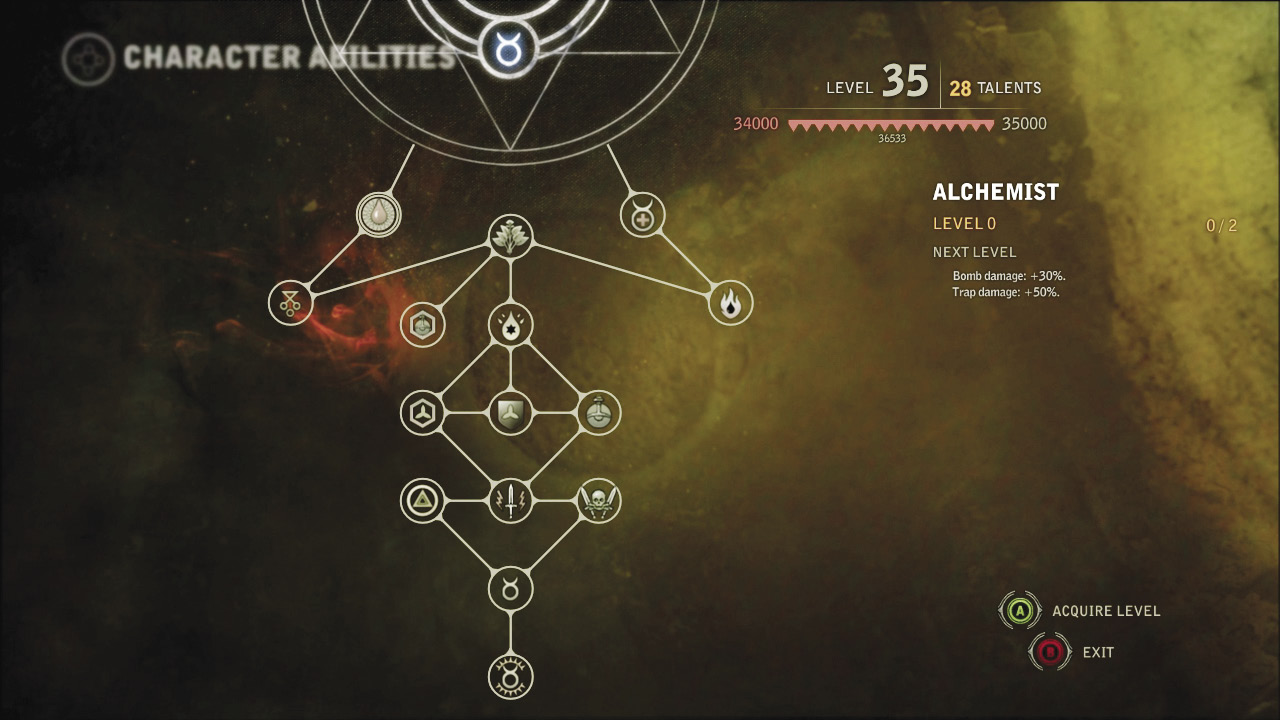
Builds that emphasize the alchemy skill tree are not for the faint of heart or first-time players. The alchemy skill tree offers significant power, but powers that are almost entirely situational. Before you can really take advantage of any of the skills offered by the alchemy tree, you need a very solid understanding of how the game’s various mechanics work and how to maximize the benefits the alchemy skill tree offers. An alchemist build can be, overall, just as effective as any mage or swordsman build, but only if the player knows how to properly exploit all of the skills at his or her disposal. Playing an alchemist well can also be challenging from a financial standpoint, since it requires a huge up-front investment in formulas and diagrams.
The core of an alchemist build is going to be use of potions and high-end mutagens to confer enormous stat boosts. An alchemist should always purchase both levels of Impregnation before slotting any mutagens. Note that Impregnation’s effects are not retroactive, and you will not gain any bonuses to mutagens you slotted beforehand. Skills relating to bombs, traps, and oils should be taken early in the game to give the alchemist a fallback in situations where potions are difficult to use. Both levels of Harvester are also an essential investment, both for helping to generate lots of alchemical materials and for generating lots of monster drops that can be sold off early in the game to help fund necessary investments in formulas. Both levels of Catalysis are highly recommended, to minimize the drawbacks of powerful potions.
The alchemist’s adrenaline ability is Mutant, a power that lets the player send Geralt into a berserk state where he deals extremely heavy damage to foes for an extremely short period of time, around 15 seconds. Alchemists generate adrenaline primarily through drinking potions and keeping their toxicity high. This means that during combat, so long as the alchemist has any toxicity at all, Geralt’s adrenaline meter is going to slowly and passively creep up regardless of what he’s actually doing. Several key alchemist abilities that enhance damage and critical effects also key off of high toxicity, making his berserk rages even more terrifyingly powerful.
Alchemist builds have the easiest time generating adrenaline of any of the builds, but are also the most completely reliant on constantly gaining and expending adrenaline for effectiveness. Where mages ultimately have many tricks at their disposal, alchemists at heart just chug potions and hope they get strong enough to steamroll enemies. An alchemist with access to high-end potions and strong mutagens, however, can make Geralt’s stats ridiculously high, so that on lower difficulties he’s functionally invincible to even the most powerful enemies in the game. Even on Hard difficulty, you should find that enemy damage output can have a very hard time keeping up with an alchemist’s ability to buff effectively.
Cross-Class Skills
- Enhanced Quen Sign: Alchemists can be a little fragile early in the game, when they’re strapped for cash and only beginning to enhance potion effects. Quen III can go a long way toward helping an alchemist survive the game’s grueling early challenges.
- Enhanced Axii Sign: An alchemist can use the red haze bomb to make Axii easier and faster to cast. Combine this with a few points spent in Axii to create a witcher who can trivially seize control of groups of enemies.
- Feet Work: Early in the game, an alchemist can use Feet Work to rapidly escape from terrifying groups of enemies. Later in the game, use it to chase down terrified groups of enemies.
- Riposte: An alchemist has relatively limited uses for vigor and can boost the chance of instant kills while poisoned. A few points of Riposte can help make key battles in Chapter 2 much easier.
Sample Build: Alchemist
| Level | Skill | Level | Skill |
|---|---|---|---|
| 1 | — | 19 | Mutant |
| 2 | Hardiness | 20 | Amplification |
| 3 | Hardiness | 21 | Condensation |
| 4 | Parrying | 22 | Amplification |
| 5 | Dagger Throwing | 23 | Mutant |
| 6 | Arrow Redirection | 24 | Berserker |
| 7 | Fortitude | 25 | Metathesis |
| 8 | Alchemist | 26 | Catalysis |
| 9 | Side Effect | 27 | Catalysis |
| 10 | Side Effect | 28 | Specialization: Potions |
| 11 | Harvester | 29 | Specialization: Potions |
| 12 | Harvester | 30 | Taster |
| 13 | Specialization: Oils | 31 | Transmutation |
| 14 | Impregnation | 32 | Transmutation |
| 15 | Impregnation | 33 | Specialization: Oils |
| 16 | Taster | 34 | Synthesis |
| 17 | Metathesis | 35 | Synthesis |
| 18 | Berserker | ||
This build is going to be very fragile throughout Chapter 1 but should come into its own in Chapter 2. Early in the game, this build trades off immediate sources of power for investments that pay off in later levels. Splashing one point each into Arrow Redirection and Fortitude opens up mutagen slots that become extremely valuable after both levels of Side Effect and Impregnation are in play. Two levels of Harvester taken in the early game can also help an alchemist deal with the severe cash flow problems that can occur during Chapter 1, due to the expense of necessary formulas and diagrams. Alchemist and Specialization: Oils should help keep early-game tasks manageable.
This build begins to blossom after it takes both levels of Impregnation and can begin slotting mutagens. Talents invested beginning at level 19 open up powerful abilities that make the alchemist increasingly powerful whenever Geralt goes into battle while dosed up with potions. Investments in Catalysis and Specialization: Potions amplify this exponential rise in power, as does further investment in abilities like Taster, Metathesis, and Berserker. Relatively early in Chapter 3 or possibly even late in Chapter 2, this build has come into its own and can deal tremendous damage in battles of any sort, provided Geralt can drink potions first.
Points invested late in the game are essentially in backup abilities like Transmutation that help deal with situations where Geralt cannot possibly keep his potions going throughout an entire battle. These situations are rare, though they do include some crucial optional fights. Overall, though, if the alchemist build is in the hands of a player skillful enough to survive a devastating early game, it can turn into a damage-dealer that’s extremely powerful.
Jack-of-All-Trades
| Level | Skill | Level | Skill |
|---|---|---|---|
| 1 | — | 19 | Enhanced Yrden Sign |
| 2 | Hardiness | 20 | Magical Life Force |
| 3 | Hardiness | 21 | Sense of Magic |
| 4 | Parry | 22 | Synthesis |
| 5 | Parry | 23 | Specialization: Potions |
| 6 | Arrow Redirection | 24 | Harvester |
| 7 | Fortitude | 25 | Specialization: Oils |
| 8 | Feet Work | 26 | Taster |
| 9 | Schemer | 27 | Metathesis |
| 10 | Tough Guy | 28 | Berserker |
| 11 | Hardy | 29 | Mutant |
| 12 | Finesse | 30 | Whirlwind |
| 13 | Invincible | 31 | Amplification |
| 14 | Combat Acumen | 32 | Control Over the Power |
| 15 | Enhanced Axii Sign | 33 | Whirlwind |
| 16 | Enhanced Quen Sign | 34 | Amplification |
| 17 | Magical Vigor | 35 | Control Over the Power |
| 18 | Fatal Attraction | ||
Build Notes
It cannot be emphasized enough that this build is not recommended for players picking up the game for the first time. In some ways it’s not really a recommended build, as it trades off a lot of useful early-game skills in exchange for, basically, performing a late-game party trick. It’s one hell of a party trick, though, and worth pointing out as an example of what you can achieve with careful character building in this game.
The jack-of-all-trades build is designed specifically to acquire all three of the game’s adrenaline abilities. Once you’ve successfully invested talents in Combat Acumen, Sense of Magic, and Mutant, you can activate all three at once by spending your adrenaline meter. This means that for the cost of one adrenaline bar, you instantly kill everything around you, slow time around Geralt, and then get about 15 seconds to go on a mass-damage killing spree. You can take advantage of Heliotrope’s relatively long duration to finish off anything that somehow still survives.
You make significant trade-offs for pulling off this trick. Although you can generate adrenaline using all three methods (landing sword blows, drinking potions, and casting signs), you aren’t going to be especially good at any of them. You end up generating adrenaline slower than a swordsman or alchemist, though you get much more bang for your proverbial buck. Your build is going to suffer a bit in the early game and midgame, since it’s still gathering steam when others are beginning to unleash their full potential. You’ll be more fragile at the end of the game than a swordsman or alchemist would be, though this is offset by having 12 open slots for mutagens.
The drawbacks of this build aren’t anything that a player with sharp reflexes and a thorough knowledge of the game can’t handle. You can adapt this build in all sorts of ways, to create your own personal über-build for Geralt. Maybe you want to use it as a template for creating a build that focuses on two skill trees instead of all three. Use the sample builds provided in this guide as templates to help you create a Geralt build that perfectly fits your own preferences and fighting style.
Character Attributes
We’ve covered how you can customize Geralt through talents and skills in exhaustive detail, but there’s another, entirely separate way you can make your Geralt more distinct. As you progress through the game and complete tasks, the things you do can unlock certain character attributes for Geralt. Each attribute usually has a name evocative of what you did to unlock it and grants you a new stat bonus or other ability. Some attributes are basically just novelties, while others are so useful that it’s almost not worth playing the game without them.
A complete list of the game’s character attributes and how you unlock them is included here. As you read over it, note that some attributes are mutually exclusive. Attributes you pick up by doing things while allied with Roche, for example, can’t be acquired if you decide to ally with Iorveth instead. Some attributes are easily obtained by sticking to the main story quests, while others require you to go on side quests. A handful of attributes, some among the most powerful, require you to take very specific actions at specific times.
| Attribute Name | Effect | How to Get It |
|---|---|---|
| Anatomy Lesson | Damage to humans +10% | Examine the fresh corpse in the Dwarven Catacombs as part of the side quest With Flickering Heart. |
| Arcane Knowledge | Sign intensity +0.5 | Complete the side quest The Gargoyle Contract. |
| Assassin | Damage +25% when attacking opponents from behind | Find the assassin who resembles but is legally distinct from Altair during the Prologue. |
| Axii Sign Hex | Makes Axii more effective when used in conversations | Select and successfully use a dialogue option that requires use of the Axii sign in any conversation. |
| Batter | Chance to instant kill with redirected arrows +20% | Buy both levels of the skill Arrow Redirection and redirect approximately 10 arrows back at your enemies. |
| Battle Seasoned | Vigor regeneration in combat +5% | Finish the main story quest Vergen Besieged. |
| Birdman | Damage to harpies +10% | Complete the side quest The Harpy Contract. |
| Child of the Night | Vitality regeneration at night +2 | Sneak through the Kaedweni Camp undetected during the main story quest Where Is Triss Merigold? . |
| Conjuror | Sign damage +3 | Successfully use Axii Sign Hex on an NPC during a conversation. |
| Cover | Damage reduction +10% | Escape the Scoia’tael with Triss and Roche at the beginning of Chapter 1. |
| David | Damage to large monsters +10% | Kill the golem in the kingslayers’ hideout in Chapter 2. |
| Executioner | Chance to instant kill +1% | Slay Aryan La Valette, Adam Pangratt, and Henselt of Kaedwen. Note that this is only possible if you side with Roche. |
| Exorcist | Damage to wraiths +10% | Finish the main story quest The Blood Curse. |
| Experienced | Bonus of +10% to all XP earned | Knock down 10 training dummies. |
| Haggling | 20% off at all merchants | Use the Axii sign hex to convince the merchant to double your fee during the side quest The Kayran: A Matter of Price. Complete the main story quest The Kayran, then return to the merchant to collect your fee. |
| Half-Pirouette | Resistance to all critical effects +10% | Defeat Letho during the main story quest The Assassins of Kings in Chapter 1. |
| Intimidate | Makes intimidation more effective when used in conversations | Select and successfully use a dialogue option that requires intimidation in any conversation. |
| Parry | 10% chance of performing an automatic riposte after blocking a blow | Successfully use Riposte at least 10 times. |
| Persuasion | Makes persuasion more effective when used in conversations | Select and successfully use a dialogue option that requires persuasion in any conversation. |
| Pyromaniac | Bonus of +20% to current chance of inflicting incineration | Set yourself on fire without dying at least 15 times. |
| Resistance to Magic | Damage reduction from magic attacks +20% | Reject Triss in the elven baths and blow down the false wall with Aard to escape in Where Is Triss Merigold?. |
| Sapper | Chance of avoiding damage from traps and bombs +50% | Interrupt Geralt at least five times while he is in the process of arming or disarming a trap. |
| Strong Back | Geralt’s maximum load +50 | Spare Aryan La Valette and then help him escape from La Valette Castle during the Prologue. |
| Strong Stomach | Resistance to poison +10% | Complete The Kayran: Ostmurk and drink a Mongoose potion before slaying the kayran. |
| Swordsman | Damage when using a sword +4 | Successfully defend Henselt from the kingslayers during the main quest The Assassins of Kings in Chapter 2. |
| Thrower | Damage dealt by daggers +5 | Defeat Ves in the knife-throwing competition during the side quest Hung Over. |
| Toxic Blood | Chance opponents that damage Geralt will be poisoned +30% | Survive having the poison critical effect inflicted on you at least 15 times. |