
Taming the Wilds! Mastering Minecraft 4th Edition Guide Building Bigger and Better Things
Sample Project: Chichén Itzá
Let’s give a good example of larger buildings. We’ve chosen a fairly simple project for our first one. While the build is large, we wanted to show something that could be done in a single day with about four to eight hours of work. That’s a big enough time commitment to give you an idea of the principles of larger builds, without getting too daunting.
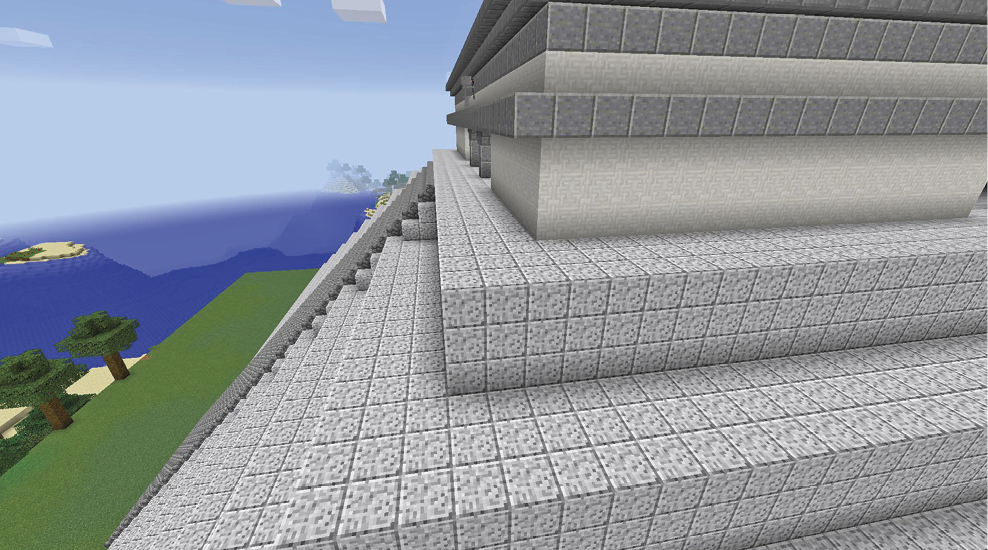
A classic building, El Castillo of Chichén Itzá presents an impressive and recognizable image. A number of people have created this building before in Minecraft, so it’s a kind of “Hello World” for people who want to try out larger buildings.
First, let’s go over a little history!
History of Chichén Itzá
In ancient times, Chichén Itzá thrived as one of the largest Mayan cities in the Yucatán Peninsula of Mexico. The Mayan civilization was the greatest power of the early Mesoamerican region, and at their height, the Mayans controlled a third of Mesoamerica. They are known for their calendar system, art, and architecture. They also recorded their history, with language found on the walls of their cities and temples, on pottery, and in screenfold books, although most of those were destroyed.
Chichén Itzá (translated name “At the mouth of the well of the Itzá”) was originally settled somewhere between 415 and 455 CE, but the city grew to prominence around 600 CE. At this time, much of the Mayan civilization was in decline, but it remains a mystery as to why (although long-term drought certainly played an important role). Nonetheless, people were fleeing their established homes to the south and flooding into Chichén Itzá, which boasted a plentiful water source. Because of this influx, Chichén Itzá became a huge political and cultural center, with the city-state dominating the local area.
The second settlement of Chichén Itzá occurred when it was conquered in the tenth century by the Toltecs, under the King of Tula, Ce Acatl Topiltzin Quetzalcoatl. The Toltecs were not benevolent conquerors; they subjugated the local population with such ferocity that even their ruling descendants regarded them with both awe and terror. The Mayans themselves were not a gentle civilization, so this must have been quite harrowing.
As an example, the Toltecs believed in human sacrifice, and although this was probably done by the Mayans occasionally, it was rarely, if ever, practiced by Chichén Itzá residents before the Toltecs took them over.
After the conquest of Chichén Itzá, the city architecture became a fusion of Mayan and Toltec elements (called Maya-Yucatec). One of the prime examples of this style is the central pyramid that dominates the city, rising above the surroundings. This pyramid is called El Castillo, and it’s a temple dedicated to Kukulkan, a serpent deity closely linked to the Toltec/Aztec god Quetzalcoatl.
We encourage you to examine other monuments in Chichén Itzá, most notably the Temple of the Warriors, which is surrounded by a huge number of impressive stone pillars called the Group of a Thousand Columns; El Caracol, which may have been an early astronomic observatory; and the Cenote Sagrado, which is a natural sinkhole filled with water that was used as a sacred pilgrimage site and sacrificial center.
What caused the end of Chichén Itzá as a thriving city is unknown. However, by the thirteenth century, there was no new construction. When the Spanish conquistadors arrived in Chichén Itzá, they found a small local population, but certainly no grand metropolis. Most of the city itself had been claimed by the surrounding wilderness. By 1588, Spain had taken all of the Yucatán, and Chichén Itzá became a (admittedly impressive) cattle ranch. It wasn’t until 1841 that the site was excavated, revealing its archeological importance.
Today, Chichén Itzá is owned by the state of Yucatán, and the site’s stewardship is maintained by Mexico’s Instituto Nacional de Antropología e Historia (National Institute of Anthropology and History). An estimated 1.2 million tourists visit the ruins every year, making it the second most-visited archaeological site in Mexico. The pyramid of Chichén Itzá conjures fantasies of forgotten ancient ruins buried in the jungle, and we’re sure that it will continue to inspire creators for many years to come.
Preparation and Research
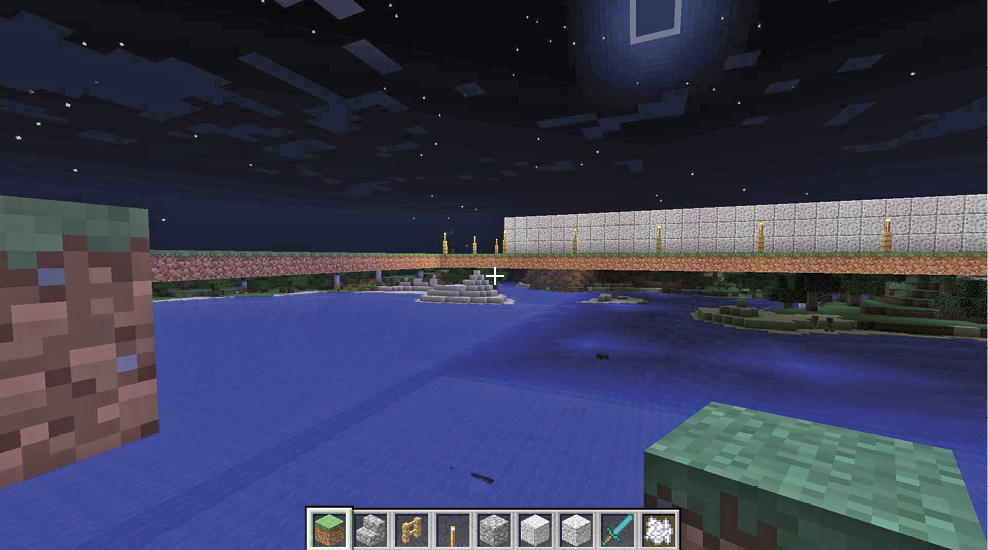
The early stages of a build are quite important. Plunging directly into your construction can waste hours because of awkward measurements, poor materials, or myriad other mistakes. Taking an hour or two to figure out what you’re doing is well worth the time. The bigger the project, the better your planning needs to be. This is true with single-player builds, and even more accurate when other players join the process. Having multiple people work together can be tricky, since it’s easy for someone to accidentally end up using the wrong number or incorrect types of blocks.
So, sit down and look at the types of buildings that inspire you. In our case, we’re doing the classic pyramid of El Castillo. There are tons of pictures of the real building to peruse, so that’s where we began. We also read through a wiki about the building, which provided the proper dimensions of the structure. You don’t have to follow the proper scale of anything, but doing so makes it easier to recreate a building that exists in the real world. You’re less likely to have the dimensions feel off in the final product. While making our building, we left pictures of El Castillo up in our browser, and frequently alt-tabbed back and forth to make sure that things looked decently similar. This helped tremendously while working on the upper temple. Our original looked bland and didn’t approximate some of the outer features at all. With some thought, we found a few ways to create additional elements that came much closer to those of the real temple. Inverted staircases really made the upper roof pop, and then we used Andesite blocks above the openings to mirror the darker highlights.
El Castillo measures 24 meters high and 55.3 meters across on its sides, with nine tiers and a six-meter temple on top. We can’t make these measurements perfectly within Minecraft, but we can do a decent job of it.
To come close, we’re going to make each level three blocks high. That gives us 27 blocks of rise, which will feel close to the 24 meters of the actual building. Minecraft blocks take two on top of each other to equal the height of a fully grown person, so saying that they’re about a meter high feels adequate. Thus, for reference, we’re saying that Minecraft blocks are a cubic meter.
Writing your measurements down on paper, or in an electronic document, really helps to set this stage. Graph paper is awesome because it’s exactly what people use when they’re building something with specific dimensions. There are free downloadable pieces of graph paper that you can print, so you won’t need a trip to the store unless you want to go out.
After our research, we write down that our levels are three blocks high, with nine total tiers. Then we decide to make the sides 60 blocks each. Again, that isn’t exactly the same as El Castillo’s 55.3-meter sides, but it’s close and even.
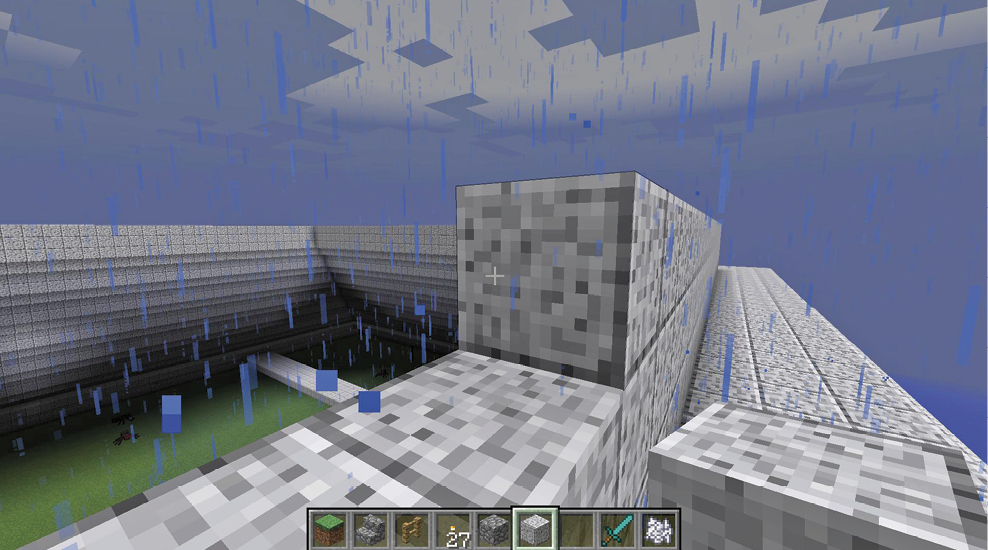
Our foundation will thus be a large square measuring 60x60 blocks of whatever material we decide to use. To build this out fully, we’d use 3600 blocks of material. However, we have options there. It’s possible to build over open air in Minecraft, so we can create the outer foundation and leave the interior of the pyramid empty. Or we could make interior rooms, just for fun.
Another option, for people who want to make a building more realistically, is to create the outer sections of your building with special materials (we’ll use Diorite for our exterior), but use Cobblestone or another ultra-common material for non-visual structures. It’s a way to save on your best materials if you’re building in Survival Mode.
Sticking to Your Measurements
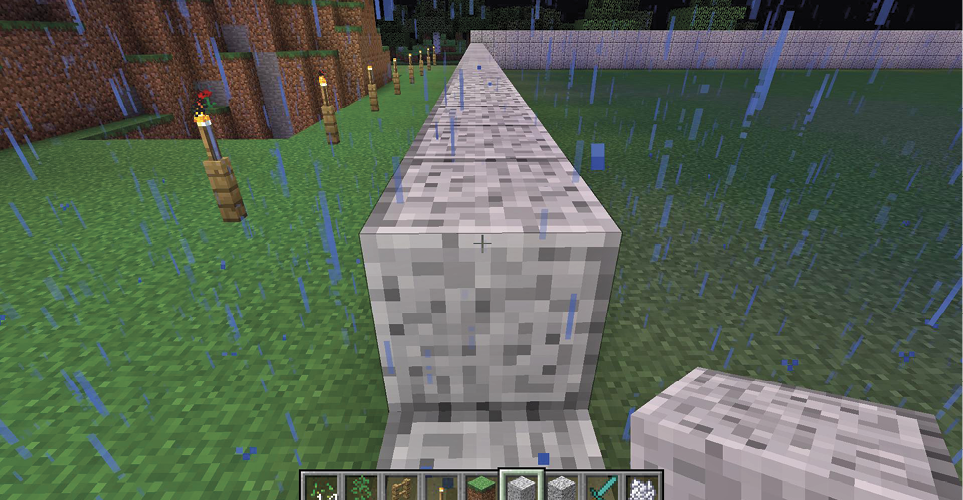
Even with a plan in place, you need to be rigorous about laying your foundation. Our plan of a pyramid with 60x60 sides is a rather easy one to stick to, but lose count when you’re setting things up, and suddenly you’re lopsided. To help avoid this, use milestones when making runs that are relatively large. Every 10 or 20 blocks, place a Torch. This makes it much easier to quickly assess your distances in the future. That comes in handy even after the blocks are on the ground, so leave your markers up until the project is entirely done. For example, you can easily end up with your staircases off-center if you don’t carefully find the middle point of your walls. Having the Torches makes it much faster to figure out where to start placing those elements.
Counting is a powerful way to stay on your measurements while putting down blocks. If you’re easily distracted, go back and recount the final product to ensure that you didn’t get a bit creative with the math. It’s slower this way, but it prevents you from looking at your finished building and saying, “That wall is three blocks too long. Oh, crud. This will take forever to fix.” In tiny builds, a correction takes seconds, so who cares if you do something wrong? But the larger the build, the more time it’ll take to correc tmistakes.
Our Actual Build
We chose Diorite as our primary building material because it gives the closest visual look to El Castillo. The color is very good, and the texture of the rock is closer to the rather smooth stone of the pyramid. The temple on top has a different appearance, so we switched to Chiseled Quartz blocks there. This sets the temple off and avoids having a samey feel to the structure. For an Egyptian pyramid, we’d probably go with a traditional Sandstone set, unless we’re adding the limestone cap that the pyramids had back in the old days. For those, Nether Quartz might work best—it’s so nice and bright.
Let’s take a moment to talk about the problems we faced, even with a relatively simple project like this. El Castillo was a one-day project, and we estimate that almost an hour was wasted on small mistakes, inefficient construction, and only decent planning. There’s always room for improvement.
What did we do right, and what did we do wrong?
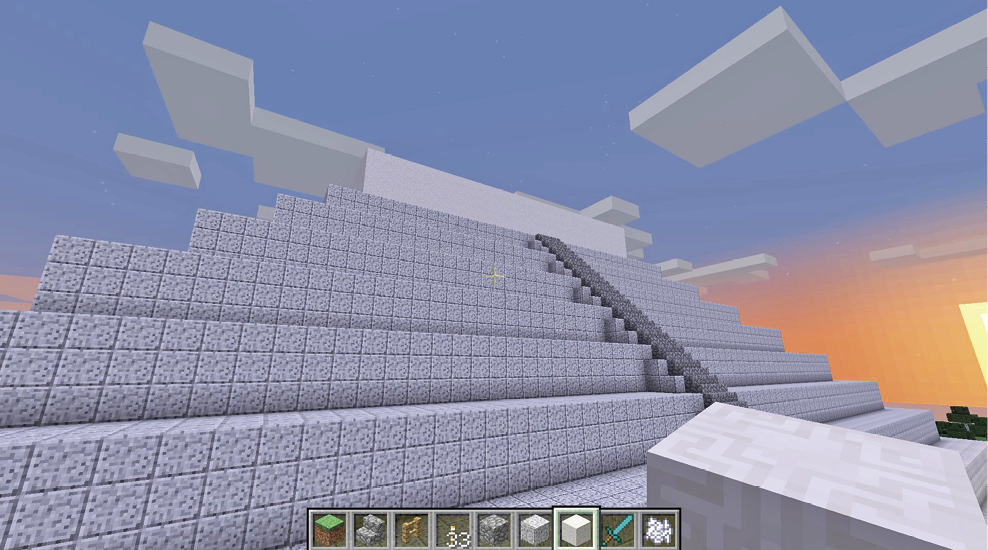
We failed to check our Torch milestone markers when making a staircase, so it ended up off-center. The thinking involved: “This looks like the middle, and it’s right next to a Torch.” However, it was the wrong Torch. We decided to leave that staircase in, because it’s a great example of what happens when you get fast and free with your measurements.
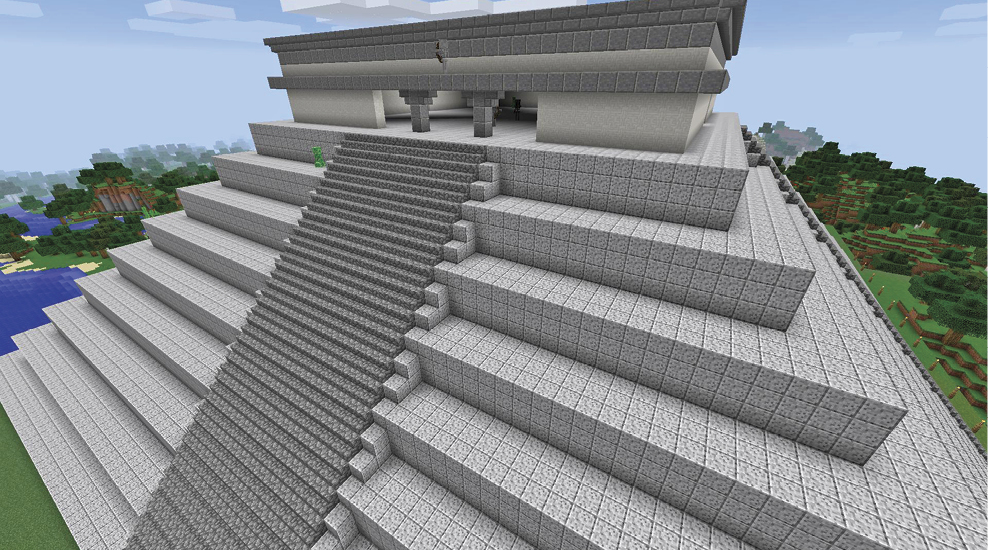
But all in all, the final product was almost exactly what we wanted to make. The overall appearance of the building is quite nice, the dimensions feel solid, and the pyramid is great for walking around and exploring. We were especially happy with the Stairs, once we widened them a little.
To keep things uniform, we show all of our screenshots without Resource Packs or Shaders installed, but El Castillo looks amazing when you add in proper shadows and watch the sunset.
That is just one of our projects. Now it’s time to talk about another—one that’s even more ambitious!