
Civilization V: Brave New World Guide Trade Routes
International Trade Routes
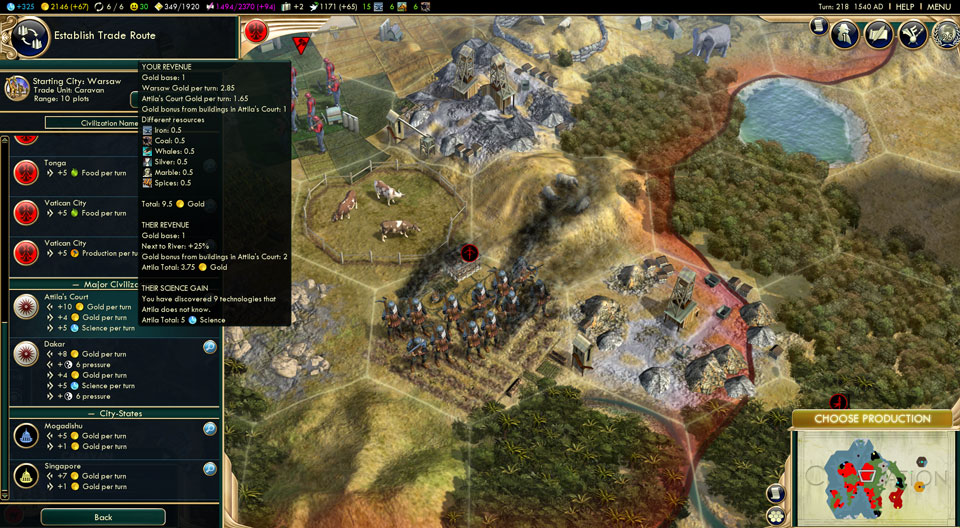
The new type of connection in Brave New World is called an International Trade Route, though this name is a little bit misleading (because you're allowed to use these routes domestically as well). International Trade Routes connect one of your cities to another city within range. Foreign routes generate money. Domestic routes generate free Food or Production. You can make friends and Gold by dealing with rival nations, play it safe and get rich by trading with City-States, or avoid the hassle and promote the Growth and Production of your best cities through domestic trade.
What Can Foreign Trade Routes Do, and What Do They Cost?
+ Earn Gold for your nation and your trade partner
+ Spread religion
+ Generate Science
+ Improve relations between the nations
– Require an unused International Trade Route slot
– Require a Caravan or Cargo Ship in the starting city for your route
– The target city must be within range of your Caravan/Cargo Ship
– Barbarians and enemies are able to attack your routes and plunder them
– Late-game Diplomacy can sever your routes even in times of peace
What Can Domestic Trade Routes Do?
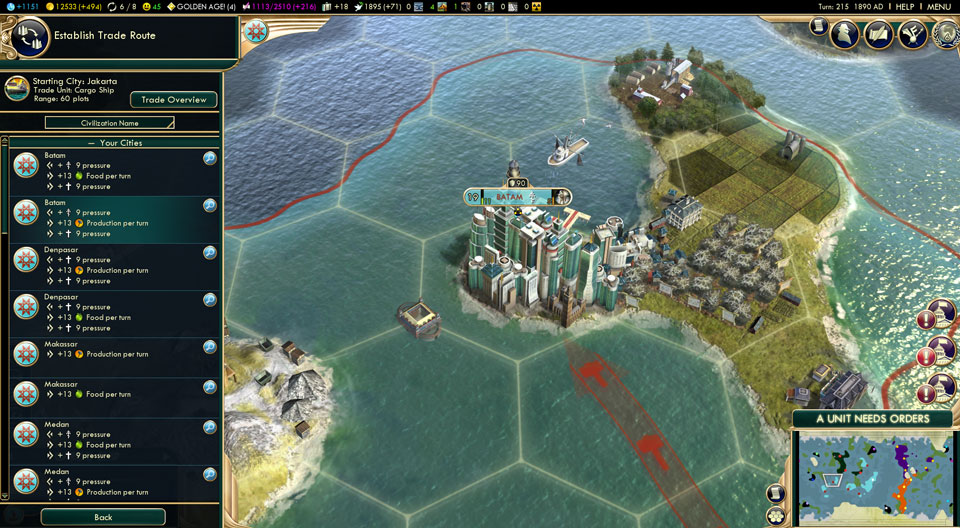
+ Generate free Food or Production for the target city
+ Spread religion
+ Barbarians are less likely to make it inside your borders to plunder these routes
+ No one has any sway over your routes, so they can never be manipulated diplomatically
– Require an unused International Trade Route slot
– Require a Caravan or Cargo Ship in the starting city for your route
– The target city must be within range of your Caravan/Cargo Ship
In the beginning of the game, each civilization has very few slots for their Trade Routes. Over time, Technology and special Wonders unlock more routes until you have quite a few at your disposal. Certain nations also get bonus Gold from their trading (e.g., Morocco) or receive more Trade Routes (Venice). These nations are able to get a huge amount of money through the trade system.
One If By Land
Land routes are easy to create. You do not need a road leading to your target. Although having a road makes the journey safer for your Caravans because they spend less time away from your borders.
Land routes have a disadvantage for domestic trade because they carry only half of the goods compared with naval routes. Your empire is well suited by trading Food or Production along your coast rather than over land.
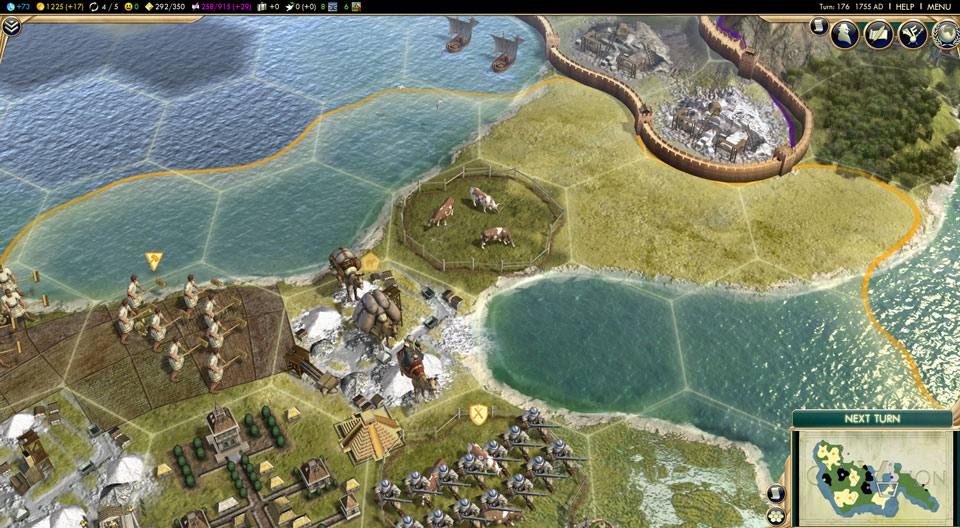
Terrestrial trade won't let you earn as much Gold or send as much Food or Production as naval routes, but it's easy to train Caravans and send them off (even in the early game). You won't need much Technology (Animal Husbandry), and any of your land units can patrol the area in between the connected cities. The route itself is even highlighted when you're making the route or, later on, if you select the Caravan. Once you know the path that unit is going to take, it's easy to see if there are any exposed points on your path. Does it go outside of everyone's borders, into the wilderness? If so, Fortify a unit in the middle of the open territory and have them ward off barbarians. When they see an enemy coming, bring in reinforcements, kill the raider, and track down the Encampment where they spawned. Burn it down, and go back to your happy trading.
When you initially select a Caravan, you have two real options. Either move the Caravan to another city (like changing the base of operations for a Bomber) or set up your Trade Route. If you train the Caravan in one city but want it to start a route somewhere else, you need to spend a full turn moving the Caravan over. Select the new city and make your route on the next turn.
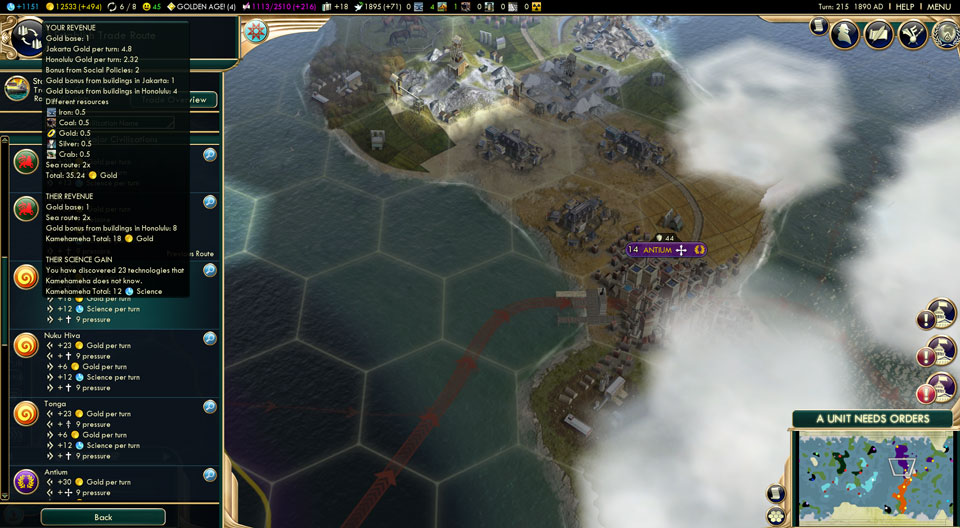
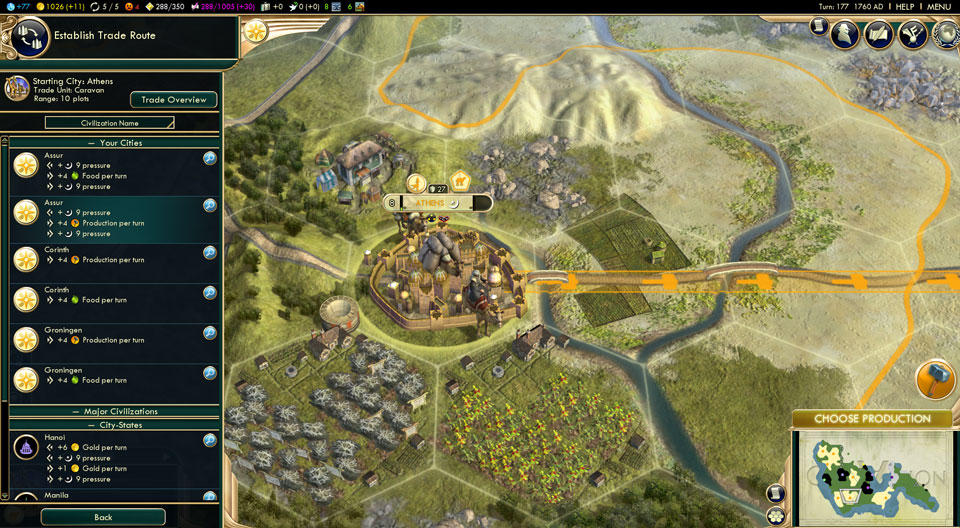
Creating a route is simple. After you select the option to establish the International Trade Route, a screen appears with information about every possible route that your Caravan can take. The income (in Gold, Technology, Food, Production, etc.) is shown right there, so comparing different routes is a fast process.
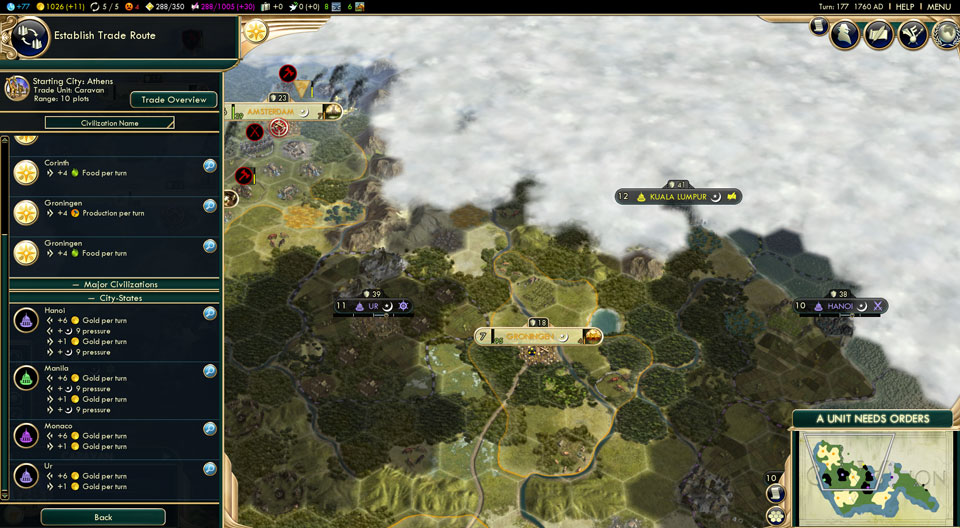
You also get to see how much a City-State or foreign city can make off of your Trade Route. Their Gold income is often much lower than yours, but some buildings and civilizations earn money when people trade with them. Note that you don't lose any Gold at all. The Gold that's generated through trade is absolutely free; the only downside is that you're helping a rival to make more money. That's usually a small price to pay.
Science is another matter. You can't do much to promote Scientific growth through trade. This amount is normally determined by the Technologies possessed by each civilization. Each nation gets a number of free Science that directly corresponds to the Technologies that are known by the other civilization and not your own.
If you know five Techs that your trade partner doesn't, they'll make a moderate amount of Science per turn off of your route. If they know three other Technologies that you don't, your nation gets some Science, but less than your rival. It's possible to have both nations get Science, and this is fairly common in the early stages of the game, in which people pursue different Tech paths and no one has so much Science that they dwarf their rivals.
Two If By Sea
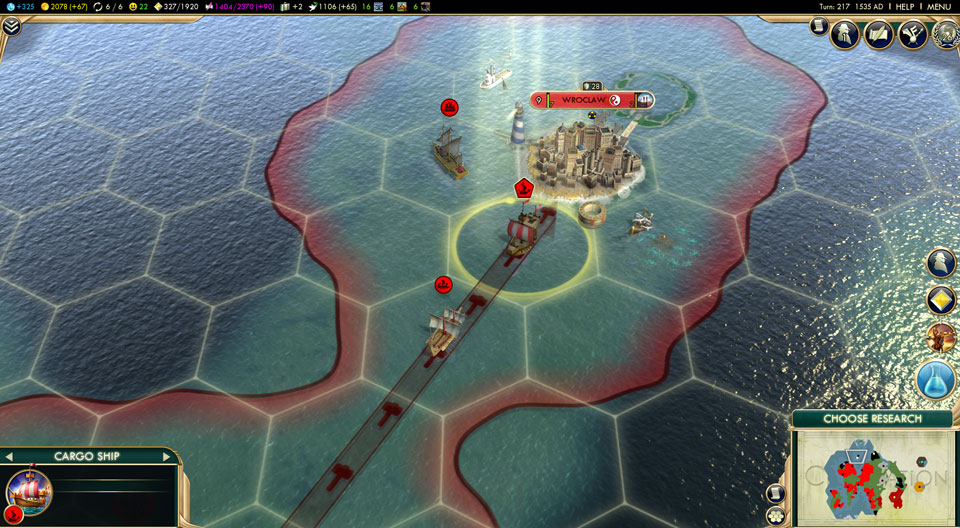
Naval routes are set up in a similar way. Make sure that two coastal cities are within range of each other and construct your Cargo Ship. Select the ship when it's ready and establish a route or transfer the ship to a new city. From there, everything is similar to a land route. If there are barbarians sailing through the area, make sure to have a patrol ship around and send land-based units to destroy the barbarians' home.
Foreign and Domestic
Foreign Trade Routes are quite profitable whether you're dealing with City-States or your rivals. It's usually more advantageous to trade with other civilizations, because you have the potential to get Science as well as Gold. You're also less likely to be attacked by nations that you're trading with currently. Still, City-States might be in a safer position for trade. Or you might only have access to a nation that you want to attack soon, so you're hoping to keep them poor and isolated.
Send your Caravans and Cargo Ships forth when you need the Gold. If development is more important, save your Trade Routes for domestic use. Cities can start trading Food with each other once they have a Granary. With a Workshop, they're allowed to send Production. Use routes with these goods to make your nation grow faster. Send Food in the first days after founding a new city; this gets Population into the new town rapidly. When that Trade Route expires (as they eventually do), assign your Caravan/Cargo Ship to the same city with Production instead. Now your established city can work on the bigger and more costly buildings.
Another domestic trick is to connect satellite cities to your Capital. Have the smaller cities send Food or Production to the Capital so that it grows beyond any reasonable expectations. This works well with Tradition Policies, especially if you're trying to build a wide range of Wonders. But beware—enemies won't let you do this for long if you have a crummy army. Make sure to spend some of your time building defenders.
Because Cargo Ships carry more resources on domestic routes, it's always worthwhile to found your city on the coast if you're anywhere near the shore. Two coastal towns are able to send their Cargo Ships to each other, even with the same goods. This allows your naval cities to generate a major amount of free Production, as long as you're able to spare the Trade Routes.
Valuation and Improvement of Routes
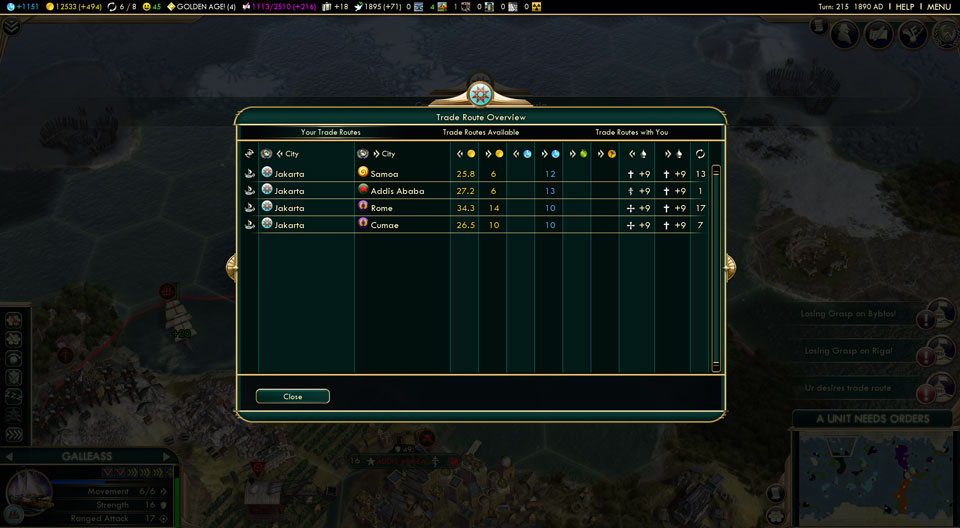
Go into the Trade Route Overview to learn about all of the routes that are possible in your area. This screen lets you look at your routes, foreign routes that connect to your empire, and potential routes within the areas that you've explored.
Sort the routes by Gold income to find out what would be the most profitable. That's a good way to start looking for people to trade with.
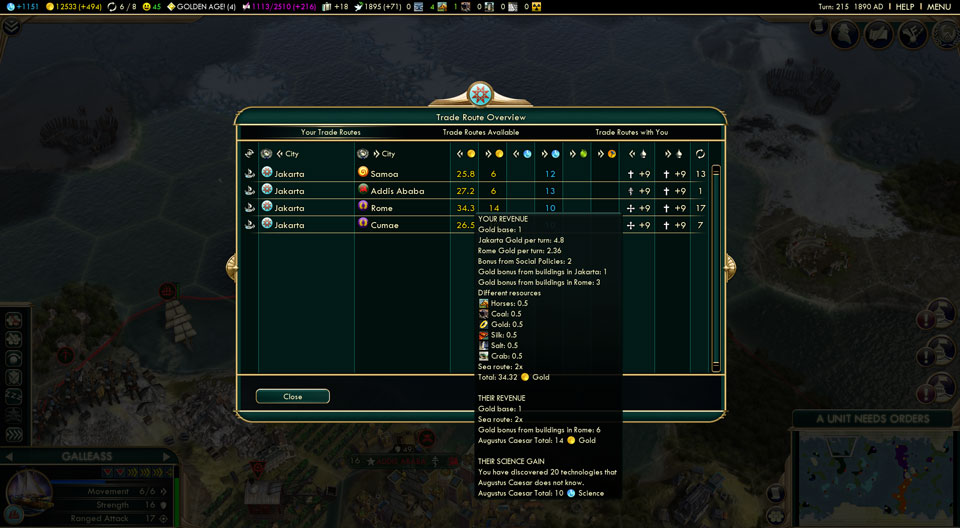
Even while you're doing that, start thinking about why different routes have better values. This lets you learn how to get more out of your trade empire in the future. Highlight the amount of Gold on a trade route. This reveals a breakdown of the routes worth. It's an enlightening experience because you see which parts of a city are contributing toward its value.
Once you learn what to build and which tiles to improve, do your best to enhance your trade cities and increase their profitability!
How to Increase a City's Trade Value
- Improve any tiles with Luxuries or Strategic Resources
- Found cities beside a river (+25% value) or on the coast (+100% value!)
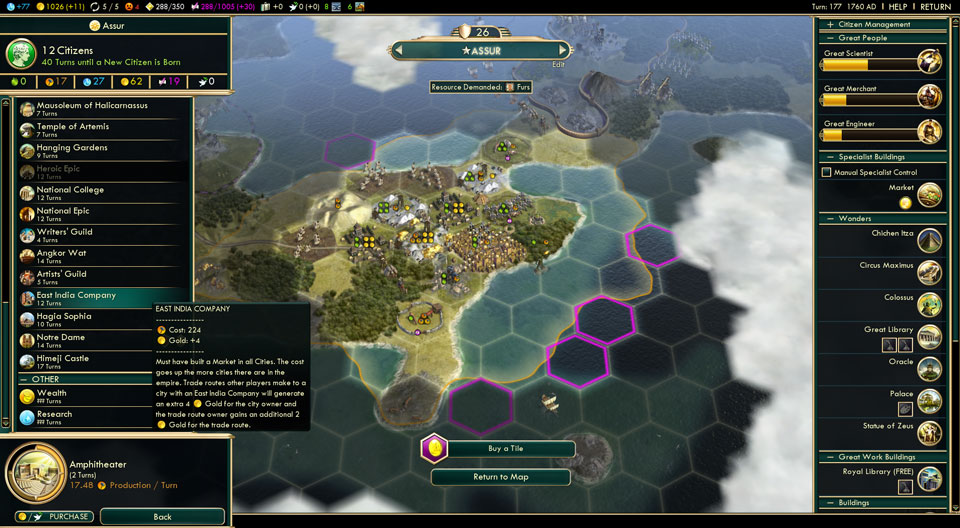
- Construct trade buildings (Caravansary, Harbor, Market, Bank) to increase trade range and route values
- Enact Policies to raise Trade Route values (Commerce→Wagon Trains, Exploration→Treasure Fleets)
- Research better Technology to improve goods exchanged domestically (each Era raises the amount of goods that are exchanged this way)
Trade Route Duration
While looking in the Trade Route Overview, you'll notice a countdown timer on each route. That tells you how long until the trade unit comes back to your city and can be reassigned without any problems or diplomatic penalties. Until that elapses, you cannot cancel an existing route except through extraordinary means. War severs trade routes between opponents, and the World Congress may enact Resolutions that sever trade to a specific nation or to all City-States.