
Assassin's Creed: Brotherhood Guide Essentials Primer
Essential Gameplay Concepts
Basic Movement
As with other games in the series, Assassin's Creed Brotherhood divides actions into "Low Profile" and "High Profile" categories, with a specific button trigger to switch easily between the two.
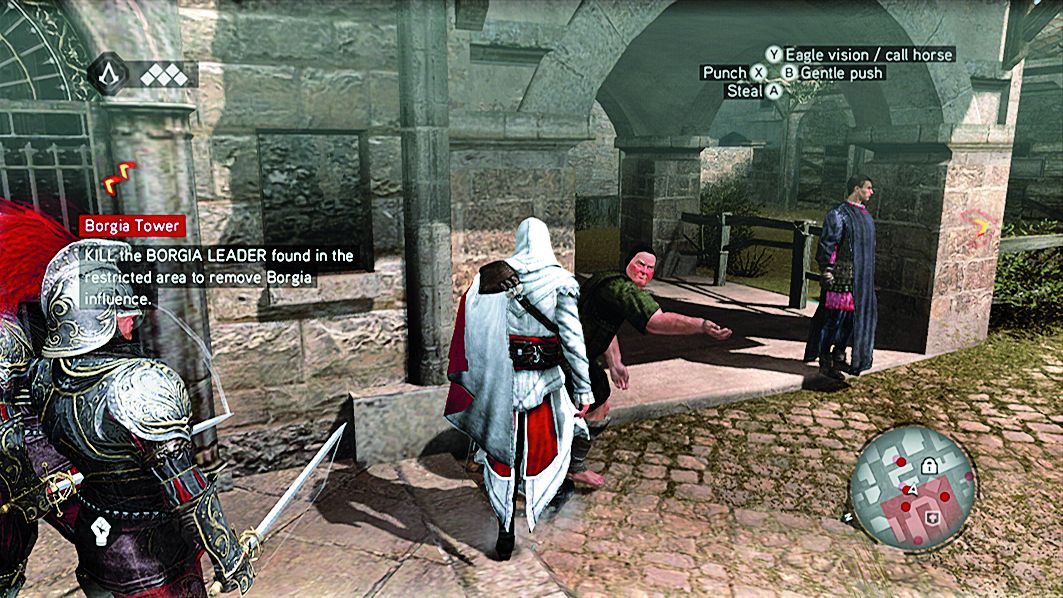
This feature works in tandem with the contextual Controls HUD that appears in the top right-hand corner of the screen (Fig. 1).
This isn't a game where you will find yourself regularly scrabbling to recollect which button press does what: a quick glance at the onscreen display will give you the prompt you require. In time, though, you won't even need or notice it.
01
Low Profile activities include walking, gently pushing through a crowd and interacting with vendors – actions, in short, that are unlikely to distinguish Ezio as a threat or attract unwanted attention.
High Profile activities include climbing, free running and acts of violence, and may provoke a variety of responses from those who witness them.
When discretion is directly called for (such as when a task or scenario requires Ezio to avoid the gaze of vigilant eyes), it's usually prudent to restrict your movements to Low Profile mode.
However, as walking between destinations is obviously impractical, you'll regularly hold the High Profile button (
 /
/
 by default) in order to break into a sprint and slalom through crowds at street level, scale a wall, then free run over the rooftops to take a more direct route to your next port of call.
Free running is a simple joy that never seems to pall – which is fortunate, as you'll be doing an awful lot of it.
For those who have yet to play a game in the Assassin's Creed series, it's important to understand that this is not a platform game – at least, not in the classic sense.
There isn't a formal jump button, nor a need (for the most part) to manually instruct Ezio to catch a particular hand-hold.
As there is no emphasis on regularly punishing players for ill-timed button presses, you will find that actually steering Ezio becomes second nature with relatively little practice.
Your role, in effect, is to direct him – to act as a navigator, plotting the most efficient route from A to B (and, frequently, to escape the attentions of pursuing aggressors C, D, E, F and G).
The trick to achieving consistently fluid, decisive movement isn't to focus on where Ezio actually is, but where he will be.
Assassin's Creed Brotherhood has a distinct "visual language" in its architecture that you'll gradually learn to interpret instinctively as you bound over rooftops, scale walls and effortlessly vault obstructions.
With practice, especially as you become more familiar with Ezio's athletic prowess and the environment around him, you'll acquire the knack of planning discrete steps in your journey several seconds in advance.
Life as an Assassin
Though certain missions directly call for Ezio to remain anonymous, you will often enjoy a relatively high degree of freedom in how you choose to complete objectives.
There's a hint of roleplay to it, but many players will find it more satisfying and rewarding to minimize the body count where appropriate, remaining unseen or overlooked during the journey to the destination marker and executing an objective with clinical precision.
That said, unless directly prohibited, you can also opt to bludgeon your way to the same outcome.
This approach can be equally enjoyable, but there is a price to pay: once it becomes active later in the story, the Notoriety system (as seen in Assassin's Creed II) acts as a subtle deterrent to raw aggression in instances where it is not explicitly required.
Leave a trail of bodies in your wake, and Ezio will become Notorious – and, therefore, actively sought after by city guards. This makes the process of travelling between destinations much more complicated.
No matter your general approach, you will regularly encounter instances where Ezio must, ideally, avoid attention.
If he is trespassing, travelling through an area controlled by his enemies, or a current target for a specific faction or the local soldiery, it's prudent to stay out of direct sight.
Common-sense rules apply at all times; for example, bounding from pillar to post in a public thoroughfare will attract awe and apprehension from nearby members of the general populace, and might invite the ire of Ezio's enemies.
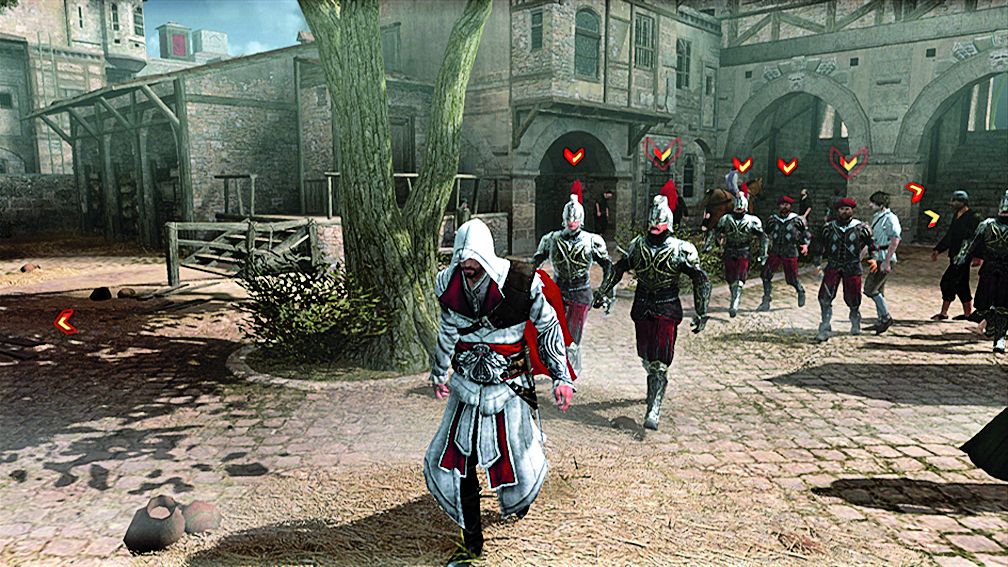
There are onscreen and audio prompts that signpost growing suspicion in nearby aggressors (Fig. 2), or a heightened awareness of Ezio's presence that (usually) foreshadows imminent hostilities.
When combat is necessary or unavoidable, you will find that Ezio rarely fights a single adversary at a time.
The majority of battles pit him against several opponents who may possess varied weapons and tactical inclinations, which necessitates an ability to formulate and execute ad-hoc strategies.
A successful confrontation is almost always swift and conclusive – and so introducing new ways to beat opponents decisively is a major feature of the Walkthrough chapter.
02
Indeed, as Ezio's range of skills and the challenges he faces expand throughout the story, you will learn that there are many opportunities to improvise, or express yourself in unique ways.
Our Walkthrough chapter will help you to understand each new game feature as it is introduced. What's more, once you're safely through the main story, you can study the Reference & Analysis chapter to learn more about what makes the game tick.
Death
Though the Assassin's Creed Brotherhood story focuses primarily on Ezio, players are – strictly speaking – playing the role of Desmond Miles who, in turn, is experiencing his ancestor's life as a genetic memory accessed via a high-tech device known as the Animus.
Success or failure rests on your ability to maintain Desmond's "Synchronization" with Ezio.
Diverging too radically from the true course of events in Ezio's history causes Synchronization to be lost – which, in pure gaming terms, sends you back to a previous checkpoint or nearby landmark.
The following conditions all lead to a loss of Synchronization, and should be avoided wherever possible:
03
- Death: This occurs whenever all blocks of Ezio's Health Meter (displayed in the top left-hand corner of the screen) have been depleted, and is generally due to injuries sustained during combat or by falling from great heights.
- Failed objectives: Desmond (and, therefore, you the player) must experience Ezio's life with a degree of precision. Failing to comply with mission parameters may lead to a return to a previous checkpoint, or necessitate a restart from the beginning.
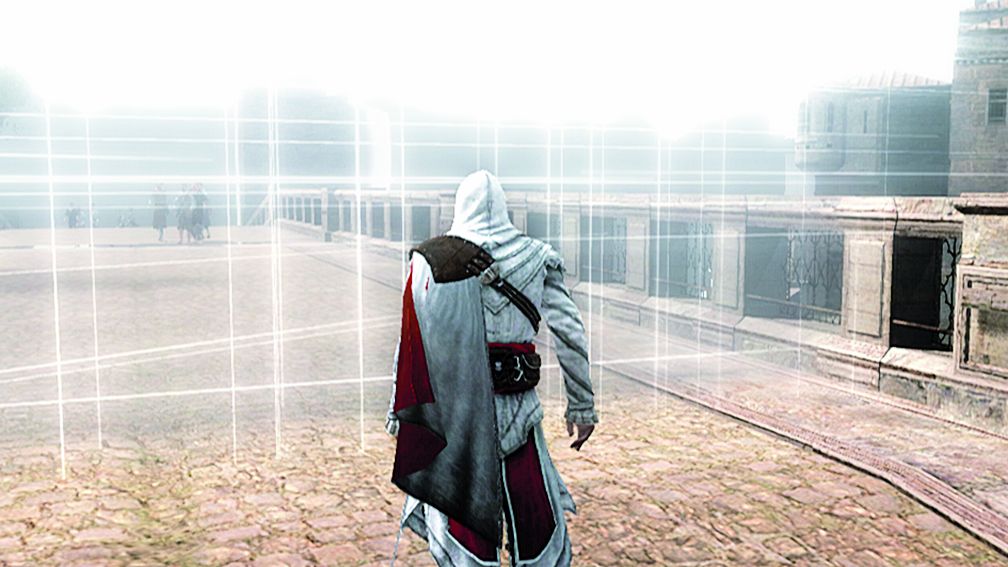
- Moving out of bounds: Attempting to visit a specific locale before the appropriate time (or moving outside the confines of a current mission area) can cause a loss of Synchronization. There is a clear visual cue that warns whenever you approach such boundaries (Fig. 3). Take heed, and move away swiftly.
- Aberrant behavior: Ezio may be a killer, but he's no butcher. If you attack allies or civilians indiscriminately, Desynchronization can be swift. There is, of course, a little leeway – accidentally striking the wrong individual during a pitched street brawl won't usually result in serious repercussions.
Game Structure
As with previous episodes in the series, Assassin's Creed Brotherhood begins with a linear sequence of missions that gradually introduce gameplay concepts, abilities and different styles of challenges.
For newcomers, the low difficulty of these opening tutorials offers a great opportunity to experiment and get a good feel for the game.
More experienced players can treat these sections as a quick refresher course, and speed through them with commensurate haste and confidence.
After a time (which, to avoid spoilers, we'll be suitably vague about here), the Brotherhood sandbox begins to open up.
In addition to main story missions, you will encounter a vast wealth of side quests, minigames and incidental challenges.
The majority of these are purely optional, and are not necessary to complete the central storyline. However, these "secondary memories" can enable you to make Ezio wealthier – and, as a consequence, stronger and better equipped.
As with Assassin's Creed II, progress in the main story eventually unlocks a management metagame where you can invest accumulated florins (" f ", the in-game currency) in restoring aspects of Rome's dilapidated infrastructure.
Ezio will then receive a dividend at regular intervals. Though the initial costs may seem high, the ultimate rewards are far greater.
Completing side quests and pouring the profits from Ezio's labors back into Rome is the only realistic way to afford all equipment and items. What's more, there are also a number of noteworthy completion bonuses to obtain.
There is no right or wrong way to approach optional objectives in Assassin's Creed Brotherhood, but there's certainly an ideal path.
Throughout the interlinked Walkthrough and Side Quests chapters we present a considered route to full game completion, with an emphasis on minimizing unnecessary effort and maximizing potential profit.