
Men of War: Condemned Heroes Guide Essentials Vehicles
Medium Tanks
Medium tanks were the workhorses of the war. Many could be used to engage other tanks, as well as fight against infantry. Their armor gave them protection against light tanks, scout vehicles, and lower caliber anti-tank guns. As the war progressed, medium tanks became more thickly armored and began wielding larger caliber guns.
Russian
T-34/57
|
Crew Size |
Main Gun |
MGs |
Speed |
10m |
30m |
70m |
150m |
Reload Time |
Hull Frontal |
Hull Side |
Hull Rear |
Hull Top |
Turret Frontal |
Turret Side |
Turret Rear |
Turret Top |
|---|---|---|---|---|---|---|---|---|---|---|---|---|---|---|---|---|
|
4 (8) |
57mm ZIS-4 |
Coax, Hull |
35 |
114 |
108 |
83 |
42 |
5 |
45 |
45 |
45 |
22 |
52 |
52 |
52 |
20 |
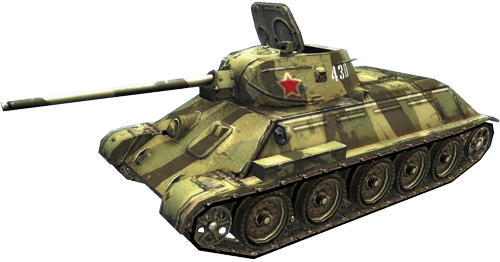
Between 1941 and 1943, some T-34 units were equipped with the high velocity 57mm ZIS-4 gun for use as a tank destroyer. Although it had more penetration capacity than previous models, the caliber of its projectiles allowed it to use the explosive charge needed to efficiently attack unarmored targets.
The T34/57 was effective at fighting against the German Panther and Tiger I tanks by attacking their less well-armored flanks. The lower cost of Soviet tanks allowed them to achieve numerical superiority over their enemies. They could also successfully confront Panzer III and IVs, but it was more profitable to keep the T-34/57s for attacking the better armed enemy tanks.
T-34/76
T-34 76_ISO.psd
|
Crew Size |
Main Gun |
MGs |
Speed |
10m |
30m |
70m |
150m |
Reload Time |
Hull Frontal |
Hull Side |
Hull Rear |
Hull Top |
Turret Frontal |
Turret Side |
Turret Rear |
Turret Top |
|---|---|---|---|---|---|---|---|---|---|---|---|---|---|---|---|---|
|
4 (8) |
76mm L11 |
Coax, Hull |
35 |
66 |
61 |
43 |
21 |
6 |
45 |
45 |
45 |
22 |
52 |
52 |
52 |
20 |
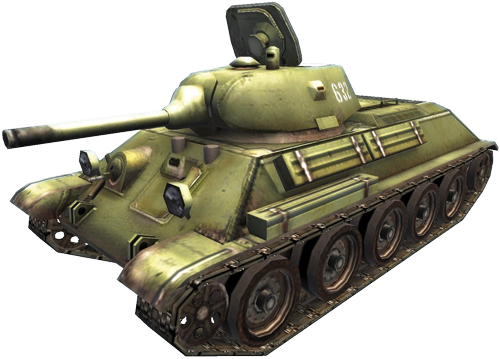
In October 1937, Factory No. 183 (called the Kharkov Tractor Factory or KhTZ before 1936) was engaged to develop a wheel-track tank with which to replace the vehicles of the BT-7 series. Further upgrade of the BT-7 hull was senseless; therefore, the tank with the factory designation BT-20 was designed from scratch, borrowing only the general layout and suspension type from its predecessor. The tank prototype designated A-20 was produced in May of 1939. Parallel to it, two prototypes of the A-32 tanks were built as a matter of initiative (on behalf of Mikhail Ilyich Koshkin, the chief designer of Factory No. 183), which represented a pure track version of the A-20. The two tanks also differed in their armament: the A-20 had the 45mm gun, whereas the A-32 had the 76mm L-10 gun. The high dynamic characteristics of the A-32 proved that Koshkin was right, and the acceptance committee approved the development of the new version of the tank with the 10mm armor increase.
The first two prototypes of the upgraded version of the A-32, designated the A-34, were produced in January andFebruary of 1940. These two vehicles became famous due to a rally from Kharkov to Moscow in March the same year. Koshkin, who was taking part in the rally, caught a bad cold and died in September of 1940. By then, his brainchild had entered service under the designation T-34. Like the A-34, the new vehicle was armed with the 76mm L-11 gun, and this was the first time such a class of a gun had beeninstalled on a medium tank. The T-34 tanks were to be produced at two factories (Factory No. 183 and the Stalingrad Tractor Factory, or STZ) but the production process took long time to implement at STZ, so the tanks were mostly produced in Kharkov (117 vehicles in 1940). There were about four hundred T-34 tanks with the L-11 gun produced by March of 1941, which are generally known under the designation “T-34, 1940 Version.”
In March of 1941, the production of the T-34 began with the 76mm F-34 gun. This was the basic modification of the T-34 by the time Germany attacked the USSR. A total of 1,225 tanks had been produced by July 1, 1941, STZ having manufactured 294 tanks and Factory No. 183 accounting for the other 931. The production of the T-34 tanks continued at Factory No. 183 through October, producing a total of 755 tanks.
When the T-34 appeared, it was the best tank in its class. The hull of the T-34 provided good protection against shells because of its sloped armor plates, while its powerful gun was able to hit enemy tanks at any distance. It did, however, have a lot of weaknesses. The turret, which had seen little changes from the time of the A-20, was narrow and could only house two crewmembers. Thus, in addition to his direct duties, the commander also had to work as a loader. The turret had visibility problems, and the front armor plate was weakened by the driver’s hatch installed in it (this weakness was only removed on the T-44). On top of that, the service life of the tank engine was only 150 hours. Despite all its weaknesses, the T-34 had one major strength: it was capable of fighting enemy tanks while remaining out of reach of enemy shells.
T-34/76 (43)
T-34 76 (43)_ISO.psd
_iso_copy.png)
|
Crew Size |
Main Gun |
MGs |
Speed |
10m |
30m |
70m |
150m |
Reload Time |
Hull Frontal |
Hull Side |
Hull Rear |
Hull Top |
Turret Frontal |
Turret Side |
Turret Rear |
Turret Top |
|---|---|---|---|---|---|---|---|---|---|---|---|---|---|---|---|---|
|
5 (9) |
76mm F34 |
AA, Coax, Hull |
35 |
82 |
77 |
56 |
26 |
6 |
47 |
47 |
47 |
22 |
70 |
52 |
52 |
20 |
Starting from summer and fall 1942, several factories began to produce the T-34 tanks with an “improved turret” developed by designer Nabutovsky. Its production technology was more efficient, although the turret itself remained as narrow as the previous one. It was nicknamed a “screw-nut” for its shape. Tanks with such turrets were known under the designation “T-34, 1942 Version” even though they were manufactured in the same configuration during 1943, as well.
In the spring of 1943, the T-34 produced by Factory No. 183 received a commander’s cupola. It’s noteworthy that the commander’s cupola was to appear on the A-43 (T-34M) tanks as early as the summer of 1941, but the work was halted due to the beginning of the war. The tanks manufactured by Factory No. 183 also received additional fuel tanks, and some changes concerning the hull were introduced. In this altered configuration, the tank is known as “T-34, 1943 Version,” although this designation is not quite correct. With some minor changes Factory No. 183 was producing this version through the spring of 1944. Also, it would be more correct to say “T-34 produced in 1943” for it is a thankless task to try and count all of the T-34 variants. The exact number of T-34 tanks with commander’s cupolas produced by Factory No. 183 is unknown; one can only say that the factory manufactured 7,766 and 1,838 tanks in 1943 and 1944, respectively. The total number of T-34 tanks produced by all the factories in 1943 was 15,833.
The “T-34, 1943 Version” appeared at the time when the German troops started receiving the Pz.Kpfw.IV Ausf.H, Pz.Kpfw.V Panther Ausf.D, and Pz.Kpfw.IV Ausf.H1 Tiger tanks. These tanks enjoyed better armor protection and more powerful guns than the T-34. The 76mm shells fired from the F-34 guns were efficient against the new enemy tanks only at a distance of less than half a kilometer, while a point-blank shot was needed to destroy the Pz.Kpfw.VI Ausf.H1. In short, the vehicle (especially its armament) needed a serious upgrade.
T-34/85
T-34 85_ISO.psd
|
Crew Size |
Main Gun |
MGs |
Speed |
10m |
30m |
70m |
150m |
Reload Time |
Hull Frontal |
Hull Side |
Hull Rear |
Hull Top |
Turret Frontal |
Turret Side |
Turret Rear |
Turret Top |
|---|---|---|---|---|---|---|---|---|---|---|---|---|---|---|---|---|
|
5 (9) |
85mm ZIS-53 |
AA, Coax, Hull |
33 |
132 |
127 |
95 |
46 |
6.5 |
47 |
45 |
45 |
22 |
90 |
75 |
75 |
20 |
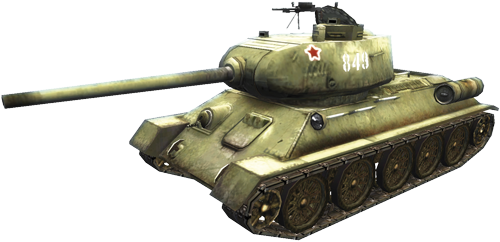
The first attempts to create a more powerful gun for the T-34 were made as early as 1942, but the real work began in early 1943. The results of the shooting tests carried out with the Pz.Kpfw.VI Ausf.H1 Tiger captured in early 1943 showed that the 85mm 52-K anti-aircraft gun (1939 version) was the most efficient. Almost at the same time, the development of the 85mm D-5T tank gun began. The D-5T gun was primarily intended for the KV-85. Tests showed that the standard turret of the T-34 was not suitable to accommodate the D-5T. It is noteworthy that Factory No. 112 was simultaneously developing a new turret with a support ring of 1,600mm in diameter. This turret resembled the one installed on the prototype of the T-43 in many ways. The tank with the D-5T gun and new turret is frequently called the “T-34/85, 1943 Version.” The tank produced by Factory No. 112 differed from the more numerous T-34/85 versions by having a two-man turret. A total of 250-300 tanks of this type were produced.
On January 1, 1944, the 85mm S-53 gun entered service. This had an easier design that that of the D-5T. The gun was installed in the turret produced by Factory No. 183, which finally became a three-man turret. This tank entered service under the designation T-34/85 and its full-scale production began in March of 1944. It should be mentioned that Factory No. 112 started to manufacture the Т-34/85 with new turrets and the D-5T guns in February of that year. The tanks armed with the 85mm S-53 gun had characteristic bulges along the gun mantlet sides. Since late October 1944, the Т-34/83 tanks started to be equipped with an upgraded version of the gun known under the designation ZIS-S-53. The gun mantlets of the tanks with ZIS-S-53 lost the bulges characteristic of the S-53. A total of 23,000 Т-34/85 tanks were produced in 1944-45.
Thanks to its new gun, the Т-34/85 could vie with the latest Pz.Kpfw.IV tanks, which were the Wehrmacht’s primary tanks since 1943. The turret became slightly more spacious, which somewhat improved work conditions for the crews. At the same time, the armor protection remained at the same level, along with of its weaknesses. For example, the hull front armor plate was weakened because of the driver’s hatch and the installation of a bow machine gun. Also, continuous enemy tank armor upgrades made it obvious that the power of the 85mm ZIS-S-53 gun would not suffice for long. However, these weaknesses did not prevent the Т-34/85 from becoming the most numerous medium tank during the final period of WWII, and also from remaining in service for many decades (there are some places where these tanks are still in service).
German
PzKpfw III Ausf. J
|
Crew Size |
Main Gun |
MGs |
Speed |
10m |
30m |
70m |
150m |
Reload Time |
Hull Frontal |
Hull Side |
Hull Rear |
Hull Top |
Turret Frontal |
Turret Side |
Turret Rear |
Turret Top |
|---|---|---|---|---|---|---|---|---|---|---|---|---|---|---|---|---|
|
5 (9) |
50mm KwK 39 |
AA, Coax, Hull |
27 |
99 |
88 |
49 |
19 |
4 |
50 |
30 |
50 |
22 |
50 |
30 |
30 |
10 |
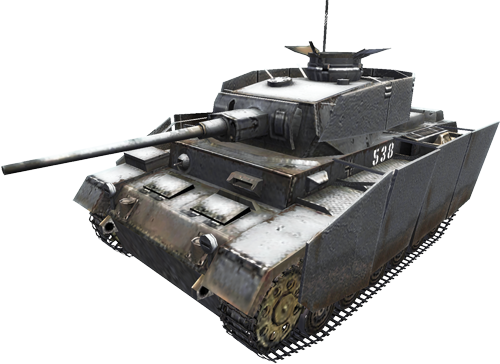
The arrival of the Soviet T-34 at the eastern front compelled the German Army to accelerate development of the Panzer III. Between 1941 and 1942, 1,500 units of the Ausf.J were manufactured, which included the 50mm KwK 39 gun. This gun was longer, more accurate, and had greater penetration capacity than its predecessor.
Furthermore, in the Ausf. J the front and rear hull armor were replaced with 50mm steel plates. In addition, armor plates were installed, spaced on the turret and hull to protect from Russian anti-tank rifles, and a new and powerful 320 HP engine was added (90 HP more than its predecessors).
In 1943 the Panzer III was relegated to support missions, and the lead role was transferred to the Panzer IV and Panther.
The Panzer III Ausf. J was an excellent medium tank with the capacity to destroy other, better armed and armored medium tanks such as the Soviet T-37 and the American M4 Sherman. Its powerful engine allowed it to reach higher speeds than previous models and gave it excellent mobility. Specifically, this tank needed speed in order to survive, but due to the reinforced hull armor, its straight, uninclined plates offered little protection against the enemy's tank weapons and heavy guns, and its side armor was unsuitable for confronting any contemporary anti-tank weapon.
PzKpfw IV Ausf. E
|
Crew Size |
Main Gun |
MGs |
Speed |
10m |
30m |
70m |
150m |
Reload Time |
Hull Frontal |
Hull Side |
Hull Rear |
Hull Top |
Turret Frontal |
Turret Side |
Turret Rear |
Turret Top |
|---|---|---|---|---|---|---|---|---|---|---|---|---|---|---|---|---|
|
5 (9) |
75mm Kwk 37 |
AA, Coax, Hull |
27 |
52 |
48 |
38 |
22 |
6 |
50 |
30 |
20 |
22 |
60 |
20 |
20 |
20 |
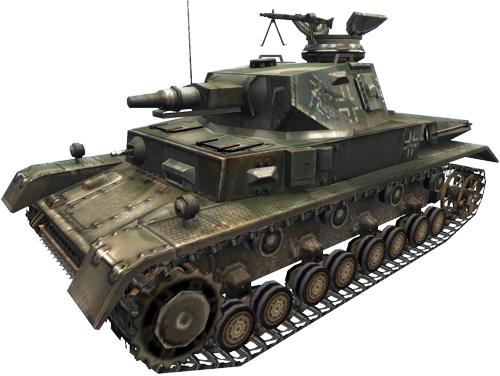
Until the development of the Ausf.F1 model, all versions had the KwK 37 L/24, a short 75mm gun, which fired high explosive ammunition against anti-tank guns, barricades, and scarcely protected positions. However, it showed a lack of accuracy, a low projectile speed, and only average penetration capacity.
Fulfilling its support tank role, it could not fight face to face against medium tanks as the main gun did not have sufficient penetration capacity.
However, that same gun allowed it to attack enemy gun emplacements that were firing in low parabolas over small hills and obstacles on the ground behindwhich they could hide without exposing themselves to hostile fire. And with a little bit of luck, it could hit the upper part of an enemy tank, where the armor was weaker. The speed of movement of the Panzer IV was slightly inferior to that of the Panzer III and comparable to that of the Soviet T-34, which allowed it to move rapidly in order to remain undercover and continue providing support to its infantry units.
PzKpfw IV Ausf. G
|
Crew Size |
Main Gun |
MGs |
Speed |
10m |
30m |
70m |
150m |
Reload Time |
Hull Frontal |
Hull Side |
Hull Rear |
Hull Top |
Turret Frontal |
Turret Side |
Turret Rear |
Turret Top |
|---|---|---|---|---|---|---|---|---|---|---|---|---|---|---|---|---|
|
5 (9) |
75mm Kwk 40 L/43 |
AA, Coax, Hull |
27 |
112 |
108 |
88 |
47 |
6 |
50 |
30 |
20 |
22 |
50 |
30 |
30 |
10 |
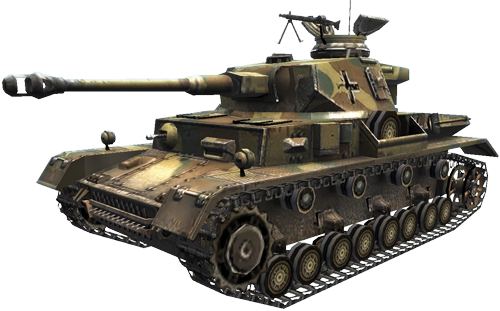
June, 1941. The German Army confronted Soviet tanks for the last time and proved that the T-34, with its 45mm inclined armor favoring the rebound of impacting projectiles, and the KV-1, with its 100mm front armor, were difficult to defeat.
In November of that same year, the manufacture was ordered for a gun equivalent in performance to the PaK 40 anti-tank gun, to be installed in the Panzer IV, whose turret could house a superior weapon. In March, 1942, the first units under the name of Panzer IV Ausf.F2 came to light, but soon after entering service they were rechristened as Ausf.G.
Given its excellent performance against the Sherman and the allied T-34, its low cost, and its mechanical reliability, production of the Panzer IV continued even after the Panther medium tank (which was better armored and armed) entered service.
In short, the Panzer IV Ausf.G was an example of excellent German engineering, with an exceptional balance between armament, armor, and mobility. It could carry out tank support tasks to the infantry and destroy medium tanks, even though its uninclined front armor continued to make it vulnerable to large caliber anti-tank weapons such as the previous models.
PzKpfw IV Ausf. H
|
Crew Size |
Main Gun |
MGs |
Speed |
10m |
30m |
70m |
150m |
Reload Time |
Hull Frontal |
Hull Side |
Hull Rear |
Hull Top |
Turret Frontal |
Turret Side |
Turret Rear |
Turret Top |
|---|---|---|---|---|---|---|---|---|---|---|---|---|---|---|---|---|
|
5 (9) |
75mm Kwk 40 L/48 |
AA,Coax, Hull, Rear |
24 |
123 |
117 |
92 |
48 |
6 |
80 |
30 |
20 |
22 |
50 |
30 |
30 |
10 |
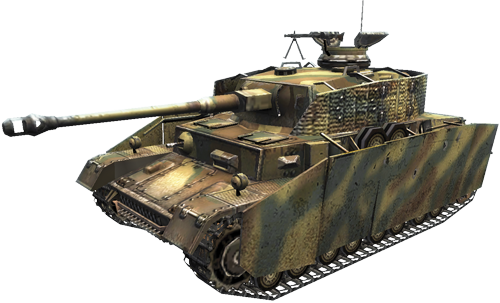
The Panzer IV Ausf.H included the KwK 40 L/48 gun, which was double the length of its predecessor with, thanks to the projectile exit velocity (790 m/s), a considerably increased penetration capacity and firing range.
Compared with the G model, the new front armor of the Ausf.H notably increased its capacity for survival, and its new gun increased the probability of causing damage at medium distance and reaching targets located even further away. However, the turret armor plating did not show any improvement, and therefore an impact in that area could render its main weapon useless and leave the vehicle defenseless.
PzKpfw V Panther
|
Crew Size |
Main Gun |
MGs |
Speed |
10m |
30m |
70m |
150m |
Reload Time |
Hull Frontal |
Hull Side |
Hull Rear |
Hull Top |
Turret Frontal |
Turret Side |
Turret Rear |
Turret Top |
|---|---|---|---|---|---|---|---|---|---|---|---|---|---|---|---|---|
|
5 (9) |
75mm Kwk 42 |
AA,Coax, Hull, Rear |
34 |
159 |
151 |
121 |
51 |
6 |
85 |
50 |
40 |
22 |
110 |
45 |
45 |
16 |
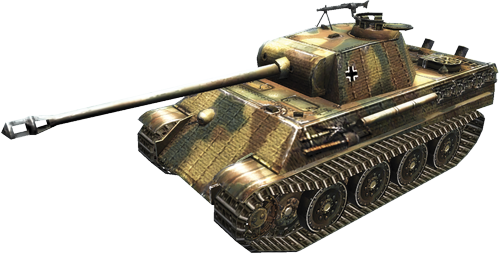
In September of 1942, line production began of the Panzerkampfwagen V Panther, the tank designed in response to the powerful Soviet T-34. The German engineers opted to equip the Panther with the main features of the enemy tank: inclined armor, wide caterpillar tracks and larger wheels to improve mobility on the soft ground of the Russian winter, and a large caliber gun.
Germany assigned maximum priority to the production of this vehicle, involving several factories from different companies. In 1943, an average of 150 units were manufactured per month (380 in July) and the total number of units produced by March of 1945 was 6,000.
The first models had a 60mm smooth steel, welded armored plate, with an increase to 80mm on the front part. In addition, the hull was covered in zimmerit, an anti-magnetic material, which gave it its unmistakable rough appearance.
Excellent as tank destroyers, the Panthers could use their mobility and excellent battle gun to destroy any medium tank with only a single shot, or to surround heavy tanks with the objective of attacking their vulnerable flanks. Their only weak point was their limited side armor, which made it advisable for them not to confront two threats located in different positions.
The Panther was considered one of the best tanks of World War II. In fact, once the conflict ended, the excellent combination of mobility, firepower, and protection continued to inspire the design of new tanks.