
Men of War: Condemned Heroes Guide Essentials Vehicles
Heavy Tanks
As medium tank guns were upgraded during the war, both the Germans and Soviets began building heavy tanks. Mounting even larger caliber guns atop very thick armor, these slow moving behemoths were difficult to destroy unless hit from the side or rear. However, their slow speed gave medium tanks with higher mobility an advantage, as they would try to maneuver around the heavy tanks.
Russian
IS-1
|
Crew Size |
Main Gun |
MGs |
Speed |
10m |
30m |
70m |
150m |
Reload Time |
Hull Frontal |
Hull Side |
Hull Rear |
Hull Top |
Turret Frontal |
Turret Side |
Turret Rear |
Turret Top |
|---|---|---|---|---|---|---|---|---|---|---|---|---|---|---|---|---|
|
4 (13) |
85mm ZIS-53 |
Coax, Hull, Rear |
24 |
132 |
127 |
95 |
46 |
6.5 |
90 |
90 |
75 |
40 |
100 |
100 |
100 |
40 |
In 1942, the KV-1, slow and not well armed, was the only heavy Soviet tank. The medium T-34 tank and its successive improvements exceeded its performance, as it was cheaper, more easily manufactured, and more efficient in combat. This being the case, the Red Army was about to reject the development of new heavy tanks, but the appearance of the German Panthers and Tigers forced a change of view. A new tank was quickly designed which could carry a high velocity 85mm D-5T gun. The need to immediately counteract the power of the new German tanks brought about the KV-85, an intermediate model that included the new turret with the 85mm gun and the old chassis of the KVs. Meanwhile, the final design of the new heavy tank continued under the name KV-13. As the military man Kliment Voroshilov had fallen into disgrace, the new series of heavy tanks got the name IS in honor of the Soviet Prime Minister, Iósif Stalin.
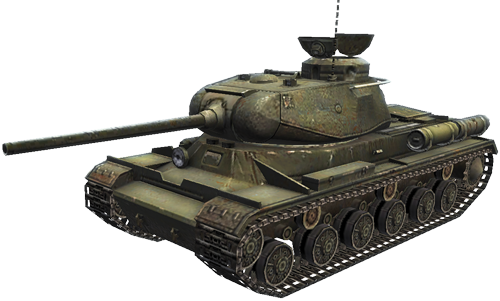
The IS-1 was the prototype of a new generation of tanks. It was never mass-produced, and only 130 units were made. However, it served as a base for testing the IS-2. Compared with the KV-85, the IS-1 mounted the same heavily armored turret and the same 85mm gun with great penetration capacity (which was slightly better than the 75mm gun mounted on the Panzer IV Ausf.H, but surpassed by the new German weapons added to the Tiger I and Panther). Following the KV doctrine, the hull armor was almost 100mm thick in the front. The side armor was better than that of the KV-1. The vehicle was driven by a 520-horse diesel engine and provided the tank superior mobility to the KV-85, despite the fact its tonnage was greater. The IS-1 could carry out the same tasks as the KV-85, and it could better withstand frontal attacks, which meant that it did not have to depend so much on the coverage offered by terrain.
IS-2
|
Crew Size |
Main Gun |
MGs |
Speed |
10m |
30m |
70m |
150m |
Reload Time |
Hull Frontal |
Hull Side |
Hull Rear |
Hull Top |
Turret Frontal |
Turret Side |
Turret Rear |
Turret Top |
|---|---|---|---|---|---|---|---|---|---|---|---|---|---|---|---|---|
|
5 (9) |
122mm D25 |
AA,Coax, Hull, Rear |
24 |
167 |
159 |
137 |
61 |
15 |
120 |
90 |
60 |
30 |
100 |
90 |
60 |
20 |
In January, 1943, following the capture of a German Tiger I at the Battle of Kursk, the Red Army carried out several firing tests on the tank using different guns. The results showed that the 85mm anti-aircraft guns and the 122mm anti-tank gun could penetrate the armor.
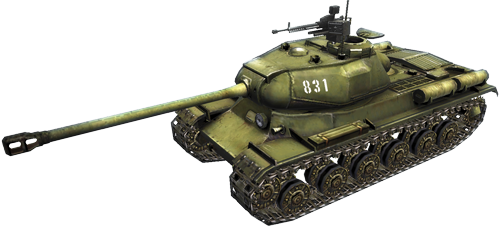
The pressure of time brought about the creation of tanks with 85mm guns, which gave rise to the KV-85 and IS-1. However, the 122mm gun was chosen as the main weapon for the new heavy Soviet tank, the IS-2, as it had to compete in the same conditions against the German Tigers and Panthers.
With the incorporation of the IS-2, the Soviets had a tank that could surpass the Tiger I and Panther in combat, even though the latter continued to be more rapid and more maneuverable. The IS-2 could destroy the Panther from long distances before the German weapon could effectively penetrate its front armor.
However, the massive 122mm gun, although superior in firepower to the German 88 and 75mm guns, was not exempt from problems. On increasing the size of the ammunition fired, the number of cartridges that could be transported by the tank was drastically reduced. Additionally, the ammunition of the D-25T gun was stored with the projectile separated from the powder charge. The loader had to join both parts before each reload, which, along with the huge weight of the projectile, meant very high loading times and a rate of fire that was considerably lower than that of the Panther and Tiger guns.
IS-3
|
Crew Size |
Main Gun |
MGs |
Speed |
10m |
30m |
70m |
150m |
Reload Time |
Hull Frontal |
Hull Side |
Hull Rear |
Hull Top |
Turret Frontal |
Turret Side |
Turret Rear |
Turret Top |
|---|---|---|---|---|---|---|---|---|---|---|---|---|---|---|---|---|
|
5 |
122mm D25 |
AA,Coax, Hull, Rear |
24 |
167 |
159 |
137 |
61 |
15 |
120 |
90 |
60 |
40 |
160 |
160 |
160 |
40 |
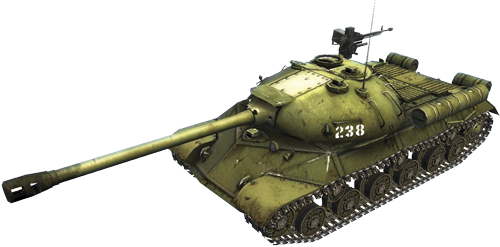
In 1944, the Soviet Union improved the design of the IS-2 by redistributing the armor in order to achieve better protection without adding weight to the vehicle. The front of the hull was modified by adding new angles favoring the rebound of enemy projectiles towards the sides and not towards the tank itself. But the main change was the new, lowered dome-shaped turret, whose inclination and rounded shape increased its protection far beyond the standards for the time.
The first prototype was manufactured in 1945 but the only participation of this tank in the Second World War took place in Berlin on September 7, at the allied victory parade. Unconfirmed reports indicated that a regiment of IS-3s was deployed to Manchuria against the Japanese. In any case, despite having participated in few real operations, the IS-3's hull configuration and turret greatly influenced subsequent Soviet tanks, such as the T-55, and its influence can still be seen in the modern T-72 and T-90.
The IS-3 had the same 122mm gun as the IS-2, a model that was problematic due to its low ammunition supply and long reload times. However, the tank only had one coaxial machine gun and one heavy machine gun mounted on the commander's cupola, which allowed the crew to open fire in any direction. This meant that the IS-3 was more useful in heavy tank destroying tasks than in support tasks against enemy infantry.
In spite of its great advantages, the IS-3 was not invulnerable. The high velocity guns mounted on the German Tiger II heavy tanks and the Japanese Chi-RI, or the large tank destroyers such as the Jagdpanther, the Elefant, or the Ho-RI, could penetrate its front armor at medium distances in combat. Other enemy weapons had to be satisfied with hitting its sides or destroying its tracks, keeping the IS-3 busy.
KV-1
|
Crew Size |
Main Gun |
MGs |
Speed |
10m |
30m |
70m |
150m |
Reload Time |
Hull Frontal |
Hull Side |
Hull Rear |
Hull Top |
Turret Frontal |
Turret Side |
Turret Rear |
Turret Top |
|---|---|---|---|---|---|---|---|---|---|---|---|---|---|---|---|---|
|
4 (13) |
76mm F32 |
Coax, Hull, Rear |
21 |
72 |
68 |
48 |
21 |
6 |
100 |
100 |
75 |
40 |
75 |
75 |
60 |
35 |
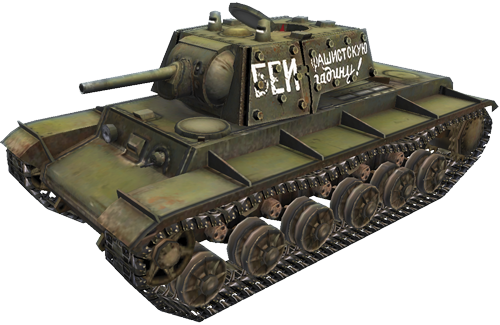
On June 22, 1941, the German attack on Soviet troops occurred. At that time, the Red Army had 508 KV tanks. Thanks to its extraordinary armor, the KVs could withstand fire from German 37mm and 50mm weapons. Only the German 88mm gun or variants such as the Flak 37 could destroy it from medium distances.
When the Germans deployed their PaK 40 anti-tank guns on a massive scale– guns capable of penetrating the armor of the KV-1-production of this tank was stopped and the Soviet Army decided to concentrate all its efforts on manufacturing the T-34.
In combat, the KV-1 was extremely slow compared to the T-34 model. However, both models complemented each other, as the KV-1 had thick armor that could withstand a lot of punishment. While the enemy concentrated its attack on the visible and heavily armored KV-1, the speedy T-34s, with their low profiles, could surround enemy positions and attack their flanks.
KV-2
|
Crew Size |
Main Gun |
MGs |
Speed |
10m |
30m |
70m |
150m |
Reload Time |
Hull Frontal |
Hull Side |
Hull Rear |
Hull Top |
Turret Frontal |
Turret Side |
Turret Rear |
Turret Top |
|---|---|---|---|---|---|---|---|---|---|---|---|---|---|---|---|---|
|
4 (13) |
152mm ML20 |
Coax, Hull, Rear |
20 |
110 |
108 |
97 |
32 |
20 |
75 |
75 |
70 |
30 |
75 |
75 |
75 |
35 |
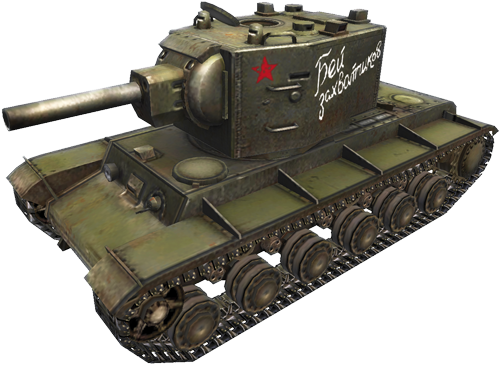
This heavy artillery tank, like the KV-1, owes its name to comrade Kliment Voroshilov. In fact, both models entered service together during the invasion of Finland in 1939. The KV-2 was armed with a powerful 152mm howitzer that fired explosive ammunition, but it was soon discovered that it had too many deficiencies to successfully do battle during the Second World War.
Its 54 tons in weight made it an excessively slow tank, and its high profile turret was too easy a target for enemy guns. In addition, its production costs were extremely high. For this reason, only 250 units were manufactured.
The KV-2 was useful in the role for which it was designed: the transportation of a heavy 152mm howitzer that could fire highly explosive projectiles across long distances. The parabolic trajectory of its firings allowed it to bombard fixed enemy defenses from covered positions, whilst its heavy armor was more than adequate for withstanding attacks from light tanks and other incursion vehicles. The reload time of the howitzer was very high, so it was of vital importance not to miss any shots.
KV-85
|
Crew Size |
Main Gun |
MGs |
Speed |
10m |
30m |
70m |
150m |
Reload Time |
Hull Frontal |
Hull Side |
Hull Rear |
Hull Top |
Turret Frontal |
Turret Side |
Turret Rear |
Turret Top |
|---|---|---|---|---|---|---|---|---|---|---|---|---|---|---|---|---|
|
4 (13) |
85mm ZIS-53 |
Coax, Hull, Rear |
19 |
132 |
127 |
95 |
46 |
6.5 |
75 |
60 |
75 |
40 |
100 |
100 |
100 |
40 |
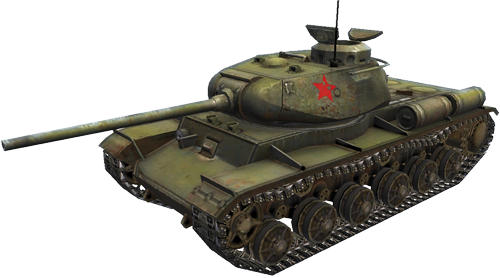
In the summer of 1943, the German Panthers and Tigers had shown their superiority over Soviet tanks on the battlefield. This motivated the design of the KV-85, a modified version of the heavy KV-1 tank. Distinguishable by its new turret, it was prepared to transport the 85mm D-5T gun that was used by the self-propelled SU-85 tank destroyers and the first versions of the T-34/85.
The large demand for 85mm guns delayed the initially forecast production dates. At the end of 1944, only 130 units of this model had been manufactured, and there was no delay in replacing it with the new series of IS heavy tanks.
Thanks to its 85mm gun, equivalent in performance to the gun mounted on the T-34/85, the KV-85 could measure up to the German Panthers and Tigers during long distance confrontations. In addition, its reinforced armor, inherited from the base model KV-1, much increased its probability of survival on the battlefield.
The KV-85's enormous turret was heavily armored both on the front and the sides. The hull armor was better than the KV-1's in order to give the tank greater maneuverability. However, this same hull, with scarcely any inclination, could easily be penetrated by weapons which otherwise could not have destroyed the tank. For this reason, the tank hull had to be hidden behind cover to avoid exploitation of this weak point.
German
PzKpfw VI Tiger
PzKpfw VI Tiger_ISO.psd
|
Crew Size |
Main Gun |
MGs |
Speed |
10m |
30m |
70m |
150m |
Reload Time |
Hull Frontal |
Hull Side |
Hull Rear |
Hull Top |
Turret Frontal |
Turret Side |
Turret Rear |
Turret Top |
|---|---|---|---|---|---|---|---|---|---|---|---|---|---|---|---|---|
|
5 (11) |
88mm Kwk 36 |
AA, Coax, Hull |
22 |
145 |
137 |
112 |
48 |
6 |
100 |
82 |
82 |
28 |
100 |
80 |
80 |
28 |
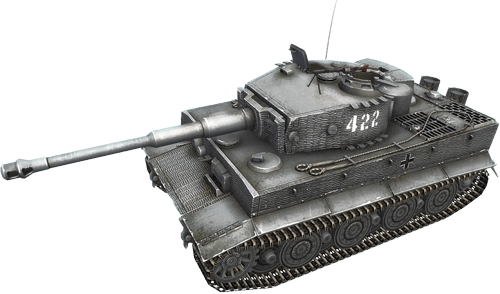
The Tiger I entered service at the end of 1942 and remained active until the surrender of Germany. Without a doubt, the elevated manufacturing costs (double that of the Panzer V and four times more than the Stug III) conditioned its production, and may even have prevented Germany from changing the course of the war in Europe.
In total, 1,350 Tiger I and 500 Tiger II were manufactured. At that same time, the United States produced more than 40,000 Sherman tanks, and the Soviet Union produced 80,000 T-34s.
The Tiger I gave excellent performance in open country, firing at enemy tanks from long ranges. Although it was not as slow as the monstrous Tiger II, its low movement speed made it vulnerable to flanking maneuvers and close-quarter combat.
Only a small number of allied weapons could penetrate the front armor of a Tiger at medium distance: the American M4A3E8(76)W and M26 Pershing, the British 17-pdr QF anti-tank gun, the Russian IS-2 and IS-3, the American M36 Slugger tank destroyers, and the Soviet SU-100. The British M4A4 VC Firefly, a variant of the Sherman armed with a massive anti-tank gun, was one of the few medium tanks capable of destroying a Tiger I at long range.
PzKpfw VI Kingtiger
|
Crew Size |
Main Gun |
MGs |
Speed |
10m |
30m |
70m |
150m |
Reload Time |
Hull Frontal |
Hull Side |
Hull Rear |
Hull Top |
Turret Frontal |
Turret Side |
Turret Rear |
Turret Top |
|---|---|---|---|---|---|---|---|---|---|---|---|---|---|---|---|---|
|
5 (9) |
88mm Kwk 43 |
AA, Coax, Hull |
21 |
233 |
223 |
181 |
76 |
8 |
150 |
80 |
80 |
40 |
180 |
80 |
80 |
40 |
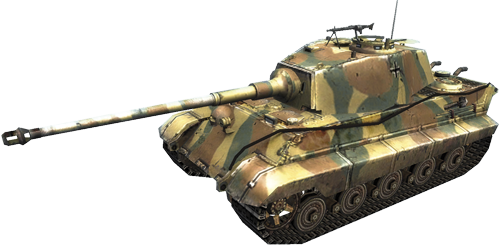
In May, 1941, the first Tiger II designs were made, but production did not commence until October of 1942. The aim was to create a tank more powerful than the enemy tanks.
Re-nicknamed by German soldiers as Königstiger (Bengal tiger), the first Tiger II entered combat on July 18, 1944, in Normandy, following the allied landings. They also took part in the Battle of the Ardennes, in Poland, in Hungary, and in the defense of Berlin. Among the allies, it was known as King Tiger or Royal Tiger.
Any frontal confrontation against the Tiger II would result in its opponent's destruction, as its excellent 88mm gun and highly accurate sights were lethal for enemy tanks. Only the American M-26 Pershing and the Soviet IS-2 could rival the Königstiger.
In spite of its large tonnage, the Tiger II possessed good mobility, comparable to that of the Tiger I and other allied tanks. The turret turned slowly, which could be a problem during short-range combat. Even so, the side and rear armor, although less powerful than the front part, was capable of withstanding the impact of weapons mounted on light tanks and many medium tanks. However, the ammunition storage system could cause the tank to explode if a projectile penetrated the rear part of the turret. Destroying a Tiger II required the coordination of several threats located at different attack angles. Without a doubt, the presence of a Tiger II on the battlefield always attracted enemy attention.