
Men of War: Condemned Heroes Guide Essentials Vehicles
Light Tanks
At the start of World War II, light tanks made up the majority of tanks. However, as more medium and heavy tanks took to the battlefield, light tanks were often relegated to scout roles. Light tanks lack heavy guns and are lightly armored. Their advantage is their speed. Keep them moving so that they are more difficult targets to hit, and use the speed to maneuver around or behind enemy tanks to hit the thinner flank or rear armor.
Russian
BT-7a
|
Crew Size |
Main Gun |
MGs |
Speed |
10m |
30m |
70m |
150m |
Reload Time |
Hull Frontal |
Hull Side |
Hull Rear |
Hull Top |
Turret Frontal |
Turret Side |
Turret Rear |
Turret Top |
|---|---|---|---|---|---|---|---|---|---|---|---|---|---|---|---|---|
|
3 (7) |
76mm KT-26 |
Coax, Rear |
40 |
- |
- |
- |
- |
5.5 |
13 |
13 |
13 |
13 |
15 |
15 |
15 |
15 |
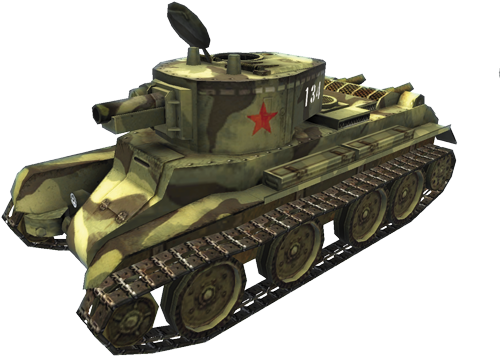
As the BT-7 was being developed, it was also being used as a basis for the creation of an artillery support tank designated BT-7A. It differed from the basic modification by including a new turret with the short-barrel 76mm KT-28 gun (the same gun as was installed on the early versions of the T-28). The hull was also slightly modified to accommodate the new turret. A total of 155 BT-7A tanks were produced from 1937 through 1938, and 134 of them were supplied to the army.
The BT-7A had the same strengths and weaknesses as those of the basic tank. The KT-28 gun was quite efficient against enemy infantry, but the armor was definitely insufficient for a support tank. This was probably why only a small number of BT-7As were manufactured.
Its capacity to fire above low obstacles and hills made it very useful for attacking fixed anti-tank guns, as well as providing support by bombing enemy infantry. The BT-7a always had to be kept at maximum range, as its limited armor made it vulnerable to fire from light guns and anti-tank rifles.
T-26
|
Crew Size |
Main Gun |
MGs |
Speed |
10m |
30m |
70m |
150m |
Reload Time |
Hull Frontal |
Hull Side |
Hull Rear |
Hull Top |
Turret Frontal |
Turret Side |
Turret Rear |
Turret Top |
|---|---|---|---|---|---|---|---|---|---|---|---|---|---|---|---|---|
|
3 (5) |
45mm 20K |
Coax, Rear |
31 |
51 |
44 |
32 |
16 |
3 |
15 |
15 |
15 |
15 |
15 |
15 |
15 |
15 |
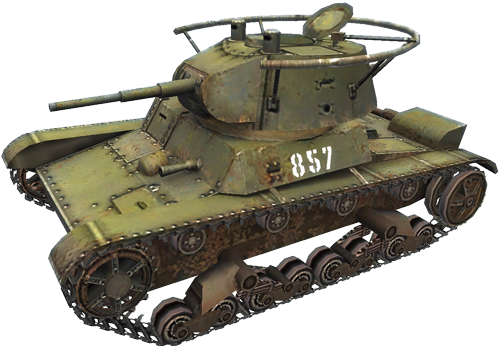
The T-26 had a simple design, was resistant to mechanical breakdown, and was easy to maintain. Its main armament could provide infantry support, taking out machine gun emplacements and light vehicles. The machine gun, mounted on the rear of the turret, was designed to defend against infantry assault in close-quarter combat.
Its limited armor offered protection only against light weapons. Even a heavy machine gun could get through the 15mm thick armor plates, and it was very vulnerable to 20mm automatic guns and anti-tank rifles.
Like a number of other countries, the USSR became interested in the Vickers Mk.E tank developed by the British company Vickers-Armstrongs Ltd. in 1928. In the spring of 1930, the Soviet delegation signed a contract for the supply of 15 Vickers Mk.E Type A tanks, the documents for its mass production being purchased, too. Initially designated V-26, the tank was supplied to the Red Army in spring 1931 under the designation T-26 (the 1931 version). A total of 1,626 tanks of this type were manufactured in 1931-33. Some of the tanks were equipped with the 37mm Hotchkiss gun installed in the right turret.
Along with expanding mass production of the T-26, the design bureau (headed by S.A. Ginsburg) started the development of a single-turret version. Unlike Poland, which purchased the sets for upgrading their tanks to the Vickers Mk.E Type B standard, the Soviet designers developed the turret on their own. A 45mm 20-K gun (the 1932 version) and a 7.62mm DT coaxial machine gun (the 1933 version) were installed in the two-man cylindrical turret that featured a rear niche. The turret plate was redesigned to accommodate the new turret. The first vehicles manufactured in the summer of 1933 had turrets with small-sized rear niches. The tank was continuously improved during the production run: after 1936 the hulls became welded, and a ball mount with the DT machine gun was installed in the rear niche. Some vehicles produced in 1937 had an anti-aircraft ring mount with a DT machine gun. Some tanks were equipped with radio stations and could be identified by a stub antenna on the turret. The 1938 version entered mass production with a conic turret. The final 1939 version had a re-shaped hull. A total of 10,117 tanks of the T-26 family were produced from 1931 to 1940.
The T-26 had become obsolete by June 1941. The low-speed and poorly armored tank was quite an easy target for German anti-tank cannons. Yet, in a fight against enemy tanks (especially light ones) the T-26 had fair chances to succeed since its 45mm rounds could penetrate most German tanks armor.
T-70
|
Crew Size |
Main Gun |
MGs |
Speed |
10m |
30m |
70m |
150m |
Reload Time |
Hull Frontal |
Hull Side |
Hull Rear |
Hull Top |
Turret Frontal |
Turret Side |
Turret Rear |
Turret Top |
|---|---|---|---|---|---|---|---|---|---|---|---|---|---|---|---|---|
|
2 (4) |
45mm 20K |
Coax |
36 |
51 |
44 |
32 |
15 |
3 |
35 |
15 |
25 |
15 |
60 |
35 |
35 |
10 |
The arrival of German tanks such as the Panzer III and Panzer IV forced the allied troops to reevaluate the light tank concept that they had used until then.
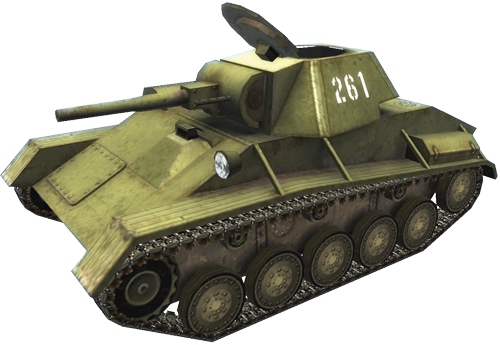
Although the T-60 and T-70 appeared to be very similar, the latter was far superior. The front hull armor could withstand impacts from anti-tank rifles and small caliber weapons, and the turret was reinforced even more to protect its sole occupant and the main 45mm armament. It could give support to infantry and survive fire that would destroy other light vehicles, and with its low profile and excellent speed it could surround the battle line and successfully attack enemy rearguard vehicles.
Almost immediately after the T-60 light tank entered mass production, the design bureau of the Gorky Automobile Factory (headed by N.A. Astrov) started to work at its successor. Using the T-60 as a base model, the designers developed a better protected tank with a far more powerful armament consisting of the 45mm gun (the 1938 version) and, later, the DT coaxial machine gun. It was also equipped with a new power unit of twin 6-cylinder engines. In January 1942, the tank entered service under the designation T-70. Mass production of the T-70 began in March. The first vehicles had cast turrets, which were quickly replaced by welded turrets. In September of 1942, the mass production of an improved version of the T-70 began, which was better known by the designation T-70M. Compared to its predecessor, the T-70M’s running gear was reinforced (a wider track was introduced) and a re-designed driver’s hatch was installed. A total of 8,226 tanks of both modifications were produced, making the T-70 the second Soviet tank in terms of production volume. Several self-propelled units were designed based on the T-70, the most famous of them being the SU-76 (SU-12 and SU-15).
The T-70 was primarily intended to support infantry. Unlike the T-60, however, this tank was a more dangerous opponent. By the time the T-70 appeared, German tanks had front armor that could not be penetrated by armor-piercing rounds from its 45mm gun. At the same time, German tanks were vulnerable to rounds shot at their sides, and there were cases when T-70 tanks managed to hit Pz.Kpfw.V Panthers in such a manner. Naturally, like any design made within a short period of time, the T-70 was not ideal, but it was quite good at coping with its direct tasks.
German
PzKpfw I Ausf. B
|
Crew Size |
Main Gun |
MGs |
Speed |
10m |
30m |
70m |
150m |
Reload Time |
Hull Frontal |
Hull Side |
Hull Rear |
Hull Top |
Turret Frontal |
Turret Side |
Turret Rear |
Turret Top |
|---|---|---|---|---|---|---|---|---|---|---|---|---|---|---|---|---|
|
2 (5) |
Twin MG-34 |
None |
30 |
- |
- |
- |
- |
- |
13 |
10 |
10 |
6 |
15 |
15 |
15 |
15 |
The Treaty of Versailles prohibited Germany to have tanks in its army. Yet, the German industry produced various types of tracked vehicles in the 1920s different solutions were tried and later used in tank engineering. Also, in contravention of the Treaty of Versailles, several tank prototypes were manufactured and named tractors for secrecy reasons.
In 1931 the Army Ordnance Department of the Reichswehr (the army of the Weimar Republic) issued an order for the development of a light combat vehicle encoded La.S (Landwirtschaftlicher Schlepper, i.e. an agricultural tractor). Heinz Guderian, a famous tank theorist who later became a prominent military leader, played a considerable role in the development of the tank concept. At that time, Guderian was chief of staff in General Lutz’s Motor Transport Inspection. It was his idea to create the La.S. The order for developing a tank was placed with four firms, and Krupp’s development was finally chosen.
The first prototype was ready by the summer of 1932. After a number of upgrades (the turret was replaced and the hull was re-designed), mass production of the tank began under the designation 1 La.S Krupp. The first 15 tanks were manufactured by April 1934 for the crews of the future Wehrmacht’s steel fist, i.e. the Panzerwaffe. After Germany had rejected the Treaty of Versailles in 1935, the tank was re-designated Panzerkampfwagen I Ausfuehrung A (abbreviated as Pz.Kpfw.I Ausf.A). The tank also received the Wehrmacht’s official designation of Sonderkraftfahrzeug 101 (abbreviated as Sd.Kfz.101).
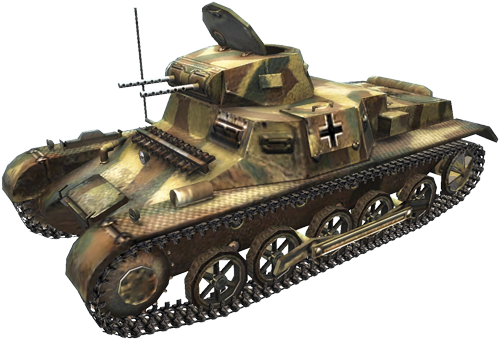
In August of 1935, the production of a new version of the tank, the Pz.Kpfw.I Ausf.B, began. It had a larger hull and different running gear, with an additional road wheel added on both sides. The MG-13 machine guns were replaced by newer MG-34 guns, and the tank was equipped with a 100 hp engine. The upgrade resulted in the Pz.Kpfw.I Ausf.B being almost half a ton heavier than its predecessor. A total of 675 Pz.Kpfw.I Ausf.B tanks were produced from August 1935 through June 1937.
The misleading name of “agricultural tractor” given by the Reichswehr’s Command was actually very near the truth. In essence, the Pz.Kpfw.I was a small tank, differing from a tankette only by having a turret. Its major purpose was to be used for trainingcrews, and it was not quite fit for combat usage. The latter fact became evident when Germany used both versions of the Pz.Kpfw.I in Spain. The German tank used by the Condor Legion proved helpless against the BT-5 and the T-26. Use of the Pz.Kpfw.I tanks in the initial period of WWII was mostly due to the lack of proper combat vehicles in the Wehrmacht. The Pz.Kpfw.I was used as a basis several types of combat vehicles including the Kleiner Panzerbefehlswagen I commander tank, the Panzerjager I tank destroyer, and the Sturmpanzer I Bison self-propelled gun.
PzKpfw II Luchs. B
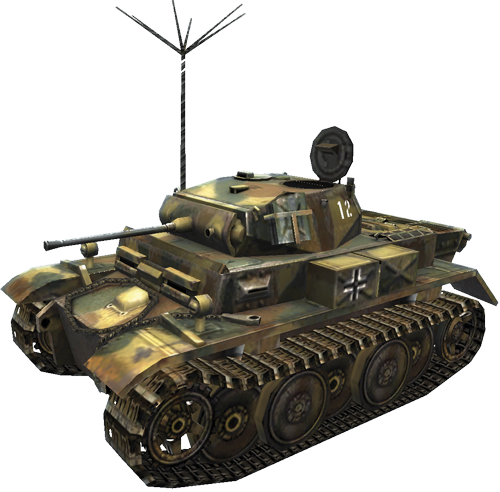
|
Crew Size |
Main Gun |
MGs |
Speed |
10m |
30m |
70m |
150m |
Reload Time |
Hull Frontal |
Hull Side |
Hull Rear |
Hull Top |
Turret Frontal |
Turret Side |
Turret Rear |
Turret Top |
|---|---|---|---|---|---|---|---|---|---|---|---|---|---|---|---|---|
|
3 (6) |
20mmKwK 30 L/55 |
Coax |
38 |
30 |
28 |
18 |
10 |
2 |
30 |
15 |
15 |
8 |
30 |
15 |
15 |
15 |
The German Army manufactured 100 units of this light tank between 1943 and 1944. Baptized with the name Panzerspähwagen II, it was nicknamed Luchs ("lynx") by German troops. It was fitted with a 20mm gun identical to the gun mounted on the SdKfz 222, although it was slower than the latter because of its heavier armor. It could be used in scout work, or to harass the enemy during the initial phases of the battle.
In late 1934 the Army Ordnance Department ordered the development of a light tank weighing 10 tons with a 20mm gun. Since the Treaty of Versailles prohibited Germany from developing and producing tanks, the project was designated La.S 100 (Landwirtschaftlicher Schlepper 100, or agricultural tractor 100). Four firms took part in the contest for the development of the La.S 100, and the joint design by MAN and Daimler-Benz was chosen.
The first ten tanks of this type were produced in late 1935. By that time they were designated Panzerkampfwagen II Ausfuehrung A (abbreviated as Pz.Kpfw.II Ausf.A) and the Wehrmacht’s official designation Sd.Kfz.121. Three series of the Pz.Kpfw.II Ausf.A were produced, as well as a Pz.Kpfw.II Ausf.B version, which was slightly different. The Pz.Kpfw.II Ausf.C, which was primarily different in its running gear, became a proper mass-produced vehicle. A total of 1,113 Pz.Kpfw.II Ausf.C tanks were produced, making it the highest-produced modification.
The Pz.Kpfw. II was primarily intended for trainingcrews. Nevertheless, it was used by troops until 1943, and unlike the smaller Pz.Kpfw.I, the Pz.Kpfw.II could hold its own in battle. When the Pz.Kpfw.II Ausf.C appeared, it was inferior in armament to tanks like the 7TP and the T-26 (as of 1933), but it could still fight against them. The German tank was several times more maneuverable, which was a decisive factor in a number of cases.
Medium Tanks
Medium tanks were the workhorses of the war. Many could be used to engage other tanks, as well as fight against infantry. Their armor gave them protection against light tanks, scout vehicles, and lower caliber anti-tank guns. As the war progressed, medium tanks became more thickly armored and began wielding larger caliber guns.