
Men of War: Condemned Heroes Guide Essentials Vehicles
Guns and Artillery
Russian
M-37
|
Crew Size |
Main Gun |
MGs |
Speed |
10m |
30m |
70m |
150m |
Reload Time |
Hull Frontal |
Hull Side |
Hull Rear |
Hull Top |
Turret Frontal |
Turret Side |
Turret Rear |
Turret Top |
|---|---|---|---|---|---|---|---|---|---|---|---|---|---|---|---|---|
|
2 |
45mm 20K |
None |
- |
51 |
44 |
32 |
15 |
3 |
- |
- |
- |
- |
- |
- |
- |
- |
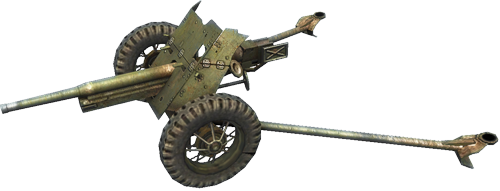
The story of the 45mm gun began in 1930, when Soviet experts bought prototypes of the Rheinmetall-Borsig Company’s 37mm anti-tank gun with technical documentation from Germany. A year later, the Revolutionary Military Council ordered its commission and put it into mass production. A similar gun was manufactured in Germany under the designation of Pak 35/36.
In 1932, a group of engineers modified the gun in order to increase its piercing performance by putting the 45mm barrel on the improved carriage of the 37mm gun. All subsequent changes were primarily related to design of the breechblock and carriage. Unlike previous varieties, the 45mm gun model of 1937 got a semi-automatic wedge breechblock, as well as the cushioning and wheels of the GAZ-AAA vehicle.
In 1941, the 45mm gun was the core of the Russian anti-tank artillery. By the middle of the war the gun had become extremely outdated, though it remained in production until 1946. About 50,000 1937 model 45mm anti-tank guns and 10,843 1942 model guns (the latter with a barrel expanded to 68.8 calibers) were manufactured.
ZiS-2

|
Crew Size |
Main Gun |
MGs |
Speed |
10m |
30m |
70m |
150m |
Reload Time |
Hull Frontal |
Hull Side |
Hull Rear |
Hull Top |
Turret Frontal |
Turret Side |
Turret Rear |
Turret Top |
|---|---|---|---|---|---|---|---|---|---|---|---|---|---|---|---|---|
|
2 |
57mm ZIS-2 |
None |
- |
114 |
108 |
83 |
42 |
4.5 |
- |
- |
- |
- |
- |
- |
- |
- |
The Vasily Grabin design bureau started working on a 57mm gun in May of 1940. The 76mm F-24 gun was used as a basis, its design considerably reworked, and the ZIS-2 prototype was submitted for field trials already in October 1940. The weapon entered the inventory under the designation of “57mm anti-tank gun model of 1941” (ZIS-2) in early 1941. Three plants manufactured it simultaneously. As many as 371 guns were manufactured before production stopped at the end of the year. The main reason for the production halt was the absence of decent targets on the battlefield. The gun’s AP shell could penetrate German tanks of that time at a distance of 1.5 km. Only when German troops acquired Tigers and Panthers was the gun put into production again under the new designation of “57mm anti-tank gun model of 1943.” Plants manufactured 13,339 guns of this type from 1943 to 1945.
The 57mm ZIS-2 gun consisted of two main sections: the monobloc barrel with a vertical wedge semi-automatic breechblock, and the cushioned carriage with wheels of the GAZ-AAA vehicle. Anti-recoil devices included a hydraulic recoil brake and a hydro-pneumatic recuperator mechanism. For gun turning, the pushing screw mechanism was used. The ammunition stock consisted of fragmentation and armor-piercing tracer shells, as well as canister shots for eliminating enemy manpower at distances of 100-200 m. ZIS-2 was transported at a speed of 30 km/h with the help of vehicles or horses.
ZiS-3

|
Crew Size |
Main Gun |
MGs |
Speed |
10m |
30m |
70m |
150m |
Reload Time |
Hull Frontal |
Hull Side |
Hull Rear |
Hull Top |
Turret Frontal |
Turret Side |
Turret Rear |
Turret Top |
|---|---|---|---|---|---|---|---|---|---|---|---|---|---|---|---|---|
|
2 |
76mm ZIS-3 |
None |
- |
80 |
74 |
50 |
24 |
4.5 |
- |
- |
- |
- |
- |
- |
- |
- |
Design of the new ZIS-3 gun began in late 1940 after successful tests of the 57mm ZIS-2 anti-tank gun. The weapon was developed by the Vasily Grabin design bureau and manufactured in small numbers in 1941, but it did not gain recognition among Soviet military leaders immediately. Only in 1942, after excellent response from the front, was the gun put into large-scale production. It had the following components: the carriage of the ZIS-2 gun, the improved barrel of the F-22USV gun with good ballistic specifications, and a recoil compensator for reducing the load on the carriage. The ZIS-3 fired at 25 rpm and had a range of 13 km.
The Red Army had three varieties of the ZIS-3 gun in its inventory:
* One with the breechblock from the 57mm anti-tank gun and a push-button pull-off.
* One with a simplified breechblock, a lever pull-off, and an elevation of 27 degrees.
* One with a simplified breechblock and an elevation of 37 degrees.
The 76.2mm divisional gun model of 1942 (ZIS-3) was successfully used by Red Army units throughout World War II. Experts, including German ones, justifiably consider it among the best anti-tank weapons.
D1 Field Howitzer

|
Crew Size |
Main Gun |
MGs |
Speed |
10m |
30m |
70m |
150m |
Reload Time |
Hull Frontal |
Hull Side |
Hull Rear |
Hull Top |
Turret Frontal |
Turret Side |
Turret Rear |
Turret Top |
|---|---|---|---|---|---|---|---|---|---|---|---|---|---|---|---|---|
|
2 |
152mm D1 |
None |
- |
- |
- |
- |
- |
20 |
- |
- |
- |
- |
- |
- |
- |
- |
This gun fires at long range. Not only is it effective against infantry, but direct hits from it can destroy even heavy tanks.
Katyusha

|
Crew Size |
Main Gun |
MGs |
Speed |
10m |
30m |
70m |
150m |
Reload Time |
Hull Frontal |
Hull Side |
Hull Rear |
Hull Top |
Turret Frontal |
Turret Side |
Turret Rear |
Turret Top |
|---|---|---|---|---|---|---|---|---|---|---|---|---|---|---|---|---|
|
1 |
M-13 rocket |
None |
26 |
- |
- |
- |
- |
180 |
- |
- |
- |
- |
- |
- |
- |
- |
There were several vehicles used to mount the Katyusha launcher: tractors, tanks, and even armored trains. However, the lorry turned out to be the most versatile option with its excellent mobility and low cost.
Like other vehicles of its class, it could launch salvos of eight rockets consecutively before having to reload. These projectiles, contrary to conventional artillery, rapidly concentrated great destructive power onto the target area. Although they had a high rate of fire, they were less accurate and required more time to reload.
Lacking any kind of armor, the Katyusha were extremely vulnerable to artillery fire and other rocket launchers. Even a nearby explosion could make its rockets detonate on the launchers and destroy the vehicle.
Germany
Pak 35/36

|
Crew Size |
Main Gun |
MGs |
Speed |
10m |
30m |
70m |
150m |
Reload Time |
Hull Frontal |
Hull Side |
Hull Rear |
Hull Top |
Turret Frontal |
Turret Side |
Turret Rear |
Turret Top |
|---|---|---|---|---|---|---|---|---|---|---|---|---|---|---|---|---|
|
2 |
37mm Pak 35 |
None |
- |
40 |
36 |
24 |
17 |
3 |
- |
- |
- |
- |
- |
- |
- |
- |
The Rheinmetall Company started developing a light anti-tank gun in 1925. The new gun’s design was based on that of the 37mm anti-tank gun, created in November of 1918. Production of the gun began in small batches in 1928. These were different from later samples in having wooden wheels, which made them transportable only by horse traction. Gun output grew in 1933, when National Socialists came to power. The gun got steel wheels with pneumatic tires next year. Wehrmacht officially commissioned the gun in 1936 under the designation of 3.7 cm Panzerabwehrkanone 35/36 L/45. About 16,000 Pak 35/36 guns were manufactured. The 1928 model was produced in the USSR as the 37mm anti-tank gun, and was later transformed into the famous 45mm gun.
The Pak 35/36 was based on a light two-wheel carriage (later used in developing the Nebelwerfer 41/42 rocket mortar). Cheeks had to be unfolded before firing, but it was also possible to fire when the cheeks were folded with cushioning switched off. The gun was fitted with a horizontal wedge breechblock, which became a characteristic trait of German anti-tank guns. Pak 35/36 used collimated and optic sights and fired fragmentation, armor-piercing, and sub-caliber shells. Moreover, the production of Steilgranate 41 super-caliber shells for Pak 35/36 and 3.7 cm Flak 36/37 began in February of 1942.
The Pak 35/36 was Wehrmacht’s main anti-tank gun at the initial stage of World War II. During the campaign of 1940, it turned out that the gun did not have enough firepower to engage French and British tanks, and at about that time Pak 35/36 got the nickname Beetle. Gradual replacement of Panzerabwehrkanone 35/36 with a more powerful Pak 38 gun began in early 1941, nevertheless, the gun stayed with the army throughout the war. Pak 35/36 was often removed from the carriage and mounted on armored vehicles, such as Sd.Kfz.251.
Pak 40

|
Crew Size |
Main Gun |
MGs |
Speed |
10m |
30m |
70m |
150m |
Reload Time |
Hull Frontal |
Hull Side |
Hull Rear |
Hull Top |
Turret Frontal |
Turret Side |
Turret Rear |
Turret Top |
|---|---|---|---|---|---|---|---|---|---|---|---|---|---|---|---|---|
|
2 |
75mm Pak 40 |
None |
- |
127 |
121 |
95 |
50 |
5 |
- |
- |
- |
- |
- |
- |
- |
- |
Development of a 75mm anti-tank gun began in 1936. A year before that, development of 5 cm Panzerabwehrkanone 38 L/60 began, and designers of the Rheinmetall Company apparently tried to be one jump ahead. First samples of the new anti-tank gun, designated 7.5 cm Panzerabwehrkanone 40 L/46, entered the Wehrmacht inventory in the winter of 1942. The Pak 40 turned out Wehrmacht’s most high-volume gun, as over 23,000 pieces of this gun were manufactured.
In a sense, the Pak 40 is an expanded variety of the Pak 38. Their barrel design, recoil systems, and carriages were very much alive. Just like its predecessor, Pak 40 had a barrel with a two-chamber recoil compensator and a wedge semi-automatic breechblock. The ZF telescopic sight, identical to the one mounted on the Pak 38, was used to control fire. The apron shield was different in having a shape that was easier to manufacture. It consisted of two sections, each of them 4mm thick. The gun fired fragmentation, armor-piercing, sub-caliber, and cumulative shells.
From 1943 to the end of the war, the Pak 40 was Wehrmacht’s main anti-tank gun. The gun guaranteed engagement of most of the enemy’s armored vehicles. A higher caliber brought to light another advantage of the Pak 40L: its fragmentation shells were much more efficient against hostile infantry than those of previous anti-tank guns in the Wehrmacht inventory. However, there is a price for everything, and the Pak 40 designers paid it by making the gun heavier. Its weight reached 1.5 tonnes. This not only reduced the number of tractors capable of towing the gun, but also made the gun’s movement by the crew a bit more complicated. The tipping part of Pak 40 was used in Marder II and Marder III self-propelled anti-tank artillery systems. The gun was also mounted on the Sd.Kfz.251 (Sd.Kfz.251/22) armored personnel carrier chassis and Sd.Kfz.234 (Sd.Kfz.234/4) armored vehicle chassis.
Flak 38

|
Crew Size |
Main Gun |
MGs |
Speed |
10m |
30m |
70m |
150m |
Reload Time |
Hull Frontal |
Hull Side |
Hull Rear |
Hull Top |
Turret Frontal |
Turret Side |
Turret Rear |
Turret Top |
|---|---|---|---|---|---|---|---|---|---|---|---|---|---|---|---|---|
|
2 |
20mm Flak38 |
None |
- |
30 |
28 |
18 |
10 |
4 |
- |
- |
- |
- |
- |
- |
- |
- |
This AA gun can also be used against infantry and light vehicles.
sFH 18 Howizter

|
Crew Size |
Main Gun |
MGs |
Speed |
10m |
30m |
70m |
150m |
Reload Time |
Hull Frontal |
Hull Side |
Hull Rear |
Hull Top |
Turret Frontal |
Turret Side |
Turret Rear |
Turret Top |
|---|---|---|---|---|---|---|---|---|---|---|---|---|---|---|---|---|
|
2 |
150mm sFH 18 |
None |
- |
- |
- |
- |
- |
20 |
- |
- |
- |
- |
- |
- |
- |
- |
This gun fires at long range. Not only is it effective against infantry, but direct hits from it can destroy even heavy tanks.
Raketen-Werfer 56 / Nebelwerfer

|
Crew Size |
Main Gun |
MGs |
Speed |
10m |
30m |
70m |
150m |
Reload Time |
Hull Frontal |
Hull Side |
Hull Rear |
Hull Top |
Turret Frontal |
Turret Side |
Turret Rear |
Turret Top |
|---|---|---|---|---|---|---|---|---|---|---|---|---|---|---|---|---|
|
2 |
150mm rockets |
None |
- |
- |
- |
- |
- |
100 |
- |
- |
- |
- |
- |
- |
- |
- |
After research done throughout the 1920s, Germany came up with an innovative technique for launching massive smoke, poisonous gas, or explosive warhead attacks. These studies resulted in the development of a 100mm mortar designed to fire gas projectiles. It was known as the Nebelwerfer, or "smoke launcher"; the name was chosen to generate confusion among enemy spies.
The Nebelwerfer 41, which consisted of a six-tube launcher mounted on the chassis of an anti-tank gun, entered service following the Battle of France. Its rockets were equipped with stabilizer elements that increased their range and accuracy, compensating for the low number of projectiles launched. Throughout the conflict, approximately 6,000 Nebelwerfer launchers were manufactured, and around 5.5 million rockets were used in the main theaters of operation.
The Nebelwerfer 41 could fire an entire salvo of six rockets in quick succession. It had to be reloaded between each firing, but the reload time was still less than in other, larger rocket launcher systems.
Panzerwerfer

|
Crew Size |
Main Gun |
MGs |
Speed |
10m |
30m |
70m |
150m |
Reload Time |
Hull Frontal |
Hull Side |
Hull Rear |
Hull Top |
Turret Frontal |
Turret Side |
Turret Rear |
Turret Top |
|---|---|---|---|---|---|---|---|---|---|---|---|---|---|---|---|---|
|
2 |
150mm rockets |
None |
27 |
- |
- |
- |
- |
150 |
15 |
15 |
15 |
15 |
15 |
6 |
6 |
6 |
This artillery vehicle was born from the need to give the Nebelwerfer rocket launchers more mobility, as the smoke trails they left after being fired made them an easy target. For this purpose, the chassis of the SdKfz 4 halftrack was chosen, which was rapid and performed well in all types of terrain.
The Panzerwerfer could fire salvos of five rockets before reloading. The fired projectiles were heavier than those of other nations, and although they did not produce as saturated effects, they were individually more powerful.