The Sims 3 Ambitions Guide Essentials The Sims 3 Primer
Relationships and Socializing
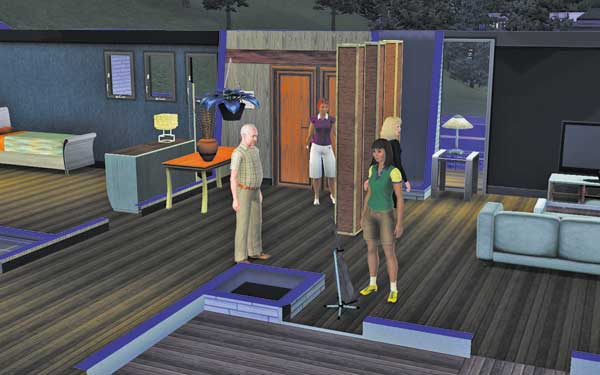
Relationships in The Sims 3 actually unfold not that differently from those in the real world. How you treat other Sims is the biggest metric in your overall relationship with them.
If you insult another Sim, expect them to get upset in the immediate conversation and for that to have a lasting effect on your relationship.
Conversely, a constant stream of support or praise will boost the immediate interaction and lead to a longer-lasting positive relationship.
Developing a successful romance means spotting if the other party is receptive to your advances and knowing when to cool your jets.
The social structure of The Sims 3 is not navigated with obvious metrics. There is a touch of mystery in conversations that makes socializing more organic.
You need to consider the current attitude of the Sim in the conversation, often referred to as the Target. (Your current Sim is known as the Actor.)
That attitude affects the long-term status of your relationships with different Sims.
Let's detail some basic concepts that will assist with understanding how relationships work: long-term relationship (LTR), short-term context (STC), and commodities.
Understanding these three factors is the key to brushing back some of the mystery of social interaction.
Long-Term Relationship (LTR)
The long-term relationship represents the state of the relationship between two Sims, which extends beyond the time during which a conversation is taking place.
LTR essentially describes the way two Sims view each other at a given moment. Every Sim outside the family starts out as a Stranger.
Once initial contact is made, the LTR moves up to Acquaintance and can never fall back into Stranger.
However, Acquaintance is the proverbial fork in the road. From here, the LTR can blossom into friendship or deteriorate into rivalry.
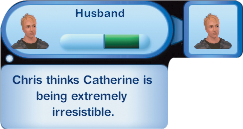 The LTR is visually measured by the bar below the portrait of the Sim you are conversing with. If the relationship develops in a positive manner, the right half of the bar fills.
Positive relationship status is noted with green. If the relationship is souring, that meter empties back out and can even dip into the left side, which is red. The red bar denotes a negative LTR.
How to achieve the different LTRs is explained in the Friendships (and Enemies) section of this chapter, but here is a list of all of the LTRs:
| Stranger | Romantic Interest |
| Acquaintance | Ex-Spouse |
| Disliked | Ex |
| Distant Friend | Enemy |
| Friend | Old Enemies |
| Good Friend | Parter |
| Best Friend | Fiancee |
| Best Friends Forever (teens only) | Spouse |
Short-Term Context (STC)
Short-term contexts are what a Sim thinks about the other Sim in the course of the current conversation, not as an LTR. The STC is displayed in the conversation box in the screen's upper-left as the conversation unfolds.
For example, the box may say that "Jenny thinks Sasha is being amusing." STC is affected by the kind of socials used in a conversation.
Each social has a commodity attached to it that directs the course of a conversation.
These are all of the STCs:
|
Dull |
Very Friendly |
| Drab | Amusing |
| Insufferably Tedious | Funny |
| Creepy | Hilarious |
| Frightening | Flirty |
| Very Scary | Seductive |
| Impolite | Hot |
| Insulting | Awkward |
| Unforgivably Rude | Very Awkward |
| OK | Steamed |
| Friendly | Odd |
Not all STCs are symmetrical. One Sim can have a totally different impression of a conversation than the other.
The only symmetrical STCs are those associated with the following commodities: friendly, funny, amorous, and steamed.
It is very possible that Jenny could think Sasha is being Dull while Sasha does not.
STC also modulates the way socials are accepted. Instead of just hot and cold, STCs and their respective commodities temper reactions.
Depending on your LTR and STC, you can see different degrees of reaction to a social. Trying to kiss a Sim on the cheek in the context of the Flirty STC will be a lot more successful than the Friendly STC.
Commodity
So, each STC is associated with a commodity? What's a commodity? Think of these as the general categories a social or STC falls under.
They are based on specific emotions we all feel, such as awkwardness or love. Use the commodity of a social to inspire an STC, which in turn affects the overall LTR.
Here are the seven commodities:
| Boring |
| Creepy |
| Insulting |
| Friendly |
| Funny |
| Awkward |
| Steamed |
As you look at the different STCs and socials in this chapter, check the associated commodities so you can push a conversation in the desired direction.
Decay and Normalizing
Relationships do not operate under inertia. They decay over time if not tended to, even if that time period is as short as 24 hours. This is why regular socializing is so important.
Decay is not necessarily a negative slide.
While positive relationship can indeed decay into mere Acquaintance, a negative relationship can normalize into the far more desirable Acquaintance. (Apparently Sims don't keep grudges quite like we do.)
As mentioned, the STC of a conversation contributes to LTR decay. These commodities dictate the decay. The amount of decay is also determined by the LTR itself.
An LTR above zero, which starts heading toward positive territory, will have a different amount of decay from a specific STC/commodity than a negative LTR, which is below zero.
No hard math on-screen shows the numerical value of an LTR, but you can sort of eyeball it.
Here's an example of how this decay works: Jenny and Sasha are Good Friends. If their last encounter was Impolite, then after a few days, the LTR will decay to just Friends.
Conversely, if Jenny and Sasha have the Disliked LTR, the relationship will normalize into Acquaintance if the last STC was Friendly.
Friendships (and Enemies)
Now that we've explained the four basics of socialization—LTR, STC, commodity, and decay—let's look at how relationships bloom and wither...and what you can do to affect the course of these relationships.
Naturally, Sims want friends. Social is a need, after all. Socializing and having friends have various effects on the course of your Sims' lives.

Friendships are a universally positive thing. Having friends, particularly in an expanded social circle, opens you up to a wealth of opportunities for receiving good moodlets.
Positive moodlets are the key to earning those coveted Lifetime Rewards. Friendships can result in such pleasing moodlets as Flattered or Nicely Decorated, such as if you are invited over to a friend's house that has some great environmental bonuses.
Achieving the different LTRs is done through conversations—and conversations are made up of socials. But there is much more to a conversation/STC than just employing a handful of socials.
A Sim's personality is hugely important in determining which socials can be used—and should be used. And it's not only the traits of the Actor that matter.
Learning the traits of the Target is also quite important.
The Art of the Conversation
So, you've approached another Sim, you left-clicked on them, and now you are staring at a menu of different social options. How do you navigate the social structure of a conversation?
Well, your options are partially defined by your LTR, current mood, age, and your traits. Categories of socials include things like Friendly, Funny, Mean, Romantic, and Special.
Special leads to socials that are encouraged by the Actor having a specific trait, such as Bookworm. Inside the Bookworm menu, there will be options to talk about books or the bookstore.
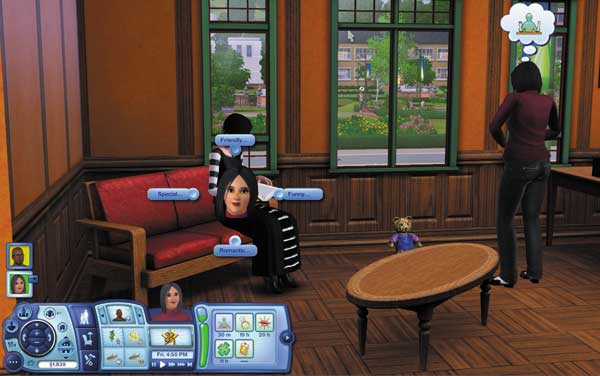
The menu of available social categories appears around your Sim's head. Left-click on an option to see what socials are available.
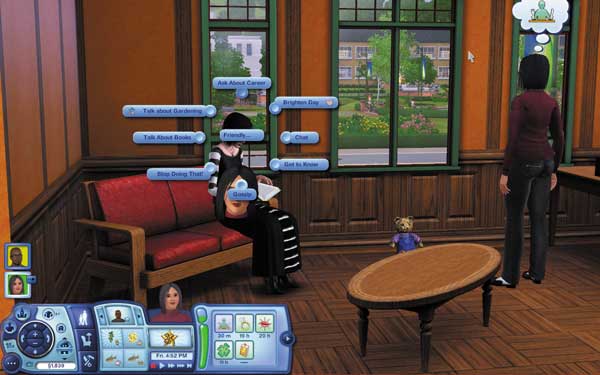
Now, select a social from the category to add it to the action queue.
When you select a social, it is added to your list of activities in the upper-right corner, just as if you were stacking interactions with objects.
When a current social ends, the next one automatically begins.
But stacking socials is not a wise strategy because you do not want to just babble away about a topic that the other Sim is just not interested in listening to.
Use socials and then watch for reactions. A positive social with a positive effect is noted with a chime and a blue symbol of two Sims next to each other.
A negative reaction is noted by two red Sims and a minus symbol.
Being Boring
Talking about the same things over and over gets boring to most Sims. The positive effect of a positive social is weakened the more you use it. Repeating a social can also affect the STC.
Continuous droning about the same subjects will nudge the STC into Dull, Drab, or Insufferably Tedious territory. If the conversation ends on one of those STCs, the LTR suffers.
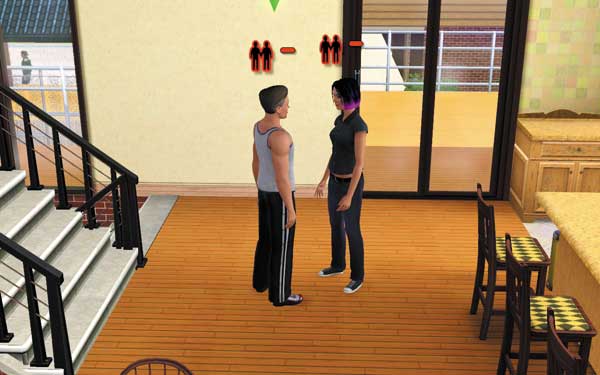
When a relationship is suffering due to a boring conversation, red symbols appear over the Sims' heads.
The default number of times you can repeat a social without getting boring is two. And if you break apart a conversation, you can use a social more than twice without any STC worries.
Some socials can be used more than twice without dullness setting in, such as Chat. Chat has four uses before it is boring in a single conversation.
However, it can be "recharged" so that the social can be used six times before it is boring. To recharge a social, you just need to break it up in the conversation.
For example, let's say you use Chat four times in a row. The other Sim is not bored, but is about to be if you use it one more time. So, you change course and Talk About Books.
After that social runs its course, you have recharged Chat once. Now you can use Chat again without it being boring.
However, if you tried to use it again without another recharge, the social would be considered boring.