
Hitman: Absolution Guide Extras Developer Interviews
An Interview with Tore Blystad

Tore Blystad
GAME DIRECTOR FOR HITMAN: ABSOLUTION
What are some highlights of your professional background?
- Started working with games in 1994, on SNES and Sega Mega drive
- Worked on the MMO Anarchy Online
- Worked on Hitman Blood Money as Art Director
- Have held a large amount of positions, from animator and environment artist to art director and game director.
How long have you been working on Hitman: Absolution?
Since the beginning.
What are your main responsibilities for Hitman: Absolution and which do you consider the most challenging? Why?
My responsibility is creative direction in all areas, so a big challenge has been to get all the different departments to work in the same direction and keep track of all the different assets. Absolution is a large and diverse game and there are probably around 100,000 assets of different kinds that need to be reviewed from time to time.
Working on unfinished technology means that it is very challenging to build prototypes of the gameplay, especially for a game as emergent as Hitman.
To create a highly cinematic and directed game while retaining all the freedom of choice from the previous Hitman games.
What are your goals for the project and some of the challenges?
Making a cinematic game has been a big goal for me, cinematic in the way that the game creates a sense of drama for the player, but on the player’s conditions. It has to be dependent on the choices the player makes. This puts a lot of pressure on the different systems in the game, as the AI, dialogue, and the dynamic music system need to compensate for the scripted drama that linear games would normally use to create drama.
Making a game that feels personal and genuine. In these days, big title games are becoming increasingly “corporate” as teams gets bigger and more and more gets outsourced, but we have always tried to keep a strong human touch in Absolution.
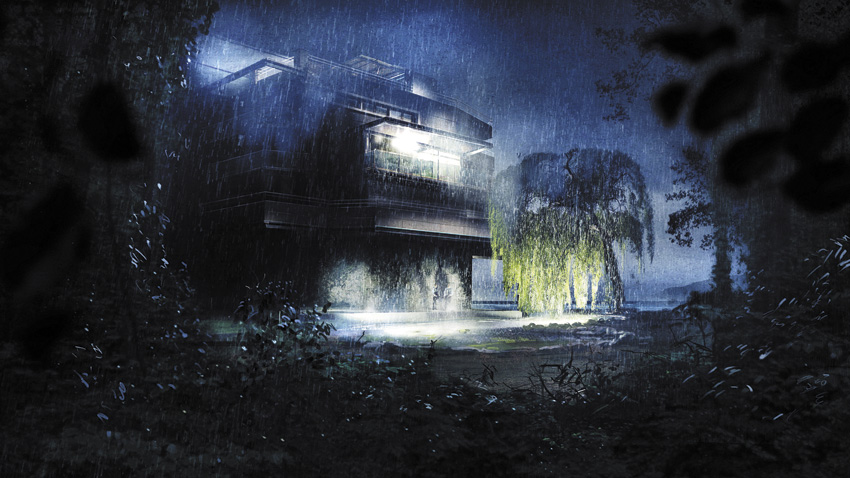
We have strived to make a beautiful and rich game world. The ultimate goal has been that every location, even every asset should have a personal touch, a sense of history and belonging in the world. This put a lot of pressure on the artists but it also challenged them to think twice before creating assets.
What do you want the player to experience as they play Hitman: Absolution?
Hitman: Absolution is the player’s game, and we have gone to great lengths to make sure that the game is as flexible and open as possible. We want the player to have an experience that is their own rather than something that is dictated by the game.
What is your favorite element of Hitman: Absolution that differentiates it from other stealth/assassination games?
The different civilian locations combined with disguises give Hitman a different feeling than any other stealth/assassination game.
What new features are included in Hitman: Absolution?
- New cover system for both stealth and combat gameplay
- Instinct
- Point shooting
- Disguise, blend in, and hiding in plain sight
Why did you decide to include Instinct, point shooting, hiding in plain sight, and other new features? How do they impact gameplay?
Instinct was added to the game for several reasons. First of all, we needed some tools to deal with the AI as they have become increasingly powerful. We saw from early play testing that players, even seasoned team members, would play the game in a very defensive manner. We tried several measures to give the player more information about the world and immediate surroundings so the feeling of playing would be less punishing and claustrophobic, and Instinct was born. Secondly, we needed to make the player aware of the different interactive elements in the level and the objective locations, basically the features of an interactive map. So we moved all the map features into the world, so to speak, so the player could always have the needed information instantly available.
Point shooting came about as we were focusing on making gunplay more relevant for a Hitman game. From a fantasy perspective, Agent 47 is a specially trained, genetically enhanced super assassin, so it is only natural that he has highly skilled gunplay and has highly tuned senses. He can walk into a room and instantly know where all the enemies are located and know how to take them down. And as we wanted a cinematic experience, point shooting was implemented as a strong visual feature where the player can take control with the cinematic camera. Point shooting is a powerful feature but it does come with a high price, both in rating and in Instinct cost.
Disguises have always been a central feature in Hitman games and with Absolution we really wanted to take it a step further. When disguised, the player can use his Instinct powers to blend in past suspicious NPC’s, and he can “hide in plain sight” by using outfit-specific objects around the world. It can be eating donuts disguised as a police officer, using a microscope disguised as a scientist, or using a gavel and sentencing a prisoner disguised as a judge. Hiding in plain sight enables the player to enter a hostile environment and stand at a stationary place to survey the area and figure out their next move.
How do mission challenges change the way people play the game?
Challenges have enabled us to show all the diversity of Absolution to the player. In previous Hitman games there was a lot of content that was never seen by the players as there was such a large amount of ways of playing them. With challenges, the player can instantly see the amount of content available and can pick and choose which experiences they are interested in.
How important do you feel a multiplayer component is to a game like Hitman: Absolution?
Every game needs to look at their gameplay and feature set and see if there is a natural way of implementing a multiplayer mode that fits the game. Playing Hitman games are normally not a social experience as they require a lot of skill and patience, while sharing the experiences has always been very social. We have a large community that are constantly debating ways of playing the game and we believe the new Contracts mode fits very well with our player base.
What factors led to including the Contracts feature that allows players to create challenges for other players?
Hitman fans have been doing this for years with the previous Hitman games and we got the inspiration for this mode from the community. We originally thought we would need an editor, which caused all kinds of problems for us, as that reduces the amount of players creating content to a very small group, and it was only when someone on the team came up with the brilliant idea of “playing to create” Contracts that everything fell into place. This way, the creator not only guarantees that his content is possible to play, he also has to challenge himself to come up with an interesting and challenging experience.
How do you expect the gaming community to respond to Contracts?
All indications we have had is that players love Contracts, and internally we have had severe concentration problems on the team as many people were clocking in a lot of hours playing and creating Contracts.

Is there something in the game of which you are particularly proud?
I think we managed to cram an astonishing amount of craziness into the game while still keeping the style appealing to a large audience.
What do you hope that people will say about Hitman: Absolution?
Of course I hope that players will love Absolution, we have worked incredibly hard to create this game, and the greatest award we can get is that the players love it.
I hope players will share all their unique experiences with each other, as this is one of the strengths of the Hitman games, “How did you play that level?”...
I hope players will enjoy and explore the world we have created, both the locations and the people inhabiting it.
What are your thoughts about the evolution of the Hitman franchise over the years?
Hitman started as a very hardcore game. Codename 47 was notoriously difficult as well as being a highly sophisticated game. The technology was far ahead in many areas and the whole concept was pretty unique. During the next three games, from Silent Assassin through Contracts to Blood Money, the concept was essentially the same, while the features and production values evolved from one title to the next.
With Absolution it was a goal for us to take a big step forward while still being true to the Hitman legacy. All mechanics were rethought and re-implemented to be more efficient and natural to use. Hitman games have a really complex feature set but we wanted to make the game easy to pick up and play, so we worked a lot with the controls and with the tutorials, so that players are trained in both features and mind set early on.