
The Witcher 3 Remastered Updated System Requirements
The Witcher 3 Remastered is both easy to run and highly demanding on your system.


The Witcher 3 Remastered can achieve a stable 60FPS on high settings even with older hardware, and mid-tier cards can play on Ultra 1440p, but it raises the PC requirements considerably once you enable Ray Tracing. Here are the updated Minimum, Recommended, Ultra, Ray Tracing, and Path Tracing requirements for The Witcher 3 Remastered.
The Witcher 3 Remastered Minimum System Requirements for 1080p 30 FPS
| Component | Minimum Requirement |
|---|---|
| Graphics Preset | Low |
| Resolution | 1080p |
| Target Frame Rate | 30 FPS |
| CPU | Intel Core i5-8400 / AMD Ryzen 5 2600 |
| GPU | Nvidia GeForce GTX 1660 / AMD Radeon RX 5500 XT 8GB / Intel Arc A580 |
| VRAM | 6GB |
| RAM | 12GB |
| Storage | 60GB SSD |
| Operating System | 64-bit Windows 11 |
| DirectX | DirectX 12 |
These are CD Projekt Red’s updated requirements for the Remastered version. An SSD is now required, DirectX 12 is now native, and Windows 10 is no longer officially supported. However, CDPR says that does not mean the game will stop running on Windows 10.
CD Projekt Red targets 1080p/30 FPS at Low settings with the Minimum specification. CDPR does claim that a GTX 1660 can achieve 60 FPS or higher at Minimum settings.
The Witcher 3 Remastered Recommended System Requirements for 1080p 60 FPS
| Component | Recommended Requirement |
|---|---|
| Graphics Preset | High |
| Resolution | 1080p |
| Target Frame Rate | 60 FPS |
| CPU | Intel Core i7-8700K / AMD Ryzen 5 3600X |
| GPU | Nvidia GeForce RTX 2060 Super / AMD Radeon RX 6600 XT / Intel Arc B580 |
| VRAM | 8GB |
| RAM | 16GB |
| Storage | 60GB SSD |
| Operating System | 64-bit Windows 11 |
| DirectX | DirectX 12 |
The recommended requirements target 1080p at 60 FPS using the High preset. Unlike CDPR’s ray-tracing tiers, this target is measured without relying on DLSS, FSR, or XeSS upscaling.
The Witcher 3 Remastered Ultra System Requirements
| Component | Ultra Requirement |
|---|---|
| Graphics Preset | Ultra |
| Resolution | 1440p |
| Target Frame Rate | 60 FPS |
| CPU | Intel Core i7-13700K / AMD Ryzen 7 7700X |
| GPU | Nvidia GeForce RTX 3070 Ti / AMD Radeon RX 6800 / Intel Arc B580 |
| VRAM | 8GB |
| RAM | 24GB |
| Storage | 60GB SSD |
| Operating System | 64-bit Windows 11 |
| DirectX | DirectX 12 |
| Upscaling | Off / Native Resolution |
CD Projekt Red’s official Ultra target is 1440p at 60 FPS using the Ultra preset at native resolution. Unlike the ray-tracing configurations, upscaling is disabled for this target. These are CDPR’s official guidelines; however, do note that our independent testing was able to run The Witcher 3 Remastered at 1440p at 60FPS with an RTX 5060 system using some minor upscaling.
The Witcher 3 Remastered Ray Tracing and Path Tracing Requirements
| RT Minimum | RT Recommended | Path Tracing | |
|---|---|---|---|
| Graphics Preset | Ray Tracing | RT Ultra | RT Ultra + Path Tracing |
| Resolution | 1080p | 1440p | 4K |
| Target Frame Rate | 30 FPS | 60 FPS | 60 FPS |
| Upscaling | DLSS / FSR / XeSS | DLSS / FSR | DLSS |
| Frame Generation | Not required | Not required | Required for the official target |
| CPU | Core i7-11700K / Ryzen 7 5800X | Core i7-13700K / Ryzen 7 7700X | Core i9-13900K / Ryzen 7 9800X3D |
| GPU | RTX 2060 Super / RX 6600 XT / Arc B580 | RTX 4080 / RX 9070 XT | RTX 5080 |
| VRAM | 8GB | 12GB | 16GB |
| RAM | 16GB | 24GB | 24GB |
| Storage | 60GB SSD | 60GB SSD | 60GB SSD |
The jump from Ultra to RT Recommended is pretty massive, and you’ll notice significant performance drops on mid-range systems by enabling RT. You’ll need an RTX 4080 for its 1440p/60 FPS RT Ultra target, even with upscaling enabled. Path tracing pushes that requirement to an RTX 5080 and also assumes Frame Generation is active, making it an option available only to top-of-the-line PCs.
From our own testing, turning on ray tracing with the ‘Performance’ settings did let us hit a fairly stable 50-55 FPS in open-world areas without too much crowd density. This was done on an RTX 5060 system at 1440p with Ultra+ textures. Meaning it’s still possible to hit 60 FPS on mid-tier cards with ray tracing enabled if you tweak the settings.
Is Ray Tracing Worth Using in The Witcher 3 Remastered?
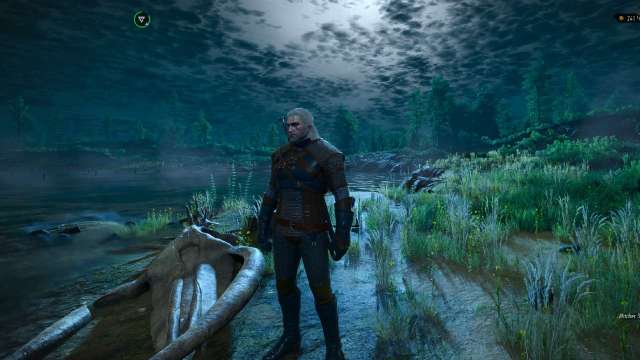
Ray tracing noticeably improves the visuals in The Witcher 3 Remastered because of the increased global illumination, along with more depth for shadows, foliage lighting, water reflections, ambient shading, and the way outdoor scenes are lit. CDPR also added ray-traced local shadows and Ray-Traced HairWorks alongside the wider lighting overhaul.
The problem is that the performance cost of ray tracing makes it very difficult to run on mid-tier systems. At 1440p, Remastered is relatively easy to run at Ultra and even Ultra+ without RT, but ray tracing cuts into the frame rate heavily.
That matches our own testing on an RTX 5060 system. The game can run at 1440p 60FPS with Ultra+ settings and ray tracing disabled easily, but to make even the bare minimum ray tracing work, you’ll have to tone down the textures. Even relatively powerful modern GPUs require upscaling to comfortably approach high frame rates with RT enabled. You’ll have to decide whether you care more about ray tracing or higher-quality textures, or you’ll have to sacrifice a stable 60 FPS for something lower.
For mid-range systems, I would prioritize Ultra or Ultra+ rasterized settings over ray tracing. The Remastered lighting and material changes still look very good without RT, and the performance difference is too significant to ignore.
Path Tracing in The Witcher 3 Remastered
Path tracing is much harder to recommend right now. It can produce more realistic indirect lighting in certain scenes, but the improvement is inconsistent. Our independent testing and other reviewers have found multiple situations where conventional ray tracing actually looked better, with path tracing sometimes producing overexposed characters or unusual color shifts. It also tanks the frame rate even more than ray tracing.
If you have the hardware to experiment with it, it is worth switching on to see the difference. For normal play, however, standard ray tracing currently offers a better balance between visuals and performance than full path tracing.
On mid-to-low-range GPUs, disabling RT entirely and spending that performance budget on higher resolution, Ultra+ settings, and a steadier frame rate is going to be the better experience.
With all of these visual updates and upgrades, you should also check out how combat has changed and how you can use mods to further enhance The Witcher 3 Remastered visuals.


