
Ninja Gaiden Ragebound Review – Action Game of the Year
Master Ninja.


Earlier this year, I had a chance to try out Ninja Gaiden: Ragebound during the Steam Next Fest, and it cemented itself as my most anticipated release of the year. See, I’m someone who loves 2D action titles, and while I’m glad that Metroidvania fans are having the time of their lives, sometimes you just want a tightly designed action platformer that doesn’t take ages to beat and doesn’t waste a second of your time.
This is what Ninja Gaiden: Ragebound is: a classically designed action platformer that isn’t concerned with branching paths and a hundred different abilities. If the title of the review didn’t already give away my thoughts, let me motivate you to try out one of the best releases of the year.
Kenji and Kumori
Yes, Ragebound is another Ninja Gaiden game that doesn’t follow Ryu Hayabusa, but calm down for a second; he does show up in the game. He’s just needed elsewhere, leaving Kenji Mozu of the Hayabusa Clan to take on the demon threat of the week. Without getting too deep into spoilers, he ends up teaming up with Kumori from the Black Spider Clan (who, if you need a reminder, are the sworn enemies of the Hayabusa Clan) to take down a common enemy.


It’s a fun premise that lets the developers merge the abilities of both characters for a familiar yet fresh Ninja Gaiden adventure. Their banter during missions is light and often funny, and despite their antagonistic history, there are several moments where you catch a glimpse of mutual respect.
Look, you aren’t playing Ninja Gaiden for the story, but Kenji is a fun contrast to the stoic and serious Ryu. Thanks to the writing and his sincere pursuit of good, he manages to stand out as a solid protagonist. The villains have awesome designs, give long speeches before the battle, and most importantly, the story is fun and never gets in the way of the action.
Ragebound and Ready to Slash
As mentioned, this is a classically designed Ninja Gaiden game, meaning most enemies go down with one hit, just like the original and the early Castlevania games. You gain some powers along the way and become stronger through new moves. Right off the bat, the first thing you’ll notice is how tight the controls, movement, and animation are. Everything just feels right. Kenji’s movement is impeccable, and you can jump, climb, and roll with ease.
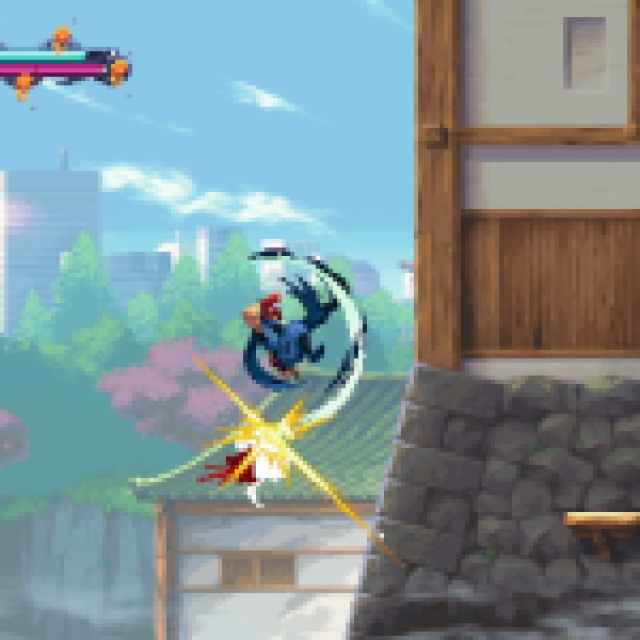

His main attack is a sword slash, which you can perform multiple times. The tougher enemies require more than one hit, or by performing a Hypercharged attack after slashing an enemy carrying the charge for it. Additionally, both Kenji and Kumori can perform a Guillotine Boost, which lets them hop on enemies, dealing damage and traversing different obstacles. When merged, you’ll have a shared moveset, with Kumori’s attacks being represented by a pink bar that fills up as you kill enemies.
So, Kenji can hit close, while Kumori can throw kunai in four directions, giving you plenty of range as well. On paper, this makes the duo feel pretty strong, but the game goes to great lengths to ensure that a decent level of challenge is retained through the color-coded Hypercharge system.
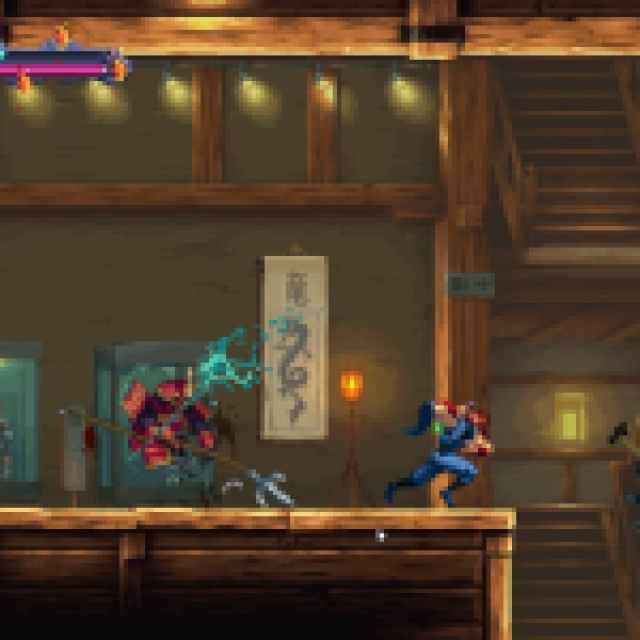

To maximize damage against stronger enemies, you need to make sure you’re using the correct character attack to attain the charge and then use it however you want. I know this might turn some people off, but it’s the opposite of tedium and nothing like those enemies in the DmC reboot. Your reflexes are rewarded, and even if you don’t get used to this system, you can always finish off enemies; it’ll just take longer.
As you find Golden Scarabs in levels, you’ll be able to purchase different Talismans, which can make the game easier or harder, and different weapons for Kumori. It’s a neat system that incentivizes replaying levels to scour for these collectibles, which, mind you, aren’t that difficult to find. There’s no bloat, skill trees, or arbitrary systems to waste your time. At the end of the day, it’s your skills, spacing, and reaction times that will help you defeat bosses.
Speaking of, the bosses in this game are an absolute joy to fight against. They’re varied, have plenty of moves, high-quality animations, and give opportunities that can be exploited by different aspects of your core combat system. Nothing feels cheap, and every single move has an appropriate reaction. Fight them enough times, and you’ll be able to take them down without getting hit once.
All these combat mechanics are simple and polished, and work in harmony for an incredibly fast-paced experience that I’ll be replaying several times to get all the ranks.
Ridiculously Detailed Pixel Art and an Excellent Soundtrack
This one should be obvious if you have played anything from The Game Kitchen. Both Blasphemous games have breathtaking pixel art, varied enemy designs, and outstanding animation work. It’s no different here, and I’m still blown away by the variety of unique enemies and locations they’ve managed to cram into this game.
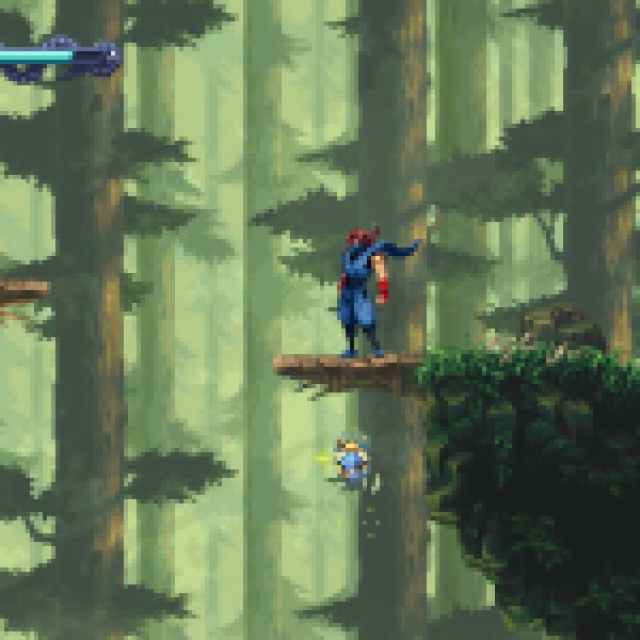

I will say that some levels have these sections that feel reused a bit too much, and it’s noticeable. Even when you’re progressing, you’ll see the same hallway a few times, with the exact same structure, and that can be a bit odd.
The gore, blood splatter, and death animations aren’t as gruesome as Blasphemous, but are faster and fit well with the pacing of Ninja Gaiden. There’s a level of precision with each strike, and that’s effectively communicated as you slash through wave after wave of demons.
Similarly, the OST has plenty of memorable tracks, and while you’ll hear some repeats, it’s very authentic to the original Ninja Gaiden trilogy. I have no complaints, and I think it’s a worthy addition to the extensive catalogue.
Verdict
Ninja Gaiden: Ragebound is my action game of the year. It’s an incredibly polished and tightly designed 2D game with the right amount of challenge, combat depth, and enemy variety. Kenji and Kumori are a fun duo to follow, and The Game Kitchen has done a fantastic job honoring the original trilogy while introducing plenty of new ideas. It’s a gorgeous game to look at, with some of the best animation work on the market. With plenty of replay value, it’ll be a while before you put Ragebound down.

Ninja Gaiden: Ragebound
Ninja Gaiden: Ragebound is one of the best action games of the year and an incredible revival of the classic series.
Pros
- Excellent combat system with plenty of depth.
- Kenji and Kumori are a fun duo to follow.
- Superb art direction, and plenty of enemy variety.
- Challenging platforming which makes good use of combat abilities.
- Tons of replayability thanks to higher difficulty, ranks, challenges and secrets.
Cons
- Some sections within levels are reused a bit much.
A copy of this game was provided by the publisher for review. Reviewed on PC.


