
Avatar Legends: The Fighting Game Review – More Than a Licensed Fighter
Go with the Flow.


Fighting games are in a great place right now, with several high-quality releases to choose from, each asking players to invest time in learning their systems. Avatar Legends: The Fighting Game is another challenger, but it’s more than just the average licensed title looking to make a quick buck.
It’s tough to review a fighting game without spending significant time with its online and competitive components, but after playing a decent amount of Avatar, I wanted to share my thoughts on what works, what doesn’t, and whether its mechanics have the depth to keep players invested.
A Faithful Adaptation
Arguably the biggest strength of Avatar is its incredibly faithful art style and animation quality. Every move is made up of several hand-drawn frames, and each fight genuinely feels like something pulled straight from the show. The way attacks connect, fireballs form and travel, each character’s unique throw animation, and the attention to detail in movement, evasion, and offense is genuinely impressive.
The commitment to recreating the show’s visual style extends to the roster’s individual fighting styles. Aang glides around the arena with great mobility, Toph manipulates the terrain beneath her opponents, Azula bends blue flames with precision, and every character feels authentic to their bending abilities. Even beyond the animation itself, the visual effects have a high level of polish that’s satisfying to see. There’s also a solid variety of stages that have a lot going on in the background.
The Flow of Battle
When it comes to the actual fighting, Avatar uses a simple four-button control scheme consisting of Light, Medium, Heavy, and Flow attacks. You can chain normals into combos or repeatedly press Light for an auto combo if you’re still learning a character. Execution, however, isn’t really where Avatar gets its depth. Most characters perform specials with familiar quarter circle inputs, making them fairly easy to execute. Instead, the complexity lies in understanding the Flow system and efficiently managing both your Energy and Flow meters throughout a match.
Flow isn’t just about movement, either. Holding the Flow button in neutral automatically evades incoming attacks, making it somewhat similar to Drive Parry in Street Fighter 6. The difference is that instead of standing in place, your character slowly drifts backward while using Flow.
Just like Drive Parry, though, this defensive option has a weakness. While you’re in neutral Flow, you’re still vulnerable to throws, which gain the critical attribute in this situation. If you rely on it too often to avoid pressure, your opponent can easily grab you for a serious damage punish. Similarly, it drains the flow meter, and both of these create a meaningful risk-versus-reward dynamic that prevents the mechanic from becoming overpowered.
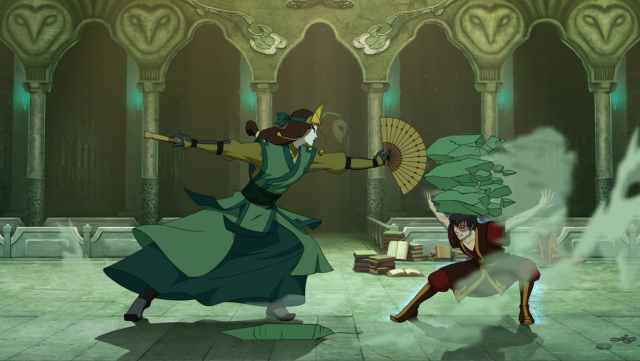
Outside of basic execution, every character also has their own unique mechanics and conditions that reward different playstyles. Based on my time playing both online and locally, I think Avatar’s fighting mechanics work really well for the most part. Early on, I occasionally misread the startup animations of a few attacks, though this became less of an issue as I grew more familiar with the roster.
That said, I really enjoyed the chaotic pace of combat. Simply sitting back and blocking won’t get you very far, because the game constantly encourages movement and aggression. You’re expected to use Flow to weave in and out of combat, reposition yourself, and overwhelm your opponent, especially once you’ve pushed them into the corner.
Movement is one of Avatar’s biggest strengths, and it’s not limited to the ground. Almost every character has aerial Flow options that let them hover, reposition, attack, and even grab opponents in the air. The constant back-and-forth between grounded and aerial states makes matches feel chaotic, keeping them moving across the stage rather than staying in one place for long.
Most of the roster also has access to some form of ranged bending attack, so projectiles become an important part of controlling space. You’ll want to weave them into your pressure, extend combos whenever possible, and use each character’s bending abilities to their fullest potential.
It takes a while to find the right balance between these systems, but the lower barrier to entry for execution makes it easier to focus on everything else. It reminds me most of Dragon Ball: FighterZ, which also wasn’t exactly strict about inputs.
Hidden in Plain Sight
While the art direction and core fighting mechanics are excellent, I don’t think Avatar Legends: The Fighting Game does the best job of pointing new players toward its tutorials.
The game includes an excellent Training Mode with a frame meter, extensive dummy settings, and just about everything you’d expect for learning characters and testing mechanics. It also features a fully interactive tutorial that teaches the game’s universal systems, but it’s tucked away inside Training > Tutorials, where you need to select the center option instead of choosing a character.
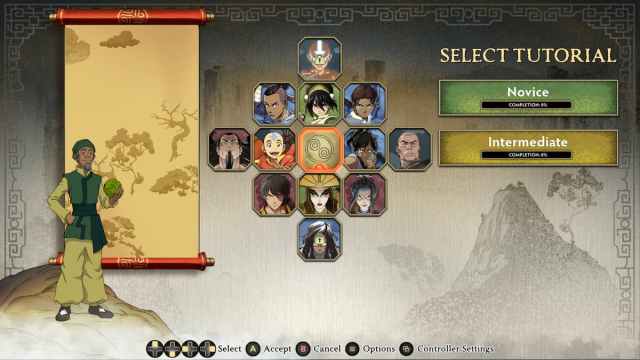
Because of how it’s presented, it’s easy to assume that section only contains character-specific tutorials and completely miss the game’s general tutorial. That was my initial impression, and I suspect I won’t be the only player who overlooks it.
Once you find it, though, it’s genuinely useful. The tutorial does a solid job of introducing mechanics like Flow and Energy through interactive lessons rather than relying solely on the text found in the “How to Play” menu.
Beyond that, each member of the roster also has their own character-specific tutorial that walks you through their unique mechanics, combo routes, and Flow options. Those lessons do a great job of helping you understand each fighter’s strengths once you’ve got a handle on the fundamentals.
I still think the game could do a better job of surfacing that universal tutorial to first-time players because it’s one of the most valuable learning tools in the package. The mechanics themselves aren’t especially difficult to execute, but they have enough depth that making the onboarding process clearer would go a long way toward helping newcomers settle in.
If you’re more of a casual fighting game player, there’s also a Story Mode featuring a fun “what if” scenario. Don’t expect Mortal Kombat-level cinematics, but a good portion of the dialogue is voiced, and the light RPG mechanics make progression engaging without overcomplicating things.
Verdict
Avatar Legends: The Fighting Game is much more than the licensed fighter I expected. It’s a faithful adaptation with fluid combat and a rewarding Flow system that’s genuinely fun to learn. Each character feels distinct enough without being overly difficult to pick up, and while there are a few rough edges, particularly around tutorial discoverability and occasional visual clarity during combat, they’re minor issues that don’t take away from what is an easy recommendation for fighting game fans.

Avatar Legends: The Fighting Game
A faithful adaptation with engaging combat that stands on its own beyond the Avatar license.
Pros
- Excellent hand-drawn presentation and animation
- Faithful interpretation of the Avatar universe
- Deep combat built around an engaging Flow system
- Distinct roster with rewarding character mechanics
- Strong training tools and character tutorials
Cons
- Universal tutorial is easy to overlook
- Could use a bit more onboarding for first-time players
A copy of this game was provided by the publisher for review. Reviewed on PC.


